The word “said” is the workhorse of dialogue attribution, but relying on it too heavily can make writing feel bland and uninspired. Learning to strategically replace “said” with more descriptive adjectives that modify the speaker can significantly enhance your prose, adding depth, nuance, and emotional resonance to your characters’ interactions.
This article explores a range of adjectives that can be used effectively alongside “said,” providing examples, usage rules, and practice exercises to help you master this valuable skill. Whether you’re a student, a budding author, or simply someone looking to improve their writing, this guide will equip you with the tools to craft more engaging and impactful dialogue.
Table of Contents
- Introduction
- Definition: Adjectives for ‘Said’
- Structural Breakdown
- Types and Categories of Adjectives for ‘Said’
- Examples of Adjectives for ‘Said’
- Usage Rules
- Common Mistakes
- Practice Exercises
- Advanced Topics
- FAQ
- Conclusion
Definition: Adjectives for ‘Said’
When we talk about “adjectives for ‘said’,” we’re not literally modifying the verb “said” itself. Instead, we’re using adjectives to describe the speaker, indirectly conveying how they said something.
These adjectives typically modify a noun or pronoun referring to the speaker, enriching the context and adding layers of meaning to the dialogue. These adjectives add depth, nuance, and emotional resonance to the dialogue, painting a more vivid picture of the speaker’s state of mind and delivery.
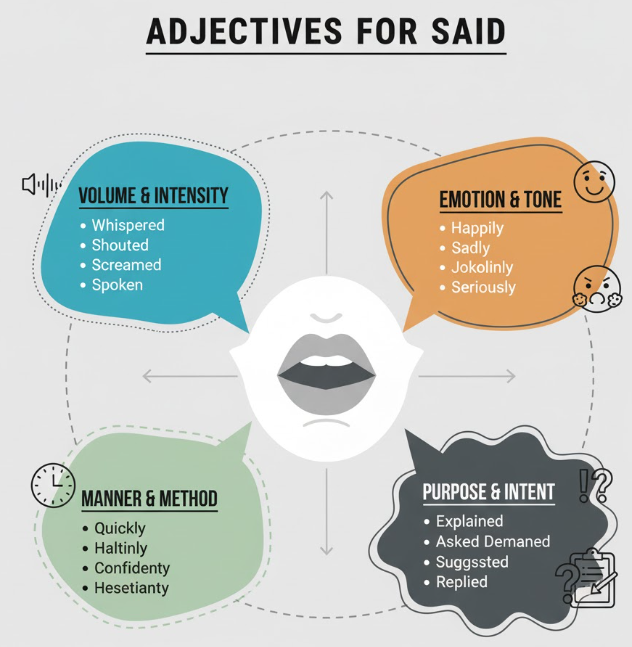
In essence, these adjectives function as shorthand for more elaborate descriptions. Instead of writing “He said, his voice trembling with fear,” you could write “He, fearful, said…” This concise approach maintains a brisk pace while enhancing the reader’s understanding of the scene. The strategic use of these adjectives can transform mundane dialogue into compelling exchanges that reveal character and drive the narrative forward.
Structural Breakdown
The typical structure involves placing the adjective directly before or after the speaker’s name or pronoun. The most common pattern is:
[Speaker], [Adjective], said…
For example: “John, angry, said…” or “She, exhausted, said…”. The adjective provides insight into John’s emotional state or her physical condition as they speak. This structure is versatile and can be adapted to fit various sentence constructions.
Another possible structure involves using a linking verb (like “was” or “seemed”) to connect the speaker to the adjective:
[Speaker] was [Adjective]. “…” said [Speaker].
For example: “Mary was hesitant. ‘I’m not sure,’ said Mary.” This structure creates a slightly more formal tone and can be useful for emphasizing the speaker’s state of mind. It also allows for more complex descriptions if needed.
Types and Categories of Adjectives for ‘Said’
Adjectives that describe the speaker can be broadly categorized based on the aspect they highlight. These categories are not mutually exclusive, and some adjectives may fit into multiple categories depending on the context.
Emotional State
These adjectives describe the speaker’s feelings or emotions. They add depth and authenticity to the dialogue, allowing readers to connect with the characters on an emotional level. Examples include: happy, sad, angry, fearful, anxious, excited, relieved, frustrated, guilty, ashamed.
Tone and Manner
These adjectives describe the way the speaker is speaking, focusing on the tone of voice or manner of delivery. They can reveal subtle nuances in the character’s attitude or intentions. Examples include: calm, quiet, loud, harsh, gentle, sarcastic, hesitant, confident, pleading, demanding.
Physical State
These adjectives describe the speaker’s physical condition. They can add realism and immediacy to the scene, especially in situations involving action or stress. Examples include: tired, breathless, weak, trembling, hoarse, strained, energetic, refreshed, invigorated, shaky.
Attitude and Opinion
These adjectives describe the speaker’s attitude or opinion toward the topic at hand. They can reveal the character’s perspective and biases, adding complexity to the dialogue. Examples include: skeptical, doubtful, certain, convinced, optimistic, pessimistic, resigned, defiant, agreeable, critical.
Examples of Adjectives for ‘Said’
The following tables provide extensive examples of adjectives used to enhance dialogue, organized by category. Each example showcases how these adjectives can bring depth and nuance to your writing.
Emotional State Examples
This table showcases examples of how adjectives describing emotional states can be used to enhance dialogue.
| Sentence |
|---|
| “I’m so happy for you,” she, joyful, said. |
| “I don’t think I can do this,” he, despondent, said quietly. |
| “That’s not fair!” she, indignant, exclaimed. |
| “I’m sorry, I didn’t mean to,” he, remorseful, whispered. |
| “Finally, it’s over,” she, relieved, sighed. |
| “I can’t believe this is happening,” he, anxious, muttered. |
| “This is going to be amazing!” she, excited, declared. |
| “I don’t understand,” he, confused, said slowly. |
| “I’m so frustrated with this,” she, exasperated, complained. |
| “I feel terrible about what happened,” he, guilty, admitted. |
| “I don’t want to talk about it,” she, ashamed, mumbled. |
| “I’m so proud of you,” he, admiring, said warmly. |
| “I’m afraid of what might happen,” she, fearful, confessed. |
| “I’m so grateful for your help,” he, thankful, said sincerely. |
| “I’m really surprised,” she, astonished, said. |
| “I’m so nervous for the test,” he, apprehensive, said. |
| “I’m so lonely,” she, forlorn, said. |
| “I’m so devastated about it,” he, grief-stricken, said. |
| “I’m so melancholic today,” she, pensive, said. |
| “I’m so terrified of spiders,” he, petrified, said. |
| “I’m so content with this,” she, serene, said. |
| “I’m so suspicious of him,” he, wary, said. |
| “I’m full of wonder,” she, awestruck, said. |
Tone and Manner Examples
This table illustrates how adjectives describing tone and manner can add layers of meaning to dialogue.
| Sentence |
|---|
| “Just do as I say,” he, demanding, ordered. |
| “Please, help me,” she, pleading, begged. |
| “I’m not sure about that,” he, hesitant, said slowly. |
| “I know what I’m doing,” she, confident, asserted. |
| “Whatever,” he, sarcastic, muttered. |
| “It’s okay, everything will be fine,” she, calm, reassured. |
| “I can’t hear you,” he, loud, shouted. |
| “I don’t think that’s a good idea,” she, cautious, warned. |
| “I’m just saying,” he, defensive, replied. |
| “I’m not going to argue with you,” she, firm, stated. |
| “I’m so sorry,” he, sincere, apologized. |
| “I have no idea what you’re talking about,” she, blunt, said. |
| “I think we should consider all options,” he, thoughtful, suggested. |
| “I’m not happy about this,” she, disgruntled, grumbled. |
| “I don’t care what you think,” he, dismissive, said. |
| “I’m just trying to help,” she, helpful, offered. |
| “I’m not sure I believe you,” he, skeptical, said. |
| “I told you so,” she, smug, remarked. |
| “I’m very disappointed in you,” he, reproachful, said. |
| “I’m not going to take this anymore,” she, resolute, declared. |
| “I’m just being honest,” he, frank, said. |
| “I’m trying to be understanding,” she, patient, said. |
| “I’m making a point,” he, emphatic, said. |
Physical State Examples
This table provides examples of how adjectives related to physical state can enhance dialogue.
| Sentence |
|---|
| “I need to rest,” she, tired, mumbled. |
| “I can’t breathe,” he, breathless, gasped. |
| “I don’t feel well,” she, weak, whispered. |
| “I’m so nervous,” he, trembling, said softly. |
| “I can barely speak,” she, hoarse, croaked. |
| “This is so difficult,” he, strained, groaned. |
| “I feel great!” she, energetic, exclaimed. |
| “I’m ready to go,” he, refreshed, declared. |
| “I feel alive,” she, invigorated, said brightly. |
| “I can’t stop shaking,” he, shaky, admitted. |
| “I just need a moment,” she, dizzy, said quietly. |
| “I’m feeling much better,” he, recovered, said. |
| “I’m so sleepy,” she, drowsy, yawned. |
| “I’m starving,” he, famished, complained. |
| “I’m burning up,” she, feverish, said weakly. |
| “I’m so cold,” he, chilled, shivered. |
| “My head hurts,” she, aching, groaned. |
| “I’m feeling much stronger,” he, robust, said. |
| “I feel so light and airy,” she, buoyant, said. |
| “I’m sweating,” he, perspiring, said. |
| “I’m so uncomfortable,” she, restless, said. |
| “I am really getting tired,” he, lethargic, said. |
| “I am moving like a zombie,” she, sleepy, said. |
Attitude and Opinion Examples
This table showcases examples of adjectives to describe attitude and opinion, enhancing the dialogue.
| Sentence |
|---|
| “I doubt that’s true,” he, skeptical, said. |
| “I’m not convinced,” she, doubtful, replied. |
| “I know it’s the right thing to do,” he, certain, stated. |
| “I’m absolutely sure,” she, convinced, asserted. |
| “Everything will work out,” he, optimistic, predicted. |
| “It’s never going to get better,” she, pessimistic, sighed. |
| “There’s nothing we can do,” he, resigned, said softly. |
| “I won’t let you do this,” she, defiant, declared. |
| “I agree with you,” he, agreeable, said. |
| “That’s not good enough,” she, critical, remarked. |
| “I think it’s a great idea,” he, enthusiastic, said. |
| “I’m opposed to this,” she, adverse, stated. |
| “I find that hard to believe,” he, incredulous, said. |
| “I’m open to suggestions,” she, receptive, said. |
| “I’m biased,” he, subjective, admitted. |
| “I’m indifferent,” she, apathetic, said. |
| “I am not able to make a decision,” he, undecided, said. |
| “I’m feeling very biased right now,” she, partisan, said. |
| “I am very traditional about this,” he, conservative, said. |
| “I am pretty radical about this,” she, liberal, said. |
| “I’m pretty neutral,” he, objective, said. |
| “I tend to like things,” she, favorable, said. |
| “I tend to not like things,” he, unfavorable, said. |
Usage Rules
While using adjectives to enhance “said” can enrich your writing, it’s crucial to follow certain rules to avoid awkwardness or grammatical errors.
- Ensure the adjective accurately reflects the speaker’s state. The adjective should genuinely align with the context and the speaker’s actions or emotions. Don’t force an adjective that doesn’t fit the situation.
- Avoid redundancy. Don’t use an adjective that simply repeats information already conveyed in the dialogue itself. For example, if a character shouts, “I’m angry!”, adding “he, angry, said” is redundant.
- Use sparingly. Overusing adjectives for “said” can become distracting and weaken your writing. Use them strategically to highlight key moments or reveal important character traits.
- Maintain grammatical correctness. Ensure the adjective agrees in number and gender with the speaker.
- Consider the tone. The adjective should match the overall tone of the scene. A lighthearted scene calls for different adjectives than a tense or dramatic one.
A key consideration is the placement of the adjective. Placing it directly after the name or pronoun is generally the most effective. Avoid separating the speaker from the adjective with too many words, as this can create confusion.
Common Mistakes
Several common mistakes can detract from the effectiveness of adjectives used with “said.” Being aware of these pitfalls can help you avoid them.
| Incorrect | Correct | Explanation |
|---|---|---|
| He, angrily, said. | He, angry, said. | Using an adverb when an adjective is needed to describe the speaker’s state. |
| She, happy, said, “I am happy!”. | She, happy, said. / She said, “I am happy!”. | Redundancy: The adjective repeats information already in the dialogue. |
| John, sadness, said. | John, sad, said. | Using a noun instead of an adjective to describe the speaker. |
| They, tired, says. | They, tired, said. | Incorrect verb tense. The tense must be consistent. |
| The dog, happy, said. | The dog, wagging his tail, barked. | Attributing human speech to an animal. Consider other descriptive verbs. |
Another common mistake is using overly complex or obscure adjectives that disrupt the flow of the writing. Choose adjectives that are clear, concise, and easily understood by the reader.
Avoid using a thesaurus to find synonyms that you wouldn’t naturally use in conversation.
Practice Exercises
Test your understanding of adjectives for “said” with these exercises. Fill in the blanks with appropriate adjectives to enhance the dialogue.
| Question | Answer |
|---|---|
| “I don’t know what to do,” he, __________, said. | “I don’t know what to do,” he, frustrated, said. |
| “I’m so glad you’re here,” she, __________, exclaimed. | “I’m so glad you’re here,” she, relieved, exclaimed. |
| “Get out of my way!” he, __________, shouted. | “Get out of my way!” he, angry, shouted. |
| “Please, don’t leave me,” she, __________, begged. | “Please, don’t leave me,” she, pleading, begged. |
| “I’m not sure about this,” he, __________, said slowly. | “I’m not sure about this,” he, hesitant, said slowly. |
| “I know I can do it,” she, __________, stated confidently. | “I know I can do it,” she, confident, stated confidently. |
| “Whatever,” he, __________, muttered under his breath. | “Whatever,” he, sarcastic, muttered under his breath. |
| “It’s going to be okay,” she, __________, reassured him. | “It’s going to be okay,” she, calm, reassured him. |
| “Can you hear me?” he, __________, yelled. | “Can you hear me?” he, loud, yelled. |
| “I don’t think that’s a safe option,” she, __________, warned. | “I don’t think that’s a safe option,” she, cautious, warned. |
Exercise 2: Rewrite the following sentences using adjectives to enhance “said.”
- He said he was tired.
- She said she was happy to see him.
- He said he was angry about the situation.
- She said she was scared of the dark.
- He said he was unsure about the plan.
Answer Key:
- He, tired, said…
- She, happy, said…
- He, angry, said…
- She, scared, said…
- He, unsure, said…
Exercise 3: Choose the best adjective to complete each sentence.
- “I don’t believe you,” he, (happy, skeptical, tired) said.
- “Please help me,” she, (demanding, pleading, calm) said.
- “I’m so glad it’s over,” she, (angry, relieved, scared) said.
- “I’m not sure I can do this,” he, (confident, hesitant, energetic) said.
- “I know everything will be okay,” he, (pessimistic, optimistic, doubtful) said.
Answer Key:
- skeptical
- pleading
- relieved
- hesitant
- optimistic
Advanced Topics
For advanced learners, consider exploring the use of participial adjectives (e.g., smiling, frowning, trembling) to add even more dynamism to your dialogue. These adjectives not only describe the speaker’s state but also imply an action occurring simultaneously with the speech.
Furthermore, experiment with using multiple adjectives to create more nuanced descriptions. For example: “He, tired and frustrated, said…”. However, be cautious not to overload the sentence with too many adjectives, as this can become cumbersome.
Consider the rhythm and flow of your sentences when incorporating adjectives. Varying the placement and structure can prevent monotony and keep the reader engaged. Sometimes, inverting the structure (e.g., “Fearful, she said…”) can add emphasis and create a more dramatic effect.
FAQ
- Q: Is it grammatically correct to use adjectives like this?A: Yes, it is grammatically correct, as long as the adjective correctly modifies a noun or pronoun referring to the speaker. The structure “Speaker, adjective, said…” is widely accepted and used in literature.
- Q: Can I use adverbs instead of adjectives?A: Generally, no. Adverbs modify verbs, adjectives, or other adverbs, not nouns or pronouns. To describe how someone said something using an adverb, you would typically modify the verb “said” itself (e.g., “He said angrily”). However, when trying to describe the speaker’s state, use an adjective.
- Q: How many adjectives can I use in one sentence?A: While there’s no strict limit, it’s best to use adjectives sparingly. Using too many can make the sentence sound cluttered and awkward. Aim for one or two well-chosen adjectives to effectively convey the speaker’s state.
- Q: Are there any adjectives I should avoid using?A: Avoid using adjectives that are vague, cliché, or redundant. Choose adjectives that are specific, descriptive, and add genuine value to the dialogue. Also, avoid adjectives that are overly complex or obscure, as they can disrupt the flow of the writing.
- Q: Can I use this technique in all types of writing?A: While this technique is most commonly used in creative writing (e.g., novels, short stories), it can also be used in other forms of writing where dialogue is present, such as screenplays or journalistic pieces. However, consider the tone and style of the writing and use adjectives judiciously.
- Q: How can I improve my vocabulary of adjectives?A: Reading widely and paying attention to how authors use adjectives is a great way to expand your vocabulary. You can also use a thesaurus to find synonyms for common adjectives, but be sure to choose words that you are comfortable using and that fit the context of the sentence.
- Q: What is the difference between using an adjective for ‘said’ and using a dialogue tag other than ‘said’?A: Using an adjective for ‘said’ still uses ‘said’ as the core dialogue tag. It simply adds detail about the speaker’s state. Replacing ‘said’ with a different verb (e.g., ‘exclaimed,’ ‘whispered,’ ‘demanded’) changes the action of speaking itself. Both techniques can be effective, but they serve different purposes. Adjectives add nuance, while alternative dialogue tags emphasize the manner of speaking.
- Q: Can I use this technique in first-person narration?A: Yes, you can use this technique in first-person narration. The narrator can observe and describe their own emotional or physical state while speaking. For example: “I, nervous, said, ‘I hope this works.'” This can add a layer of self-awareness to the narration.
Conclusion
Mastering the use of adjectives to enhance “said” is a valuable skill for any writer. By strategically incorporating these adjectives, you can add depth, nuance, and emotional resonance to your dialogue, creating more engaging and impactful stories.
Remember to use adjectives accurately, sparingly, and grammatically correctly. Be mindful of redundancy and strive for clarity and conciseness.
Practice regularly, experiment with different adjectives, and pay attention to how accomplished authors use this technique. With consistent effort, you’ll develop a keen eye for choosing the perfect adjective to elevate your dialogue and bring your characters to life.
The next time you find yourself relying too heavily on “said,” consider the possibilities of adding that one perfect adjective to transform your writing.