Understanding antonyms is crucial for enriching vocabulary and expressing a wider range of ideas. While gentleness implies kindness, tenderness, and a lack of force, its opposites paint a picture of harshness, aggression, and severity.
This article delves into the various antonyms of gentleness, exploring their nuances and providing numerous examples to illustrate their usage. This exploration will benefit English language learners, writers seeking more precise language, and anyone interested in expanding their understanding of English vocabulary.
By examining these antonyms, we gain a deeper appreciation for the spectrum of human behavior and emotions. This knowledge allows for more accurate and impactful communication, making our writing and speech more vivid and expressive.
Table of Contents
- Introduction
- Definition of Gentleness and Its Antonyms
- Structural Breakdown of Antonyms
- Types and Categories of Antonyms of Gentleness
- Examples of Antonyms in Use
- Usage Rules and Considerations
- Common Mistakes When Using Antonyms of Gentleness
- Practice Exercises
- Advanced Topics: Nuances and Context
- Frequently Asked Questions
- Conclusion
Definition of Gentleness and Its Antonyms
Gentleness is defined as the quality of being kind, tender, and mild-mannered. It implies a lack of harshness, force, or violence. It often suggests a considerate and compassionate approach in interactions and actions.
Antonyms of gentleness, conversely, represent the absence of these qualities. They encompass a range of behaviors and attitudes that are characterized by force, harshness, aggression, severity, or indifference. Understanding these antonyms is crucial for grasping the full spectrum of human behavior and communication.
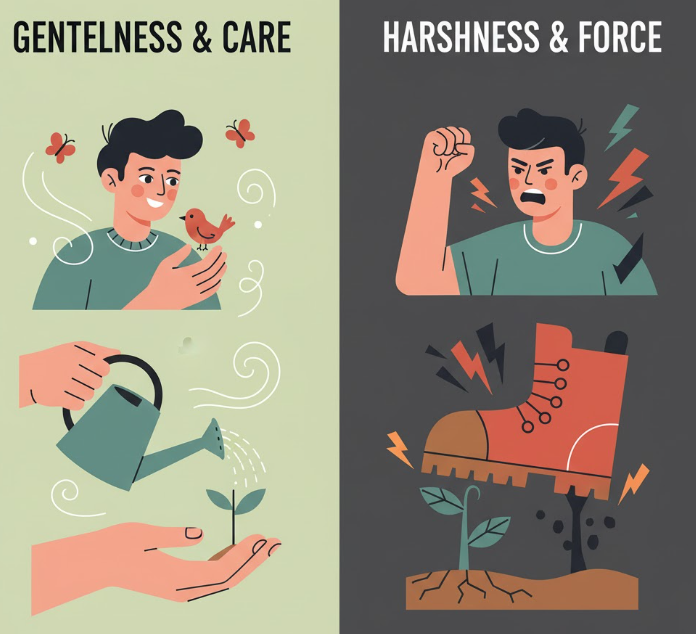
The function of these antonyms is to describe actions, attitudes, or characteristics that are the opposite of mildness and kindness. They are used to convey a sense of strength, sternness, or even cruelty, depending on the specific word chosen.
The context in which these words are used is vital for understanding the intended meaning. For instance, “firmness” can be an antonym of gentleness in the context of discipline, while “brutality” is an antonym in the context of physical force.
Structural Breakdown of Antonyms
Antonyms can be formed in several ways, affecting their structural relationship to the original word. Understanding these structures can aid in vocabulary acquisition and comprehension.
One common method is using prefixes that negate the meaning of a word. For example, adding “un-” or “in-” can create antonyms. However, this method isn’t directly applicable to “gentleness” as there isn’t common usage of “ungentleness” or “ingentleness.” Instead, we rely on entirely different words to express the opposite meaning.
Another type of antonym is a gradable antonym, which represents points on a continuous scale. For example, “hot” and “cold” are gradable antonyms, as there are degrees of temperature between them. The antonyms of gentleness often fall into this category. There is a spectrum of behavior between being gentle and being brutal, including words like “firm,” “stern,” and “forceful.”
Complementary antonyms are pairs where one word implies the absence of the other. For instance, “alive” and “dead” are complementary antonyms. While some antonyms of gentleness lean toward this, such as “mercilessness” implying a lack of gentleness, they typically exist on the gradable spectrum.
Finally, relational antonyms describe a relationship from opposite perspectives. For example, “buy” and “sell” are relational antonyms. This type isn’t highly relevant to the concept of gentleness and its direct opposites.
Types and Categories of Antonyms of Gentleness
The antonyms of gentleness can be broadly categorized based on the specific aspect of gentleness they oppose. These categories help to refine the meaning and usage of the antonyms.
Forcefulness
Forcefulness represents the use of strength or power, often in a way that is not gentle. It implies a direct and assertive approach that may disregard the feelings or needs of others.
Harshness
Harshness refers to the quality of being severe, stern, or unyielding. It suggests a lack of compassion and a willingness to inflict pain or suffering.
Aggression
Aggression involves hostile or violent behavior or attitudes toward another. It implies a readiness to attack or confront.
Severity
Severity denotes strictness, harshness, or rigor. It often relates to rules, punishments, or judgments that are inflexible and uncompromising.
Indifference
Indifference signifies a lack of interest, concern, or sympathy. It implies a detachment from the feelings or needs of others, representing a passive form of the opposite of gentleness.
Examples of Antonyms in Use
The following tables provide examples of how these antonyms are used in sentences, demonstrating their varied contexts and meanings. These examples will help solidify your understanding of each category.
Forcefulness Examples
The table below showcases how the antonyms of gentleness related to “forcefulness” are used in different contexts. The examples aim to clarify the subtle differences between the words within this category.
| Antonym | Example Sentence |
|---|---|
| Forceful | The lawyer presented a forceful argument that swayed the jury. |
| Vigorous | The athlete made a vigorous effort to win the race. |
| Energetic | The team launched an energetic campaign to promote the new product. |
| Impetuous | His impetuous decision led to unforeseen consequences. |
| Vehement | She expressed her disagreement with a vehement tone. |
| Assertive | It’s important to be assertive when negotiating a salary. |
| Powerful | The powerful engine roared to life. |
| Dynamic | The new CEO brought a dynamic approach to the company. |
| Driven | She is a driven individual, always striving for success. |
| Intense | The competition was intense, with both teams giving their all. |
| Aggressive | The company took an aggressive approach to marketing. |
| Tough | He had to make a tough decision. |
| Firm | The teacher maintained a firm but fair approach. |
| Determined | She was determined to finish the marathon. |
| Resolute | He remained resolute in his decision. |
| Bold | She made a bold move in the business deal. |
| Audacious | Their plan was ambitious and audacious. |
| Daunting | The task ahead seemed daunting, but they persevered. |
| Strenuous | The hike was strenuous, requiring a lot of effort. |
| Exertive | The work was very exertive, leaving him exhausted. |
| Compelling | The evidence was compelling, leaving no room for doubt. |
| Overpowering | The smell was overpowering. |
| Dominating | The team had a dominating performance. |
| Commanding | The general had a commanding presence. |
Harshness Examples
The following table presents examples of antonyms of gentleness that relate to “harshness.” These examples demonstrate the context in which these words are appropriately used, emphasizing their negative connotations.
| Antonym | Example Sentence |
|---|---|
| Harsh | The desert environment is harsh and unforgiving. |
| Severe | The judge imposed a severe sentence on the criminal. |
| Brutal | The war was brutal and left many casualties. |
| Cruel | It was a cruel act to abandon the animal. |
| Ruthless | The dictator was known for his ruthless tactics. |
| Callous | His callous disregard for her feelings was shocking. |
| Unkind | It was unkind to speak so harshly to her. |
| Unfeeling | His unfeeling response made her feel even worse. |
| Heartless | She described him as a heartless man. |
| Merciless | The storm was merciless, destroying everything in its path. |
| Grim | The situation looked grim after the initial failure. |
| Bleak | The future looked bleak for the company. |
| Austere | The room was decorated in an austere style. |
| Stern | The teacher gave a stern warning to the students. |
| Rigorous | The training program was rigorous and demanding. |
| Stringent | The rules were very stringent. |
| Inhuman | Such treatment was inhuman. |
| Barbaric | The practice was considered barbaric. |
| Savage | The attack was savage and unprovoked. |
| Fierce | The competition was fierce. |
| Vicious | The rumors were vicious and untrue. |
| Malicious | His actions were malicious. |
| Atrocious | The weather was atrocious. |
| Terrible | The accident was terrible. |
Aggression Examples
The following table provides examples of antonyms of gentleness related to “aggression.” These examples aim to highlight the combative and hostile nature associated with these words.
| Antonym | Example Sentence |
|---|---|
| Aggressive | The dog became aggressive when strangers approached. |
| Hostile | The meeting turned hostile when the negotiations broke down. |
| Belligerent | His belligerent attitude made it difficult to have a conversation. |
| Combative | She adopted a combative stance during the debate. |
| Defiant | The child was defiant and refused to follow instructions. |
| Confrontational | His confrontational style often led to arguments. |
| Quarrelsome | They were a quarrelsome family, always arguing. |
| Antagonistic | His antagonistic behavior created tension in the group. |
| Violent | The protest turned violent when clashes broke out. |
| Riotous | The crowd became riotous after the game. |
| Rude | It was rude of him to interrupt. |
| Impolite | She found his behavior impolite. |
| Offensive | His remarks were offensive to many people. |
| Insulting | The comment was insulting and uncalled for. |
| Provocative | Her clothing was considered provocative. |
| Fiery | She has a fiery temper. |
| Wrathful | The king was wrathful after the betrayal. |
| Irascible | He was known for his irascible personality. |
| Choleric | His choleric outbursts were feared by his staff. |
| Agitated | She seemed agitated by the news. |
| Upset | He was upset by the criticism. |
| Enraged | He was enraged by the injustice. |
Severity Examples
The table below illustrates how antonyms of gentleness connected to “severity” are used in sentences. These examples demonstrate the strict, inflexible, and often unpleasant aspects of these words.
| Antonym | Example Sentence |
|---|---|
| Severe | The weather service issued a severe storm warning. |
| Strict | The school has a strict dress code. |
| Rigid | The company’s rules were too rigid and inflexible. |
| Inflexible | The manager was inflexible and unwilling to compromise. |
| Uncompromising | She was uncompromising in her principles. |
| Draconian | The new laws were considered draconian by many. |
| Harsh | The punishment was too harsh for the crime. |
| Stringent | The safety regulations were very stringent. |
| Implacable | His anger was implacable. |
| Ruthless | The business was run with ruthless efficiency. |
| Exact | She demanded exact measurements. |
| Precise | He gave precise instructions. |
| Meticulous | She was meticulous in her work. |
| Punctilious | He was punctilious about every detail. |
| Demanding | The job was very demanding. |
| Exacting | He was an exacting boss. |
| Absolute | She has absolute authority. |
| Unconditional | The surrender was unconditional. |
| Definitive | They came to a definitive agreement. |
| Final | This is the final decision. |
Indifference Examples
The table below displays antonyms of gentleness related to “indifference.” These examples highlight the lack of concern, sympathy, or interest that characterizes these words.
| Antonym | Example Sentence |
|---|---|
| Indifferent | He seemed indifferent to the suffering of others. |
| Apathetic | The public was apathetic towards the political situation. |
| Uncaring | His uncaring attitude was hurtful. |
| Aloof | She remained aloof from the rest of the group. |
| Detached | He maintained a detached perspective on the problem. |
| Unconcerned | She seemed unconcerned about the consequences. |
| Callous | His callous disregard for the environment was appalling. |
| Cold | She gave him a cold stare. |
| Emotionless | His face remained emotionless throughout the ordeal. |
| Passive | He took a passive role in the project. |
| Neutral | The country remained neutral during the conflict. |
| Impassive | Her face was impassive, revealing no emotion. |
| Stoic | He remained stoic in the face of adversity. |
| Phlegmatic | His phlegmatic temperament made him unflappable. |
| Listless | She felt listless and unmotivated. |
| Lethargic | The heat made everyone feel lethargic. |
| Ennui | He was overcome by a sense of ennui. |
| World-weary | He had a world-weary look in his eyes. |
| Jaded | She had become jaded after years in the industry. |
| Nonchalant | He acted nonchalant about the news. |
Usage Rules and Considerations
Choosing the correct antonym of gentleness depends heavily on the specific context and the nuance you wish to convey. There are no hard and fast rules, but understanding the connotations of each word is crucial.
For example, when describing physical force, “forceful” or “vigorous” might be appropriate, whereas “brutal” would be reserved for situations involving excessive violence or cruelty. Similarly, in a professional setting, “assertive” might be a desirable antonym of gentleness, while “aggressive” could be seen as negative.
Consider the impact of your word choice on the reader or listener. Using a stronger antonym than necessary can create a negative impression, while using a weaker one might not effectively communicate your intended meaning.
Pay attention to the register of the language. Some antonyms, such as “choleric” or “phlegmatic,” are more formal and less commonly used in everyday conversation.
Others, like “rude” or “unkind,” are more informal and widely understood.
Common Mistakes When Using Antonyms of Gentleness
One common mistake is using “aggressive” and “assertive” interchangeably. While both imply a lack of gentleness, assertiveness is about confidently expressing one’s needs and opinions without violating the rights of others, whereas aggression involves hostile or forceful behavior that can be harmful. For example:
- Incorrect: She was aggressive in the negotiation, securing a better deal.
- Correct: She was assertive in the negotiation, securing a better deal.
Another mistake is using overly strong antonyms when a milder term would be more appropriate. For instance, describing a firm teacher as “brutal” is an exaggeration, as “stern” or “strict” would be more accurate.
For example:
- Incorrect: The teacher was brutal, giving out excessive homework.
- Correct: The teacher was strict, giving out a lot of homework.
Confusing “indifferent” with “disinterested” is also common. Indifferent means lacking interest or concern, while disinterested means impartial or unbiased. For example:
- Incorrect: The judge was indifferent in the case, showing no favoritism.
- Correct: The judge was disinterested in the case, showing no favoritism.
Practice Exercises
Test your understanding of the antonyms of gentleness with these exercises. Choose the best antonym to complete each sentence.
Exercise 1: Fill in the Blanks
| Question | Answer |
|---|---|
| 1. Despite her gentle nature, she could be quite ______ when defending her beliefs. | assertive |
| 2. The ______ desert climate made it difficult to survive. | harsh |
| 3. The robber’s ______ actions shocked the community. | violent |
| 4. The judge handed down a ______ sentence to the convicted criminal. | severe |
| 5. He remained ______ to their pleas for help. | indifferent |
| 6. The ______ winds battered the coastline. | forceful |
| 7. Her ______ tone made it clear she wasn’t happy. | stern |
| 8. The team adopted an ______ marketing strategy to gain market share. | aggressive |
| 9. The company’s ______ policies left little room for negotiation. | rigid |
| 10. He gave a ______ shrug, showing he didn’t care. | nonchalant |
Exercise 2: Multiple Choice
| Question | Options | Answer |
|---|---|---|
| 1. Which word best describes someone who is cruel and without pity? | a) Kind b) Gentle c) Ruthless d) Mild | c) Ruthless |
| 2. Which word suggests a strong, energetic approach? | a) Lethargic b) Vigorous c) Apathetic d) Passive | b) Vigorous |
| 3. Which word implies a hostile and argumentative attitude? | a) Amiable b) Belligerent c) Compliant d) Docile | b) Belligerent |
| 4. Which word describes a rule that is strict and inflexible? | a) Lenient b) Flexible c) Draconian d) Permissive | c) Draconian |
| 5. Which word suggests a lack of interest or concern? | a) Empathetic b) Sympathetic c) Indifferent d) Caring | c) Indifferent |
| 6. Which word best describes a powerful and commanding presence? | a) Meek b) Commanding c) Timid d) Submissive | b) Commanding |
| 7. Which word suggests a fierce and intense competition? | a) Relaxed b) Fierce c) Calm d) Gentle | b) Fierce |
| 8. Which word best describes someone who is determined and unyielding? | a) Resolute b) Wavering c) Indecisive d) Hesitant | a) Resolute |
| 9. Which word implies a malicious and spiteful act? | a) Benevolent b) Malicious c) Kind d) Generous | b) Malicious |
| 10. Which word suggests an exact and precise approach? | a) Vague b) Exact c) Approximate d) Rough | b) Exact |
Advanced Topics: Nuances and Context
The choice of an antonym is rarely straightforward. The best option depends on the specific context and the subtle shades of meaning you want to convey.
For example, consider the difference between “firm” and “harsh.” A firm approach might be necessary in parenting or leadership, implying structure and discipline without unnecessary cruelty. A harsh approach, on the other hand, suggests excessive severity and a lack of compassion.
Similarly, “assertive” and “aggressive” can be easily confused. Assertiveness is about standing up for oneself in a respectful manner, while aggression involves violating the rights of others. Recognizing this difference is crucial for effective communication.
Furthermore, the cultural context can influence the interpretation of these words. What is considered “assertive” in one culture might be seen as “aggressive” in another.
Understanding these cultural nuances is essential for avoiding misunderstandings.
Frequently Asked Questions
Here are some frequently asked questions about the antonyms of gentleness.
- Is there one single perfect antonym for “gentleness”?
No, there is no single perfect antonym. The best choice depends on the specific context and the aspect of gentleness you want to contrast. “Harshness,” “forcefulness,” “aggression,” “severity,” and “indifference” are all potential antonyms, each with its own nuance. - How can I improve my vocabulary of antonyms?
Read widely and pay attention to the words that authors use to create contrast. Use a thesaurus to explore different antonyms for a given word. Practice using these antonyms in your own writing and speech. - Are there any prefixes or suffixes that can be added to “gentleness” to create an antonym?
While prefixes like “un-” or “in-” often create antonyms, they are not commonly used with “gentleness.” Instead, we rely on entirely different words to express the opposite meaning. - What is the difference between “assertive” and “aggressive”?
Assertiveness is about confidently expressing your needs and opinions in a respectful manner. Aggression involves hostile or forceful behavior that can be harmful or disrespectful to others. - When is it appropriate to use a strong antonym of gentleness, like “brutal” or “ruthless”?
Use strong antonyms only when the situation warrants it. These words should be reserved for cases involving extreme cruelty, violence, or a complete lack of compassion. - How can I avoid using the wrong antonym of gentleness?
Consider the specific context and the message you want to convey. Look up the definitions of different antonyms in a dictionary and pay attention to their connotations. Ask a native speaker for feedback on your word choice. - Is “firmness” an antonym of gentleness?
Yes, in certain contexts. Firmness implies a lack of leniency and a willingness to enforce rules or standards. While not as extreme as “harshness,” it represents a departure from gentleness. - How does cultural context affect the use of antonyms of gentleness?
Cultural norms can influence how certain behaviors are perceived. What is considered “assertive” in one culture might be seen as “aggressive” in another. Be mindful of these cultural differences when choosing your words.
Conclusion
Mastering the antonyms of gentleness is essential for developing a rich and nuanced vocabulary. By understanding the subtle differences between words like “forceful,” “harsh,” “aggressive,” “severe,” and “indifferent,” you can express yourself with greater precision and impact.
Remember to consider the context, connotations, and cultural implications of your word choices. Practice using these antonyms in your writing and speech, and seek feedback from native speakers.
With diligent effort, you can expand your vocabulary and communicate more effectively.
Ultimately, understanding the opposites of gentleness allows for a deeper appreciation of the complexities of human interaction and the power of language to capture these nuances. Embrace the challenge of mastering these words, and you will unlock a new level of expressive ability.