Understanding the nuances of language involves more than just knowing the definitions of words; it requires grasping their relationships to each other. One of the most fundamental relationships is that of antonymy – the opposition in meaning.
While ‘happiness’ is a universally desired state, exploring its antonyms provides a richer understanding of the human emotional landscape. This article delves into the various words that represent the opposite of happiness, examining their specific connotations and contexts.
Whether you’re an English language learner, a writer seeking precise vocabulary, or simply interested in the subtleties of language, this guide will help you navigate the diverse vocabulary associated with the absence of joy.
By understanding these antonyms, you’ll be able to express a wider range of emotions and experiences with greater accuracy and depth. This knowledge is particularly useful in creative writing, academic discourse, and everyday conversations.
This article will explore the different types of antonyms related to happiness, provide numerous examples, and offer practice exercises to solidify your understanding.
Table of Contents
- Definition: What are Antonyms of Happiness?
- Structural Breakdown
- Types and Categories of Antonyms of Happiness
- Examples of Antonyms of Happiness
- Usage Rules for Antonyms of Happiness
- Common Mistakes When Using Antonyms of Happiness
- Practice Exercises
- Advanced Topics
- Frequently Asked Questions
- Conclusion
Definition: What are Antonyms of Happiness?
Antonyms are words that have opposite meanings. In the context of “happiness,” antonyms refer to words that describe states of being that are the antithesis of joy, contentment, and well-being.
These words encompass a range of negative emotions and experiences, from mild dissatisfaction to intense suffering. Understanding these antonyms involves recognizing not only their basic definitions but also their specific connotations and the contexts in which they are most appropriately used.
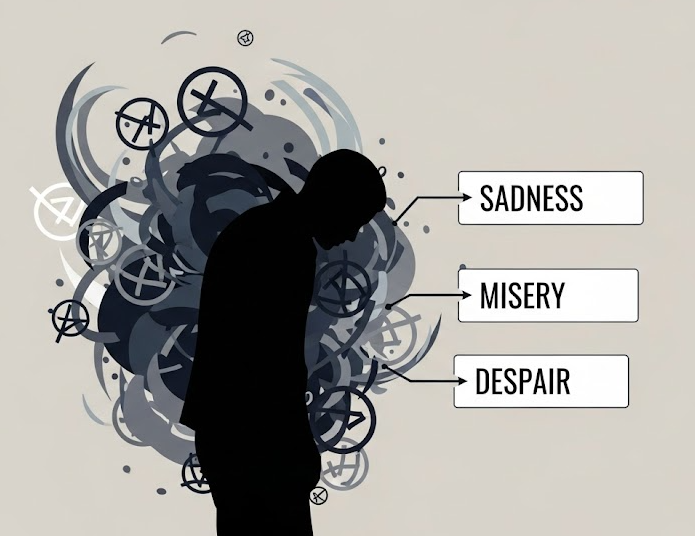
Antonyms of happiness are not a monolithic block; they represent a spectrum of negative emotions. Some, like sadness, are relatively mild and transient. Others, like despair, are profound and debilitating. Moreover, some antonyms focus on the internal emotional state (e.g., melancholy), while others emphasize external circumstances or events (e.g., tragedy). The function of these words is to provide a nuanced vocabulary for expressing the human experience of suffering and negativity. They are essential for effective communication, allowing us to articulate the precise nature and intensity of our emotions and the emotions of others.
Structural Breakdown
The structure of antonyms of happiness is diverse, reflecting the complexity of human emotions. They can be nouns, adjectives, verbs, or adverbs, each playing a different role in conveying meaning.
For example, “sadness” is a noun representing a state of being, while “sad” is an adjective describing someone experiencing sadness. “To grieve” is a verb indicating the act of experiencing grief, and “sorrowfully” is an adverb describing how something is done with sorrow.
Many antonyms of happiness are formed through prefixation, such as adding “un-” to “happiness” to create “unhappiness” or “dis-” to “content” to create “discontent.” This prefixation often indicates a direct negation of the root word’s meaning. However, other antonyms, such as “misery” or “despair,” are entirely different words with distinct etymological origins.
Understanding these structural variations allows for a more precise and nuanced use of language.
Types and Categories of Antonyms of Happiness
Antonyms of happiness can be categorized based on the specific emotions or experiences they represent. Here are several key categories, along with examples and explanations:
Sadness
Sadness is a common and relatively mild emotion characterized by feelings of unhappiness, sorrow, or disappointment. It’s a natural response to loss, setbacks, or unpleasant experiences.
Sorrow
Sorrow is a deeper and more prolonged feeling of sadness, often associated with loss or grief. It implies a sense of regret and mourning.
Misery
Misery describes a state of extreme unhappiness and suffering. It suggests a prolonged and intense experience of pain, hardship, or distress.
Despair
Despair is a complete loss of hope, often accompanied by a feeling of helplessness and futility. It represents a profound and debilitating state of hopelessness.
Grief
Grief is the intense sorrow caused by the death of a loved one or other significant loss. It involves a complex emotional process of mourning and adjustment.
Unhappiness
Unhappiness is a general term for not being happy. It encompasses a wide range of negative emotions and experiences, from mild dissatisfaction to deep sorrow.
Melancholy
Melancholy is a thoughtful sadness, often tinged with nostalgia or introspection. It suggests a pensive and reflective state of unhappiness.
Depression
Depression is a serious mental health condition characterized by persistent sadness, loss of interest in activities, and other physical and emotional symptoms. It requires professional diagnosis and treatment.
Discontent
Discontent is a feeling of dissatisfaction or restlessness, often arising from a sense of unmet needs or desires. It implies a lack of contentment with one’s current situation.
Worry
Worry is a state of anxiety and concern about actual or potential problems. It involves dwelling on negative thoughts and anticipating unfavorable outcomes.
Anxiety
Anxiety is a feeling of unease, nervousness, or fear, often accompanied by physical symptoms such as rapid heartbeat or sweating. It can be triggered by specific situations or be a more generalized condition.
Fear
Fear is an emotional response to a perceived threat. It involves a sense of danger and a desire to avoid the perceived threat.
Stress
Stress is a state of mental or emotional strain or tension resulting from adverse or demanding circumstances. It can have both physical and psychological effects.
Examples of Antonyms of Happiness
To further illustrate the use of antonyms of happiness, here are several examples categorized by the type of emotion they represent. The tables below present a wide range of sentences demonstrating the usage of these words in different contexts.
These examples will help you understand how to incorporate these terms into your vocabulary effectively.
The following table provides examples of sentences using words related to sadness and sorrow. Note the subtle differences in connotation and usage between these terms.
| Antonym | Example Sentence |
|---|---|
| Sadness | A wave of sadness washed over her as she remembered her childhood. |
| Sadness | The movie evoked a deep sense of sadness in the audience. |
| Sadness | He couldn’t hide the sadness in his eyes after hearing the news. |
| Sadness | There was a palpable sadness in the air during the memorial service. |
| Sadness | Her sadness was evident in her quiet demeanor and withdrawn behavior. |
| Sorrow | Sorrow filled her heart after the loss of her beloved pet. |
| Sorrow | The poem expressed the deep sorrow of a broken heart. |
| Sorrow | He carried the sorrow of his past mistakes with him. |
| Sorrow | The old woman spoke of her life with a mixture of joy and sorrow. |
| Sorrow | A profound sorrow settled over the community after the tragic accident. |
| Sad | She felt sad when her friend moved away. |
| Sad | The rainy weather made him feel sad and listless. |
| Sad | It’s sad to see such a beautiful building in disrepair. |
| Sad | He gave a sad smile, trying to hide his disappointment. |
| Sad | The sad news of the company’s closure spread quickly. |
| Sorrowful | She gave a sorrowful sigh as she remembered the past. |
| Sorrowful | The letter was filled with sorrowful words of apology. |
| Sorrowful | He looked at the old photographs with a sorrowful expression. |
| Sorrowful | The music had a sorrowful and haunting melody. |
| Sorrowful | She delivered a sorrowful eulogy at the funeral. |
The following table provides examples of sentences using words related to misery and despair. These words indicate more intense and prolonged states of unhappiness.
| Antonym | Example Sentence |
|---|---|
| Misery | He lived a life of misery after losing his family and home. |
| Misery | The refugees faced unimaginable misery in the overcrowded camp. |
| Misery | Her misery was compounded by poverty and illness. |
| Misery | The novel depicted the abject misery of the working class. |
| Misery | He was trapped in a cycle of misery, unable to find a way out. |
| Despair | Despair overwhelmed him when he realized his efforts were futile. |
| Despair | She sank into despair after failing her final exams. |
| Despair | The prisoners lived in a state of constant despair. |
| Despair | His despair deepened as he lost hope of ever seeing his family again. |
| Despair | The feeling of despair was palpable in the abandoned city. |
| Miserable | She felt miserable after arguing with her best friend. |
| Miserable | The weather was miserable, with constant rain and wind. |
| Miserable | He had a miserable cold that kept him in bed all week. |
| Miserable | She looked miserable as she recounted her hardships. |
| Miserable | The conditions in the refugee camp were truly miserable. |
| Despairing | He felt despairing after receiving the rejection letter. |
| Despairing | She gave a despairing cry as she watched her dreams crumble. |
| Despairing | The situation seemed utterly despairing, with no hope in sight. |
| Despairing | He wrote a despairing letter to his family before disappearing. |
| Despairing | The community was in a despairing state after the natural disaster. |
The following table provides examples of sentences using words related to grief and unhappiness. Grief is particularly associated with loss, while unhappiness is a more general term.
| Antonym | Example Sentence |
|---|---|
| Grief | Grief consumed her after the sudden death of her husband. |
| Grief | The family struggled to cope with their grief after the tragic accident. |
| Grief | She found solace in her faith to help her through her grief. |
| Grief | The depth of her grief was immeasurable. |
| Grief | Time can heal the wounds of grief, but the scars remain. |
| Unhappiness | Her unhappiness stemmed from a lack of fulfillment in her career. |
| Unhappiness | He tried to mask his unhappiness with a forced smile. |
| Unhappiness | The root of her unhappiness lay in her troubled childhood. |
| Unhappiness | She couldn’t shake off the feeling of general unhappiness. |
| Unhappiness | His unhappiness was evident to everyone around him. |
| Grieving | She was still grieving the loss of her mother. |
| Grieving | The community is grieving the victims of the earthquake. |
| Grieving | He spent months grieving in solitude. |
| Grieving | The family is grieving and requests privacy at this time. |
| Grieving | She found support in a grief support group. |
| Unhappy | She was unhappy with her current job. |
| Unhappy | He seemed unhappy and withdrawn. |
| Unhappy | The children were unhappy with the cancellation of the field trip. |
| Unhappy | She gave an unhappy sigh. |
| Unhappy | He was unhappy with the way the situation was handled. |
The following table provides examples of sentences using words related to melancholy and depression. Melancholy is a thoughtful sadness, while depression is a more severe and persistent mental health condition.
| Antonym | Example Sentence |
|---|---|
| Melancholy | A sense of melancholy hung in the air as the leaves fell from the trees. |
| Melancholy | The music evoked a feeling of deep melancholy. |
| Melancholy | She found solace in the quiet melancholy of a rainy day. |
| Melancholy | His melancholy was often reflected in his poetry. |
| Melancholy | A touch of melancholy added depth to her character. |
| Depression | He was diagnosed with clinical depression and started therapy. |
| Depression | Depression can affect people of all ages and backgrounds. |
| Depression | She struggled with depression for many years. |
| Depression | The symptoms of depression include persistent sadness and loss of interest. |
| Depression | Medication can be an effective treatment for depression. |
| Melancholic | He had a melancholic temperament. |
| Melancholic | The poem was filled with melancholic imagery. |
| Melancholic | She gave a melancholic smile. |
| Melancholic | The music had a melancholic tone. |
| Melancholic | He often felt melancholic during the autumn months. |
| Depressed | She felt depressed after the breakup. |
| Depressed | He was diagnosed as clinically depressed. |
| Depressed | The prolonged isolation made her feel depressed. |
| Depressed | He felt too depressed to get out of bed. |
| Depressed | The economy was depressed, with high unemployment rates. |
The following table provides examples of sentences using words related to discontent, worry, anxiety, fear, and stress. These words represent different forms of unease and negative anticipation.
| Antonym | Example Sentence |
|---|---|
| Discontent | His discontent with his job led him to seek new opportunities. |
| Discontent | She felt a deep sense of discontent with her life. |
| Discontent | The seeds of discontent were sown by the unfair policies. |
| Discontent | He expressed his discontent with the current state of affairs. |
| Discontent | The widespread discontent led to protests in the streets. |
| Worry | Worry kept her awake at night. |
| Worry | He tried to hide his worry from his children. |
| Worry | Her constant worry was starting to affect her health. |
| Worry | The parents expressed their worry about their child’s safety. |
| Worry | He had a perpetual worry that something bad would happen. |
| Anxiety | She experienced severe anxiety before her presentation. |
| Anxiety | Anxiety disorders can significantly impact a person’s quality of life. |
| Anxiety | He managed his anxiety with deep breathing exercises. |
| Anxiety | The constant pressure at work caused her to develop anxiety. |
| Anxiety | She sought therapy to help manage her anxiety. |
| Fear | Fear gripped her heart as she walked down the dark alley. |
| Fear | He overcame his fear of public speaking. |
| Fear | The children were paralyzed by fear during the thunderstorm. |
| Fear | Her fear of heights prevented her from enjoying the view. |
| Fear | The community lived in fear of the approaching hurricane. |
| Stress | Stress at work was affecting his health. |
| Stress | She managed her stress with yoga and meditation. |
| Stress | The high levels of stress in the city were taking a toll on its residents. |
| Stress | He tried to minimize stress in his life by simplifying his schedule. |
| Stress | The constant stress led to burnout. |
Usage Rules for Antonyms of Happiness
Using antonyms of happiness correctly involves understanding their specific connotations and the contexts in which they are most appropriate. Here are some key usage rules to keep in mind:
- Choose the Right Intensity: Select an antonym that accurately reflects the intensity of the emotion you want to convey. For example, use “sadness” for a mild feeling of unhappiness, “sorrow” for a deeper sense of loss, and “misery” or “despair” for extreme suffering.
- Consider the Context: The context of your writing or conversation should guide your choice of antonym. For instance, “grief” is most appropriate when discussing the loss of a loved one, while “discontent” is better suited for expressing dissatisfaction with a situation or circumstance.
- Pay Attention to Connotations: Be aware of the subtle differences in connotation between similar antonyms. “Melancholy” suggests a thoughtful sadness, while “depression” implies a more serious mental health condition.
- Use Descriptive Language: Enhance the impact of your writing by using descriptive language to further illustrate the emotion you are conveying. For example, instead of simply saying “She felt sad,” you could say “A wave of sadness washed over her as she remembered her childhood.”
- Avoid Overuse: While antonyms of happiness are important for expressing negative emotions, avoid overusing them. Balance them with positive language and descriptions of resilience and hope.
Common Mistakes When Using Antonyms of Happiness
Here are some common mistakes to avoid when using antonyms of happiness:
| Incorrect | Correct | Explanation |
|---|---|---|
| She felt despair because she lost her keys. | She felt frustrated because she lost her keys. | “Despair” implies a complete loss of hope, which is too strong for simply losing keys. “Frustrated” is a more appropriate term. |
| He was in a state of grief because he didn’t get the promotion. | He was in a state of disappointment because he didn’t get the promotion. | “Grief” is typically associated with the loss of a loved one. “Disappointment” is more suitable in this context. |
| The party was filled with melancholy. | The atmosphere was filled with joy. | “Melancholy” describes a state of thoughtful sadness, which is inappropriate for a party. This original sentence is trying to describe the opposite of a happy party, so a happy word like ‘joy’ is appropriate. |
| He was anxious about failing a test, so he felt despair. | He was anxious about failing a test, so he studied harder. | Feeling anxious does not automatically lead to despair. It is not a logical connection. |
| She was unhappy that she won the lottery. | She was happy that she won the lottery. | This is a direct contradiction. Winning the lottery is generally a cause for happiness, not unhappiness. |
Practice Exercises
Test your understanding of antonyms of happiness with these practice exercises. Choose the best antonym to complete each sentence.
Answers are provided below.
| Question | Answer |
|---|---|
| 1. After the company announced layoffs, a sense of _______ settled over the employees. | anxiety |
| 2. The _______ caused by the earthquake was evident in the ruined buildings and displaced families. | misery |
| 3. She couldn’t hide the _______ in her voice as she spoke about her lost dreams. | sorrow |
| 4. He felt a deep sense of _______ after realizing he had made a terrible mistake. | regret |
| 5. The constant rain and gray skies filled her with _______. | melancholy |
| 6. After failing to find a job for months, he began to feel a sense of _______. | despair |
| 7. The _______ of losing her grandmother was overwhelming. | grief |
| 8. He was _______ with his current living situation and decided to move. | discontent |
| 9. The thought of the upcoming surgery filled her with _______. | fear |
| 10. _______ at work was affecting his sleep and overall health. | Stress |
Advanced Topics
For advanced learners, exploring the nuances of antonyms of happiness can involve delving into psychological and philosophical perspectives. For example, consider the concept of ” Weltschmerz,” a German term for world-weariness or a feeling of sadness arising from the awareness that the world can never live up to one’s expectations.
This concept explores a deeper, more existential form of unhappiness.
Another advanced topic is the study of how different cultures express and perceive negative emotions. Some cultures may have a greater tolerance for expressing sadness or grief, while others may emphasize stoicism and emotional restraint.
Understanding these cultural differences can provide valuable insights into the human experience of unhappiness.
Frequently Asked Questions
- What is the difference between sadness and sorrow?Sadness is a general feeling of unhappiness, while sorrow is a deeper, more prolonged feeling often associated with loss or grief. Sorrow implies a sense of regret and mourning, while sadness can be a more transient emotion.
- When should I use “misery” instead of “unhappiness”?Use “misery” when describing a state of extreme unhappiness and suffering. It suggests a prolonged and intense experience of pain, hardship, or distress, whereas “unhappiness” is a more general term.
- Is “despair” the same as “depression”?No, “despair” is a complete loss of hope, while “depression” is a clinical mental health condition characterized by persistent sadness, loss of interest, and other symptoms. While despair can be a symptom of depression, the two are not interchangeable.
- How can I avoid misusing antonyms of happiness in my writing?Pay close attention to the specific connotations of each word and consider the context in which you are using it. Use a thesaurus to explore different options and choose the word that most accurately reflects the emotion you want to convey. Reading widely and observing how skilled writers use these words can also be helpful.
- What is the role of antonyms of happiness in literature?Antonyms of happiness are essential for creating complex and realistic characters and narratives. They allow writers to explore the full range of human emotions and experiences, adding depth and nuance to their stories. By depicting characters who struggle with sadness, grief, or despair, writers can create compelling and relatable narratives that resonate with readers.
- How can understanding antonyms of happiness improve my communication skills?By understanding the nuances of these words, you can express your emotions and the emotions of others with greater accuracy and empathy. This can lead to more effective communication and stronger relationships. Being able to articulate the precise nature and intensity of your feelings can also help you better understand and manage your own emotional well-being.
- Are there cultural differences in how antonyms of happiness are expressed?Yes, different cultures may have different norms and expectations regarding the expression of negative emotions. Some cultures may be more open and accepting of displays of sadness or grief, while others may emphasize stoicism and emotional restraint. Understanding these cultural differences is important for effective cross-cultural communication and empathy.
- How can I help someone who is experiencing intense antonyms of happiness like despair or grief?Offer your support and empathy, listen without judgment, and encourage them to seek professional help if needed. Avoid minimizing their feelings or offering unsolicited advice. Simply being present and supportive can make a significant difference. For grief, allow the person to grieve in their own way and time. For despair and depression, professional help is crucial.
Conclusion
Exploring the antonyms of happiness provides a deeper understanding of the human emotional spectrum. From the mildest forms of sadness to the most profound depths of despair, these words offer a rich vocabulary for expressing the complexities of the human experience.
By mastering these terms, you can enhance your communication skills, improve your writing, and develop a greater appreciation for the nuances of language.
Remember to consider the context, intensity, and connotations of each word when choosing the most appropriate antonym of happiness. Practice using these words in your writing and conversation, and continue to expand your vocabulary through reading and observation.
By embracing the full range of human emotions, you can cultivate a more compassionate and empathetic understanding of yourself and others. Keep practicing, and soon you’ll be able to articulate even the most subtle shades of unhappiness with precision and clarity.