Understanding antonyms is crucial for expanding vocabulary and enhancing communication skills. While we often focus on synonyms, exploring antonyms provides a deeper understanding of word meanings and their nuances.
This article delves into the concept of “disorganization” as an antonym of “infrastructure,” examining its various forms, contexts, and implications. This exploration is beneficial for English language learners, writers, and anyone seeking to refine their understanding of language.
By understanding the ways in which disorganization contrasts with infrastructure, we can more effectively describe situations lacking structure, planning, or essential support systems. This knowledge is invaluable for clear and precise communication in both written and spoken English.
This article will guide you through definitions, examples, and practical exercises to master this concept.
Table of Contents
- Definition of Disorganization (as an Antonym of Infrastructure)
- Structural Breakdown
- Types and Categories of Disorganization
- Examples of Disorganization
- Usage Rules and Guidelines
- Common Mistakes
- Practice Exercises
- Advanced Topics
- Frequently Asked Questions (FAQ)
- Conclusion
Definition of Disorganization (as an Antonym of Infrastructure)
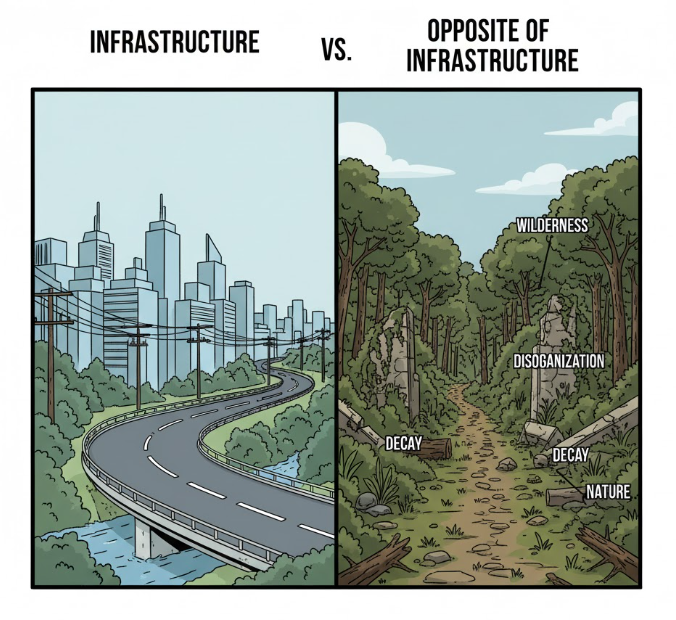
Disorganization, when considered as an antonym of infrastructure, refers to the lack of a structured system, plan, or framework. Infrastructure implies a solid foundation that supports growth and functionality. Disorganization, conversely, signifies the absence of such a foundation, leading to chaos, inefficiency, and instability. It represents a state where components are not properly arranged or coordinated, resulting in impaired functionality and potential failure.
In the context of infrastructure, which includes essential facilities and systems like transportation, communication, and utilities, disorganization manifests as breakdowns, inefficiencies, and a general lack of order. It can affect various aspects of life, from personal productivity to the functioning of entire societies.
Understanding disorganization as the opposite of infrastructure helps us recognize and address inefficiencies, ultimately promoting better systems and structures.
Classification of disorganization can be broad. It can be physical (a cluttered workspace), organizational (poor management), systemic (a failing healthcare system), or even mental (difficulty focusing or remembering). Each type reflects a deficiency in structure and order, contrasting sharply with the well-planned and maintained systems inherent in infrastructure.
Structural Breakdown
The concept of “disorganization” lacks a formal structural breakdown in the same way that grammatical structures like sentences or phrases do. However, we can analyze it by considering its components and manifestations.
Disorganization often stems from a breakdown in planning, communication, or execution. These breakdowns can occur at different levels, affecting individuals, groups, or entire systems.
Consider these elements that contribute to disorganization:
- Lack of Planning: Absence of a clear strategy or roadmap.
- Poor Communication: Ineffective exchange of information, leading to misunderstandings and errors.
- Inefficient Execution: Inability to carry out plans effectively, often due to lack of resources or skills.
- Lack of Coordination: Failure to synchronize efforts, resulting in duplication or conflicting actions.
- Absence of Structure: Lack of a defined framework or system to guide actions.
These elements interact to create a state of disorganization. For example, a lack of planning can lead to poor communication, which in turn hinders efficient execution.
Understanding these interconnected factors is essential for identifying and addressing the root causes of disorganization.
Think of a construction site (infrastructure being built). Disorganization would be evident if there were no blueprints (lack of planning), if different teams weren’t communicating about their tasks (poor communication), or if the materials were delivered haphazardly (inefficient execution).
The result would be chaos and delays.
Types and Categories of Disorganization
Disorganization can manifest in various forms, each with its own characteristics and consequences. Here are some key types of disorganization:
Physical Disorganization
Physical disorganization refers to the lack of order in physical spaces. This can include cluttered desks, messy rooms, or disorganized storage areas. It often leads to wasted time searching for items and reduced productivity. It’s the most tangible form of disorganization.
For instance, a doctor’s office with files scattered everywhere is a clear example of physical disorganization. This can lead to misfiled patient records and delays in treatment.
Organizational Disorganization
Organizational disorganization involves the lack of structure and coordination within groups or institutions. This can manifest as unclear roles, inefficient processes, and poor communication. It often results in decreased productivity, low morale, and missed deadlines. This type affects how groups function.
Consider a company where employees are unsure of their responsibilities and communication channels are unclear. This organizational disorganization can lead to project delays and employee frustration.
Systemic Disorganization
Systemic disorganization refers to the breakdown of entire systems, such as healthcare, education, or transportation. This can result from inadequate funding, poor planning, or lack of coordination between different components of the system. It often has widespread and severe consequences.
For example, a city with a poorly maintained public transportation system characterized by frequent delays and breakdowns exemplifies systemic disorganization. This can hinder people’s ability to get to work and access essential services.
Mental Disorganization
Mental disorganization involves difficulty focusing, remembering things, or organizing thoughts. This can be caused by stress, lack of sleep, or underlying medical conditions. It often leads to decreased productivity, poor decision-making, and increased anxiety. This affects an individual’s cognitive functions.
An individual struggling to remember appointments, prioritize tasks, or concentrate on work may be experiencing mental disorganization. This can significantly impact their daily life and work performance.
Examples of Disorganization
To further illustrate the concept of disorganization, here are several examples across different contexts.
The following table provides examples of disorganization in contrast to infrastructure, demonstrating how the absence of structure and planning leads to inefficiencies and problems.
| Context | Infrastructure (Organized) | Disorganization (Unorganized) |
|---|---|---|
| Transportation | Well-maintained roads and highways, efficient public transport | Pothole-filled roads, unreliable bus schedules, traffic congestion |
| Communication | Reliable internet service, clear communication channels | Frequent internet outages, unclear communication protocols |
| Healthcare | Adequate hospitals and clinics, efficient medical record systems | Overcrowded hospitals, lost medical records, long wait times |
| Education | Well-equipped schools, structured curriculum | Underfunded schools, outdated textbooks, chaotic classroom management |
| Business | Clear organizational structure, efficient workflows | Unclear roles and responsibilities, inefficient processes, missed deadlines |
| Personal Life | Organized schedule, tidy living space | Chaotic schedule, cluttered living space, missed appointments |
| Emergency Response | Well-coordinated emergency services, clear evacuation plans | Delayed response times, lack of coordination, unclear evacuation procedures |
| Government | Efficient bureaucracy, transparent processes | Red tape, corruption, lack of transparency |
| Supply Chain | Efficient logistics, reliable delivery systems | Supply shortages, delays, inefficient distribution |
| Information Technology | Secure data storage, reliable network systems | Data breaches, system failures, unreliable networks |
| Construction | Detailed blueprints, coordinated construction teams | Lack of blueprints, uncoordinated teams, material shortages |
| Urban Planning | Well-planned city layouts, efficient zoning regulations | Unplanned urban sprawl, inadequate zoning, traffic bottlenecks |
| Financial Management | Budgeting, saving, and investing | Overspending, debt, and lack of financial planning |
| Environmental Management | Waste management systems, conservation efforts | Pollution, deforestation, and lack of environmental protection |
| Legal System | Clear laws, fair trials, efficient courts | Ambiguous laws, biased trials, court backlogs |
| Agriculture | Irrigation systems, crop rotation, fertilizer use | Soil erosion, crop failure, food shortages |
| Energy Sector | Reliable power grids, renewable energy sources | Power outages, dependence on fossil fuels, environmental damage |
| Social Services | Support for vulnerable populations, welfare programs | Poverty, homelessness, lack of access to social services |
| Research and Development | Funding for scientific research, innovation | Lack of funding, brain drain, stifled innovation |
| Cultural Preservation | Museums, historical sites, arts funding | Destruction of cultural heritage, neglect of historical sites |
| Human Resources | Organized employee files, structured training programs | Lost or incomplete employee records, lack of training |
| Marketing | Targeted advertising, market research | Ineffective campaigns, lack of customer insights |
| Product Development | Structured design process, testing | Design flaws, lack of quality control |
| Customer Service | Helpful support, clear communication | Unresponsive support, unresolved issues |
| Manufacturing | Efficient production lines, quality control | Defective products, delays |
The following table provides examples of disorganized sentences and their corrected, organized counterparts, highlighting the impact of structure on clarity.
| Disorganized Sentence | Organized Sentence |
|---|---|
| The meeting, long and unproductive, went on for hours, nobody knowing what to do. | The long and unproductive meeting went on for hours, with nobody knowing what to do. |
| He arrived late, flustered and unprepared, because he had overslept. | He arrived late, flustered, and unprepared because he had overslept. |
| The report, which was due yesterday, is still not finished, and I am worried. | I am worried because the report, which was due yesterday, is still not finished. |
| She tried to cook dinner, but the ingredients were all mixed up, so she ordered takeout. | Because the ingredients were all mixed up, she ordered takeout instead of cooking dinner. |
| The code, poorly written and undocumented, was impossible to debug. | The poorly written and undocumented code was impossible to debug. |
| The documents, scattered and unfiled, were difficult to locate. | The scattered and unfiled documents were difficult to locate. |
| The project, lacking direction and resources, was doomed to fail. | Lacking direction and resources, the project was doomed to fail. |
| The presentation, rambling and unfocused, confused the audience. | The rambling and unfocused presentation confused the audience. |
| The room, messy and disorganized, stressed me out. | The messy and disorganized room stressed me out. |
| The car, dirty and unmaintained, broke down on the highway. | The dirty and unmaintained car broke down on the highway. |
| The book, poorly edited and printed, was full of errors. | The poorly edited and printed book was full of errors. |
| The event, poorly planned and executed, was a disaster. | The poorly planned and executed event was a disaster. |
| The system, complex and inefficient, needs an overhaul. | The complex and inefficient system needs an overhaul. |
| The team, unmotivated and untrained, struggled to perform. | The unmotivated and untrained team struggled to perform. |
| The process, convoluted and time-consuming, needs streamlining. | The convoluted and time-consuming process needs streamlining. |
| The argument, illogical and emotional, resolved nothing. | The illogical and emotional argument resolved nothing. |
| The speech, unprepared and delivered poorly, failed its purpose. | The unprepared and poorly delivered speech failed its purpose. |
| The experiment, uncontrolled and poorly documented, yielded useless data. | The uncontrolled and poorly documented experiment yielded useless data. |
| The response, slow and inadequate, made the situation worse. | The slow and inadequate response made the situation worse. |
| The letter, rambling and misspelled, made a bad impression. | The rambling and misspelled letter made a bad impression. |
The following table contrasts situations with and without disorganization, illustrating the tangible effects of each state on outcomes and experiences.
| Situation | Without Disorganization (Organized) | With Disorganization (Unorganized) |
|---|---|---|
| Workplace | Efficient workflow, clear communication, high productivity | Chaotic processes, communication breakdowns, low productivity |
| Classroom | Structured lessons, engaged students, effective learning | Disruptive environment, disengaged students, ineffective learning |
| Home | Clean and comfortable living space, relaxed atmosphere | Cluttered and stressful living space, tense atmosphere |
| Project | Clear goals, organized tasks, successful completion | Unclear goals, disorganized tasks, project failure |
| Event | Well-planned, smooth execution, positive experience | Poorly planned, chaotic execution, negative experience |
| Data Management | Organized database, easy access to information | Scattered data, difficult access, data loss |
| Personal Finances | Budgeting, saving, financial stability | Overspending, debt, financial instability |
| Healthcare System | Efficient medical care, accessible services | Long wait times, inaccessible services, inadequate care |
| Emergency Response | Rapid deployment, coordinated teams, effective aid | Delayed response, uncoordinated teams, ineffective aid |
| Public Transportation | On-time schedules, reliable service | Delays, cancellations, unreliable service |
| Inventory Management | Accurate tracking, just-in-time delivery | Stockouts, overstocking, inefficient logistics |
| Software Development | Structured coding, version control | Buggy code, lack of documentation, version conflicts |
| Meeting | Focused discussion, clear outcomes | Rambling discussion, unclear outcomes |
| Customer Service | Prompt responses, helpful solutions | Delayed responses, unresolved issues |
| Legal System | Fair trials, efficient courts | Backlogs, unjust outcomes |
| Urban Planning | Sustainable development, livable communities | Urban sprawl, congested traffic, environmental degradation |
| Scientific Research | Rigorous methodology, accurate data | Flawed methodology, inaccurate data |
| Artistic Creation | Creative expression, cohesive design | Lack of focus, incoherent design |
| Cooking | Well-organized recipes, delicious results | Missing ingredients, inedible results |
| Gardening | Well-tended plants, beautiful landscape | Overgrown weeds, neglected plants |
Usage Rules and Guidelines
When using “disorganization” as an antonym of infrastructure, keep the following guidelines in mind:
- Context Matters: Ensure that the context clearly establishes the contrast between a structured system (infrastructure) and the lack thereof (disorganization).
- Specificity: Be specific about the type of disorganization you are describing (physical, organizational, systemic, or mental).
- Consequences: Highlight the negative consequences of disorganization to emphasize its impact.
- Clarity: Use clear and concise language to avoid ambiguity.
For example, instead of saying “The city was disorganized,” you could say “The city’s transportation system suffered from systemic disorganization, leading to frequent delays and congestion.” This provides more specific information and emphasizes the impact of the disorganization.
Consider the use of adjectives and adverbs to modify “disorganization.” Words like “rampant disorganization,” “utter disorganization,” or “chronically disorganized” can add emphasis and nuance to your descriptions.
Common Mistakes
Here are some common mistakes to avoid when using “disorganization”:
| Incorrect | Correct | Explanation |
|---|---|---|
| The infrastructure was disorganization. | The infrastructure suffered from disorganization. | Disorganization is a state, not something that the infrastructure *is*. |
| He is disorganization. | He is disorganized. | “Disorganization” is a noun; “disorganized” is an adjective. |
| The disorganization was very infrastructure. | The disorganization was the antithesis of infrastructure. | “Infrastructure” is not an adjective to describe disorganization. |
| The project was disorganizing. | The project was disorganized. | “Disorganizing” is a verb form; “disorganized” is the correct adjective. |
| She has a disorganization. | She is experiencing disorganization. | Disorganization is an abstract state, not a tangible possession. |
Another common mistake is using “disorganization” interchangeably with “chaos.” While they are related, “chaos” implies a more extreme and unpredictable state. Disorganization can be a precursor to chaos, but it doesn’t necessarily imply the same level of disorder.
Practice Exercises
Complete the following sentences with the appropriate form of “disorganization” (disorganization, disorganized, disorganize).
| Question | Answer |
|---|---|
| 1. The office was in a state of complete __________. | disorganization |
| 2. His __________ approach to work led to many errors. | disorganized |
| 3. The manager tried to __________ the project, but it was too late. | disorganize |
| 4. The __________ of the files made it difficult to find anything. | disorganization |
| 5. She felt __________ and overwhelmed by the amount of work. | disorganized |
| 6. The company’s __________ structure hindered its growth. | disorganized |
| 7. The lack of planning led to __________ throughout the project. | disorganization |
| 8. He struggled to __________ his thoughts and present them clearly. | organize |
| 9. The __________ state of the economy worried many people. | disorganized |
| 10. The team’s __________ efforts resulted in a failed project. | disorganized |
Rewrite the following sentences to emphasize the contrast between infrastructure and disorganization.
| Original Sentence | Rewritten Sentence |
|---|---|
| 1. The city’s transportation system was poor. | 1. The city’s transportation system suffered from disorganization, leading to frequent delays and congestion, a stark contrast to a well-maintained infrastructure. |
| 2. The hospital was inefficient. | 2. The hospital’s disorganization, characterized by long wait times and lost records, stood in stark contrast to the efficient infrastructure it should have provided. |
| 3. The school lacked structure. | 3. The school’s disorganization, with outdated textbooks and chaotic classrooms, was the opposite of the structured infrastructure needed for effective learning. |
| 4. The company’s processes were inefficient. | 4. The company’s disorganization, evident in unclear roles and missed deadlines, hindered its growth, highlighting the need for a robust organizational infrastructure. |
| 5. The project was chaotic. | 5. The project’s disorganization, marked by unclear goals and disorganized tasks, led to its ultimate failure, underscoring the importance of a well-defined project infrastructure. |
| 6. The data was scattered. | 6. The disorganization of the data, making it difficult to access, was a clear example of how lack of proper infrastructure can cause problems. |
| 7. The finances were in shambles. | 7. The disorganization of their finances, with overspending and debt, was a far cry from the infrastructure of budgeting, saving, and financial stability. |
| 8. The emergency response was delayed. | 8. The disorganization of the emergency response resulted in delays, highlighting its lack of proper infrastructure and the need for better coordination and better equipment. |
| 9. The inventory was a mess. | 9. The disorganization of the inventory, with stockouts and overstocking, was the opposite of how it should be. |
| 10. The meeting was unproductive. | 10. The meeting’s disorganization, with rambling discussion and unclear outcomes, was the opposite of a focused discussion. |
Advanced Topics
For advanced learners, consider exploring the relationship between disorganization and entropy. Entropy, in physics, refers to the tendency of systems to move towards disorder.
This concept can be applied to various fields, including organizational management and information theory, to understand the forces that contribute to disorganization and how to counteract them.
Another advanced topic is the study of complexity theory. Complex systems, such as cities or economies, are inherently prone to disorganization due to the interactions of numerous components.
Understanding complexity theory can provide insights into how to manage and mitigate disorganization in these systems.
Furthermore, explore the concept of “creative disorganization.” In some contexts, a degree of disorganization can foster creativity and innovation. This involves breaking free from rigid structures and allowing for experimentation and unexpected connections.
However, it’s important to balance creative disorganization with sufficient structure to prevent complete chaos.
Frequently Asked Questions (FAQ)
- What is the difference between disorganization and chaos?Disorganization implies a lack of structure and planning, while chaos suggests a more extreme and unpredictable state of disorder. Disorganization can lead to chaos, but they are not always synonymous.
- How can I overcome physical disorganization?Start by decluttering your space and creating designated storage areas for different items. Develop a system for organizing and maintaining your belongings, and make it a habit to put things back in their place after use.
- What are the signs of organizational disorganization?Signs include unclear roles and responsibilities, inefficient processes, poor communication, missed deadlines, and low employee morale.
- How can systemic disorganization be addressed?Addressing systemic disorganization requires a comprehensive approach that involves identifying the root causes of the problem, developing a strategic plan for improvement, and implementing changes across the entire system. This often requires collaboration between different stakeholders and significant investments in resources and infrastructure.
- What are the consequences of mental disorganization?Mental disorganization can lead to decreased productivity, poor decision-making, increased anxiety, difficulty focusing, and impaired memory.
- Is some disorganization acceptable?In some cases, a degree of disorganization can be beneficial, fostering creativity and innovation. However, it’s important to balance disorganization with sufficient structure to prevent negative consequences.
- Can technology help combat disorganization?Yes, technology can be a valuable tool for combating disorganization. Software applications for project management, task tracking, and data organization can help individuals and organizations stay organized and efficient.
- How does disorganization affect productivity?Disorganization significantly reduces productivity by wasting time searching for items, creating confusion, hindering communication, and increasing errors. A structured environment is essential for optimal productivity.
Conclusion
Understanding “disorganization” as an antonym of “infrastructure” provides valuable insights into the importance of structure and planning. By recognizing the various forms of disorganization and their consequences, we can take steps to create more organized and efficient systems in our personal lives, workplaces, and communities.
Remember that organization is not just about tidiness; it’s about creating a framework that supports functionality and growth. By prioritizing organization and addressing disorganization proactively, we can build stronger foundations for success in all areas of life.
This understanding enhances communication, problem-solving, and overall effectiveness, making it a crucial skill for anyone seeking to thrive in today’s complex world.