Understanding antonyms is crucial for building a rich vocabulary and expressing nuanced meanings. The word “silent” often implies a lack of sound or communication, but the English language offers a diverse range of words to describe the opposite: a state filled with noise, expression, and activity.
This article delves into the various antonyms of “silent,” exploring their specific connotations and usage. Whether you’re an English language learner or a seasoned writer, mastering these antonyms will enhance your ability to communicate effectively and precisely.
This comprehensive guide is designed for students, educators, writers, and anyone looking to expand their vocabulary and improve their understanding of the English language. By exploring the nuances of each antonym, we aim to provide a deeper appreciation for the richness and versatility of English vocabulary.
Table of Contents
- Introduction
- Defining ‘Silent’ and Its Antonyms
- Structural Breakdown of Antonyms
- Types and Categories of Antonyms for ‘Silent’
- Examples of Antonyms in Use
- Usage Rules and Considerations
- Common Mistakes to Avoid
- Practice Exercises
- Advanced Topics: Nuances and Connotations
- Frequently Asked Questions
- Conclusion
Defining ‘Silent’ and Its Antonyms
The word “silent” primarily means the absence of sound or speech. It can also imply a lack of communication or activity.
Understanding its antonyms requires considering these different facets of “silent.” Antonyms, in general, are words that have opposite meanings. For “silent,” the antonyms can range from words denoting loud noises to words indicating active communication and expression.
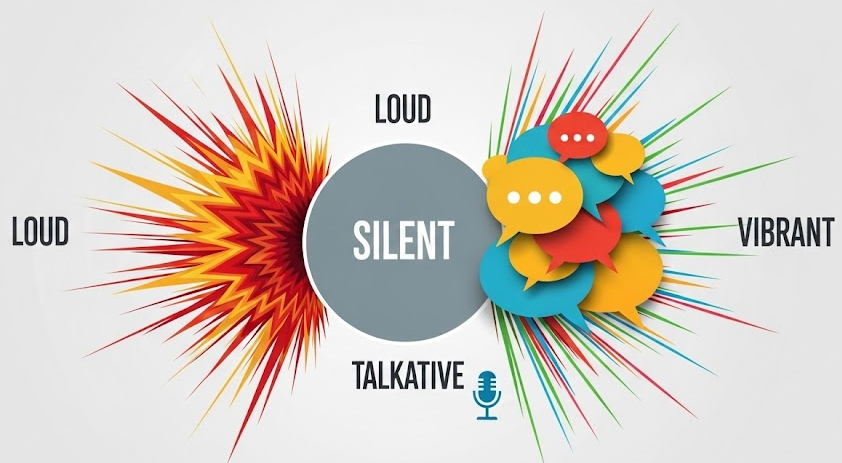
The antonyms of “silent” can be classified based on the aspect of silence they oppose. For example, if “silent” refers to the absence of sound, antonyms like “noisy,” “loud,” and “boisterous” are appropriate.
If “silent” refers to a lack of communication, antonyms like “vocal,” “communicative,” and “expressive” are more fitting. Context is crucial in determining the most appropriate antonym.
In essence, the function of antonyms for “silent” is to paint a contrasting picture. They allow us to describe situations, people, or environments that are characterized by sound, activity, or communication, rather than the quiet stillness implied by “silent.” This understanding is fundamental to precise and effective communication.
Structural Breakdown of Antonyms
Understanding the structure of antonyms can help in recognizing and using them correctly. Antonyms often belong to the same part of speech as the original word.
Since “silent” is primarily an adjective, its antonyms are also typically adjectives. However, depending on the context, nouns and verbs can also function as antonyms.
Many antonyms are formed by adding prefixes such as “un-,” “in-,” “im-,” “dis-,” or “non-” to a word. However, antonyms of “silent” don’t typically follow this pattern.
Instead, they are often entirely different words with distinct roots. This is because “silent” is a relatively simple word, and its antonyms often describe complex concepts related to sound, communication, and activity.
The formation of these antonyms involves a semantic shift, where the meaning fundamentally changes to represent the opposite concept. For instance, “silent” implies a lack of sound, while “noisy” implies the presence of sound.
This shift is not merely a negation but a complete reversal of the core meaning.
Types and Categories of Antonyms for ‘Silent’
The antonyms of “silent” can be grouped into several categories based on the aspect of silence they contradict. These categories include words related to sound, speech, communication, and activity.
Each category offers a different shade of meaning, allowing for precise expression.
Noisy
This category includes words that describe the presence of sound, often loud or disruptive. Words like “loud,” “boisterous,” “clamorous,” and “deafening” fall into this category.
These antonyms emphasize the auditory experience and the lack of quiet.
Vocal
This category focuses on the act of speaking or expressing oneself verbally. Antonyms like “talkative,” “loquacious,” “articulate,” and “outspoken” belong here.
These words highlight the use of voice and speech.
Communicative
This category emphasizes the exchange of information or ideas. Words like “expressive,” “forthcoming,” “responsive,” and “chatty” are included.
These antonyms stress the act of sharing and connecting with others.
Expressive
This category highlights the outward display of emotions or thoughts. Antonyms such as “demonstrative,” “effusive,” “vivid,” and “eloquent” fit this category.
These words emphasize the visible or audible manifestation of inner feelings.
Active
This category encompasses words that describe a state of busyness or engagement. Words like “lively,” “dynamic,” “vibrant,” and “bustling” are appropriate here.
These antonyms emphasize movement and energy.
Examples of Antonyms in Use
To illustrate the usage of these antonyms, let’s examine them in various contexts. The following tables provide examples of how each antonym can be used in sentences, showcasing their specific meanings and nuances.
The table below showcases antonyms of “silent” that emphasize the presence of sound. These words are useful when describing environments or situations filled with noise.
| Antonym | Example Sentence |
|---|---|
| Loud | The music was so loud that we couldn’t hear each other speak. |
| Noisy | The construction site was incredibly noisy, with drills and hammering echoing through the streets. |
| Boisterous | The children were boisterous and full of energy as they played in the park. |
| Clamorous | The crowd became clamorous, demanding the speaker’s attention. |
| Deafening | The explosion was deafening, leaving everyone temporarily disoriented. |
| Raucous | The bar was filled with raucous laughter and loud conversations. |
| Resonant | The opera singer’s resonant voice filled the concert hall. |
| Thunderous | A thunderous applause erupted after the performance. |
| Vociferous | The protesters were vociferous in their opposition to the new law. |
| Tumultuous | The market was tumultuous with vendors shouting and customers haggling. |
| Blaring | The car alarm was blaring, disturbing the peace of the neighborhood. |
| Roaring | The crowd gave a roaring cheer as the home team scored. |
| Piercing | A piercing scream echoed through the empty building. |
| Shrill | The whistle emitted a shrill sound, signaling the start of the game. |
| Stentorian | The drill sergeant had a stentorian voice that commanded attention. |
| Uproarious | The comedian’s jokes were met with uproarious laughter. |
| Rumbling | The rumbling of thunder warned of an approaching storm. |
| Clattering | The clattering of dishes in the kitchen indicated that dinner was being prepared. |
| Crashing | The crashing waves against the shore were mesmerizing. |
| Bellowing | The coach was bellowing instructions to the players on the field. |
| Ringing | The church bells were ringing, announcing the start of the service. |
| Buzzing | The room was buzzing with excitement as the winner was announced. |
| Screaming | The fans were screaming with delight as their favorite band took the stage. |
This table illustrates antonyms that emphasize verbal communication and speech. These words are useful when describing individuals or situations characterized by talking and expression.
| Antonym | Example Sentence |
|---|---|
| Talkative | She was a talkative person, always ready to strike up a conversation. |
| Loquacious | The loquacious professor could lecture for hours without notes. |
| Articulate | He was an articulate speaker, able to express his ideas clearly and persuasively. |
| Outspoken | She was an outspoken advocate for human rights. |
| Chatty | The chatty receptionist always had something to say to everyone who walked in. |
| Verbose | His verbose explanations often confused more than clarified. |
| Garrulous | The garrulous old man loved to tell stories about his youth. |
| Voluble | She was a voluble debater, easily countering her opponent’s arguments. |
| Communicative | Effective leaders are communicative, keeping their team informed and engaged. |
| Forthcoming | He was forthcoming with information, answering all our questions honestly. |
| Responsive | The customer service representative was responsive to our concerns. |
| Vocal | The community was vocal in its opposition to the proposed development. |
| Eloquent | The lawyer delivered an eloquent closing argument. |
| Blabbing | He was blabbing secrets he shouldn’t have revealed. |
| Gossiping | They were gossiping about their colleagues behind their backs. |
| Prattling | The child was prattling on about his day at school. |
| Chattering | The monkeys were chattering noisily in the trees. |
| Ranting | He was ranting about the government’s policies. |
| Raving | The critic was raving about the new play. |
| Speaking | He was speaking passionately about his beliefs. |
| Narrating | The author was narrating the story of his life. |
| Announcing | The president was announcing new measures to combat climate change. |
This table presents antonyms that describe the outward display of emotions and thoughts. These words are appropriate when describing individuals or situations marked by visible or audible expression.
| Antonym | Example Sentence |
|---|---|
| Expressive | Her expressive eyes conveyed a range of emotions. |
| Demonstrative | He was a demonstrative person, always showing his affection openly. |
| Effusive | She gave an effusive welcome to all the guests. |
| Vivid | His vivid descriptions brought the scene to life. |
| Animated | She became quite animated when discussing her favorite subject. |
| Passionate | He delivered a passionate speech about the importance of education. |
| Fervent | The fans showed their fervent support for the team. |
| Ardent | He was an ardent admirer of her work. |
| Emotional | She became emotional when talking about her family. |
| Exuberant | The children were exuberant with joy on Christmas morning. |
| Radiant | She looked radiant on her wedding day. |
| Gleaming | Her eyes were gleaming with excitement. |
| Vibrant | The painting was full of vibrant colors. |
| Lively | The party was lively with music and dancing. |
| Dynamic | The city was dynamic and full of energy. |
| Bustling | The market was bustling with activity. |
| Spirited | The team put up a spirited fight. |
| Vivacious | She was a vivacious and charming woman. |
| Energetic | The puppy was energetic and playful. |
| Zealous | He was a zealous advocate for animal rights. |
| Feisty | The feisty kitten refused to back down from the larger dog. |
| Audible | Her whisper was barely audible in the crowded room. |
| Resounding | The team’s victory was met with resounding cheers. |
Usage Rules and Considerations
When choosing an antonym for “silent,” consider the specific context and the aspect of silence you want to contrast. If you’re referring to the absence of sound, use antonyms like “loud” or “noisy.” If you’re referring to a lack of communication, use antonyms like “vocal” or “communicative.”
Pay attention to the connotations of each antonym. Some antonyms, like “boisterous,” can have negative connotations, implying excessive noise or disruption.
Others, like “eloquent,” have positive connotations, suggesting skillful and persuasive communication.
Consider the register of the language. Some antonyms, like “loquacious,” are more formal, while others, like “chatty,” are more informal.
Choose an antonym that is appropriate for the audience and the purpose of your communication.
Common Mistakes to Avoid
A common mistake is using an antonym that doesn’t accurately reflect the intended meaning. For example, using “active” when you really mean “noisy” can lead to confusion.
Always consider the specific aspect of silence you want to contrast.
Another mistake is using an antonym with inappropriate connotations. For example, describing a speaker as “garrulous” might be seen as impolite, as it implies excessive and rambling talkativeness.
Finally, be mindful of redundancy. Avoid using multiple antonyms that essentially mean the same thing.
For example, saying “The room was loud and noisy” is redundant, as both words convey a similar meaning.
Here are some examples of common mistakes and their corrections:
| Incorrect | Correct | Explanation |
|---|---|---|
| The library was very active. | The library was very noisy. | “Active” implies busyness, while “noisy” implies the presence of sound. |
| She was silent, but very expressive. | She was quiet, but very expressive. | While “silent” and “quiet” can be synonyms, “quiet” fits better when contrasting with “expressive” in terms of demeanor. |
| The meeting was silent and communicative. | The meeting was lively and communicative. | “Silent” and “communicative” are contradictory; “lively” better contrasts with a lack of activity. |
Practice Exercises
Test your understanding of the antonyms of “silent” with these exercises. Choose the best antonym for “silent” in each sentence.
Exercise 1: Choose the best antonym.
| Question | Options | Answer |
|---|---|---|
| The once silent classroom became ______ after the teacher left. | (a) quiet (b) noisy (c) still (d) hushed | (b) noisy |
| Instead of remaining silent, she became a ______ advocate for change. | (a) mute (b) quiet (c) vocal (d) reserved | (c) vocal |
| The usually silent office was ______ with chatter as everyone discussed the upcoming holiday. | (a) hushed (b) still (c) buzzing (d) quiet | (c) buzzing |
| Far from being silent, his performance was ______ and full of emotion. | (a) subdued (b) expressive (c) taciturn (d) reserved | (b) expressive |
| The silent factory floor became ______ with the machines starting up. | (a) tranquil (b) dormant (c) bustling (d) serene | (c) bustling |
| After years of being silent, she finally became ______ and shared her story. | (a) reserved (b) taciturn (c) forthcoming (d) quiet | (c) forthcoming |
| The silent night was shattered by a ______ explosion. | (a) hushed (b) deafening (c) muted (d) tranquil | (b) deafening |
| Instead of a silent retreat, the conference was ______ with discussions and debates. | (a) still (b) quiet (c) vibrant (d) hushed | (c) vibrant |
| The once silent streets became ______ after the victory. | (a) peaceful (b) quiet (c) uproarious (d) still | (c) uproarious |
| Instead of remaining silent, he gave a ______ speech that moved everyone. | (a) subdued (b) quiet (c) eloquent (d) taciturn | (c) eloquent |
Exercise 2: Fill in the blank with the most appropriate antonym of “silent”.
| Question | Answer |
|---|---|
| The forest was anything but silent; it was ______ with the sounds of birds and insects. | noisy |
| Instead of being silent, the politician was ______ about his plans for the city. | vocal |
| The dance was not a silent affair; it was a ______ celebration of life. | lively |
| The painting was far from silent; it was ______ with color and emotion. | expressive |
| Instead of a silent protest, they organized a ______ march through the city. | clamorous |
| The usually silent child became quite ______ when talking about his favorite toys. | talkative |
| The silent movie was replaced by a ______ film with dialogue and sound effects. | vocal |
| The atmosphere was not silent; it was ______ with anticipation. | charged |
| The team was not silent after the loss; they were ______ about their disappointment. | outspoken |
| The silent night was interrupted by the ______ barking of dogs. | loud |
Advanced Topics: Nuances and Connotations
At an advanced level, it’s crucial to understand the subtle nuances and connotations of each antonym. For instance, “vocal” can imply assertiveness or even aggression, while “communicative” suggests a more collaborative and open approach.
Similarly, “noisy” can be neutral or negative, while “boisterous” often carries a negative connotation of rowdiness.
Consider the context in which the antonym is used. The same word can have different meanings and connotations depending on the situation.
For example, “lively” can describe a vibrant party or a spirited debate, but it can also describe a restless child.
Explore the use of antonyms in figurative language, such as metaphors and similes. Antonyms can be used to create powerful contrasts and emphasize certain qualities.
For example, “Her silence was deafening” uses an antonym paradoxically to highlight the significance of her lack of speech.
Frequently Asked Questions
Here are some frequently asked questions about the antonyms of “silent.”
- What is the most common antonym of “silent”?The most common antonym is likely “noisy,” as it directly contrasts the absence of sound with the presence of sound. However, the best antonym depends on the specific context.
- Are there any situations where “silent” and its antonyms can be used interchangeably?While some antonyms may overlap in meaning, they are rarely interchangeable. Each antonym has its own specific connotation and usage. For example, “loud” and “noisy” both describe the presence of sound, but “loud” implies a higher volume or intensity.
- How can I improve my understanding of the nuances of these antonyms?Read widely and pay attention to how different antonyms are used in various contexts. Use a dictionary or thesaurus to explore the specific meanings and connotations of each word. Practice using the antonyms in your own writing and speaking.
- Can “silent” have positive connotations?Yes, “silent” can have positive connotations in certain contexts. For example, “silent contemplation” suggests a peaceful and reflective state. “Silent respect” implies a deep sense of reverence.
- What is the difference between “quiet” and “silent”?“Quiet” implies a low level of sound, while “silent” implies a complete absence of sound. “Quiet” is often used to describe a peaceful or tranquil environment, while “silent” can describe a more solemn or oppressive atmosphere.
- How do I choose the right antonym for “silent” in a given situation?Consider the specific aspect of silence you want to contrast. Are you referring to the absence of sound, speech, communication, or activity? Choose an antonym that accurately reflects the intended meaning and has appropriate connotations for the context.
- Are there any regional differences in the usage of these antonyms?While the core meanings of these antonyms are generally consistent across different regions, there may be subtle differences in their frequency or specific connotations. Pay attention to how native speakers use these words in your region.
- How can I avoid making mistakes when using antonyms of “silent”?Double-check the meaning and connotations of each antonym before using it. Consider the context and the intended audience. Ask a native speaker or language expert for feedback if you are unsure.
Conclusion
Mastering the antonyms of “silent” is a valuable step towards enhancing your English vocabulary and communication skills. By understanding the nuances of each antonym, you can express yourself more precisely and effectively.
Remember to consider the context, connotations, and register of language when choosing the most appropriate antonym.
Continue to practice using these antonyms in your writing and speaking. Read widely and pay attention to how native speakers use them.
With consistent effort, you will develop a deeper appreciation for the richness and versatility of the English language. Embrace the power of expression and unlock your full potential as a communicator.
By exploring the diverse range of antonyms for “silent,” you’ve equipped yourself with the tools to paint vivid and contrasting pictures through language. Keep practicing, keep exploring, and keep expanding your linguistic horizons.