Understanding antonyms is a crucial aspect of mastering English vocabulary. It allows for more nuanced communication, richer expression, and a deeper comprehension of the language.
In this article, we will explore the various antonyms of the word “useful,” delving into their meanings, contexts, and proper usage. By understanding these opposites, you can significantly enhance your vocabulary and improve your ability to articulate your thoughts effectively.
This guide is beneficial for English language learners, writers, and anyone looking to expand their linguistic skills.
Table of Contents
- Introduction
- Definition of “Useful” and Antonyms
- Structural Breakdown of Antonyms
- Types and Categories of Antonyms of “Useful”
- Examples of Antonyms in Sentences
- Usage Rules and Contexts
- Common Mistakes to Avoid
- Practice Exercises
- Advanced Topics: Nuances and Collocations
- Frequently Asked Questions
- Conclusion
Definition of “Useful” and Antonyms
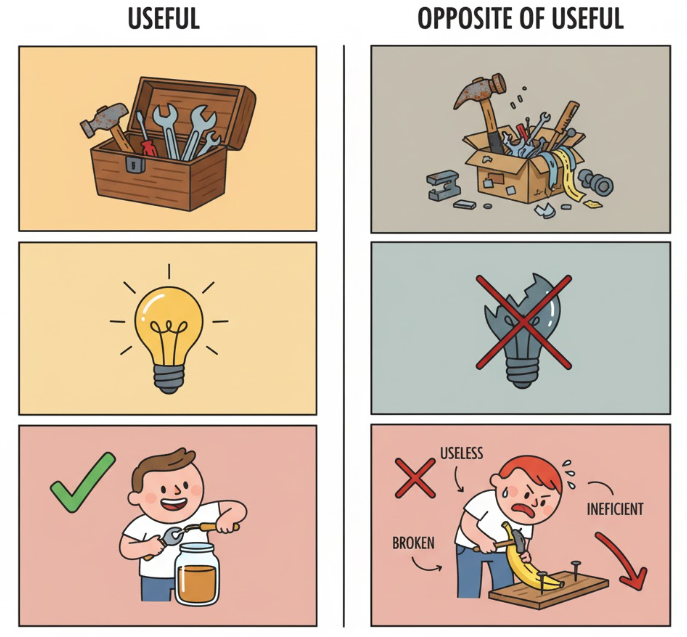
The word “useful” describes something that is capable of being used advantageously; helpful in accomplishing a purpose. It implies practicality, functionality, and the ability to provide assistance or benefit. Antonyms, on the other hand, are words that have opposite meanings.
Therefore, antonyms of “useful” describe things that are not helpful, practical, or beneficial. These words often convey a sense of ineffectiveness, worthlessness, or even harm.
Understanding these antonyms allows for a more precise and nuanced understanding of situations and objects.
Structural Breakdown of Antonyms
Antonyms can be formed in several ways, including:
- Prefixes: Adding prefixes like un-, in-, im-, dis- can negate the meaning of a word. For example, un-useful, in-effective.
- Root words with opposite meanings: Some words inherently carry opposite meanings. For example, “useful” and “worthless.”
- Contextual antonyms: Words that act as antonyms only in specific contexts. For example, “helpful” can be considered an antonym of “useful,” but in some contexts, “harmful” might be a more appropriate antonym.
Understanding these structural elements helps in recognizing and using antonyms effectively. The choice of antonym depends heavily on the specific shade of meaning you want to convey.
Types and Categories of Antonyms of “Useful”
The antonyms of “useful” can be categorized based on their specific nuances. Here are some key categories:
Useless
Useless means completely ineffective or serving no purpose. It signifies a total lack of utility.
Example: A broken tool is useless for repairing anything.
Worthless
Worthless implies having no value or importance. It often refers to items or efforts that are not worth the time or resources invested.
Example: The counterfeit money was worthless.
Ineffective
Ineffective means not producing the desired effect or result. It suggests a failure to achieve the intended outcome.
Example: The old medicine was ineffective against the new strain of the virus.
Futile
Futile describes something that is incapable of producing any useful result; pointless. It often implies a sense of hopelessness or despair.
Example: Trying to reason with him was futile.
Impractical
Impractical means not adapted for use or action; not sensible or realistic. It suggests that something is theoretically possible but not feasible in a real-world situation.
Example: Building a house out of cardboard is impractical.
Unhelpful
Unhelpful means not providing assistance or support. It implies a lack of aid or guidance.
Example: His criticism was unhelpful and negative.
Detrimental
Detrimental means causing harm or damage. It suggests a negative impact or adverse effect.
Example: Smoking is detrimental to your health.
Counterproductive
Counterproductive means having the opposite of the desired effect. It suggests that an action or effort actually hinders progress or makes a situation worse.
Example: Yelling at the employees was counterproductive and lowered morale.
Examples of Antonyms in Sentences
The following tables provide examples of how these antonyms are used in sentences, showcasing their different contexts and nuances. Each table focuses on a specific set of antonyms to illustrate their unique applications.
Table 1: Useless, Worthless, and Ineffective
This table shows how “useless,” “worthless,” and “ineffective” are used in various contexts to describe things that lack utility or fail to produce desired results.
| Antonym | Example Sentence |
|---|---|
| Useless | The broken computer was useless until it was repaired. |
| Useless | Trying to argue with him in that state is useless. |
| Useless | Without the proper tools, the attempt was useless. |
| Useless | The old map was useless because it was so outdated. |
| Useless | His advice was completely useless in solving the problem. |
| Worthless | The stock became worthless after the company’s bankruptcy. |
| Worthless | His promises were worthless; he never kept them. |
| Worthless | The stolen goods turned out to be worthless imitations. |
| Worthless | Spending time worrying about things you can’t control is worthless. |
| Worthless | The antique was so damaged it was considered worthless. |
| Ineffective | The new policy proved ineffective in reducing crime. |
| Ineffective | His attempts to mediate were ineffective. |
| Ineffective | The marketing campaign was ineffective and failed to attract new customers. |
| Ineffective | The security measures were ineffective against the sophisticated attack. |
| Ineffective | The pain medication was ineffective in providing relief. |
| Useless | Trying to start a fire with wet wood is completely useless. |
| Worthless | A diploma is worthless if you don’t apply the knowledge you’ve gained. |
| Ineffective | The government’s efforts to control inflation were ineffective. |
| Useless | Having a car is useless if you don’t know how to drive. |
| Worthless | Without context, data is often worthless. |
| Ineffective | The new software update was ineffective and caused more problems. |
| Useless | Trying to fix the problem without the right tools is useless. |
| Worthless | A promise is worthless if it’s not kept. |
| Ineffective | The new teaching method proved ineffective. |
Table 2: Futile and Impractical
This table illustrates the usage of “futile” and “impractical,” highlighting their connotations of pointlessness and lack of feasibility, respectively.
| Antonym | Example Sentence |
|---|---|
| Futile | It was futile to resist the inevitable. |
| Futile | Their efforts to save the company were ultimately futile. |
| Futile | Arguing with him when he’s angry is a futile exercise. |
| Futile | It’s futile to dwell on the past; focus on the future. |
| Futile | Trying to catch the wind is futile. |
| Impractical | His plan was impractical given the limited resources. |
| Impractical | Building a skyscraper in that location is impractical due to the unstable ground. |
| Impractical | Wearing high heels for a hiking trip is impractical. |
| Impractical | The proposed solution was theoretically sound but impractical to implement. |
| Impractical | Relying solely on solar power in a cloudy region is impractical. |
| Futile | Trying to stop the rain is a futile endeavor. |
| Impractical | Expecting everyone to agree on every issue is impractical. |
| Futile | It is futile to try and change someone who doesn’t want to change. |
| Impractical | Building a house without a solid foundation is impractical. |
| Futile | Reversing time is futile. |
| Impractical | Driving a race car on a public road is impractical. |
| Futile | Attempting to fix a broken heart with material things is futile. |
| Impractical | Planning a picnic in the middle of winter is impractical. |
| Futile | Trying to learn everything at once is futile. |
| Impractical | Expecting perfection is impractical. |
Table 3: Unhelpful, Detrimental, and Counterproductive
This table demonstrates the use of “unhelpful,” “detrimental,” and “counterproductive,” emphasizing their negative connotations of lacking support, causing harm, and hindering progress, respectively.
| Antonym | Example Sentence |
|---|---|
| Unhelpful | His comments were unhelpful and only made the situation worse. |
| Unhelpful | The customer service representative was unhelpful and did not address my concerns. |
| Unhelpful | Giving vague instructions can be unhelpful to new employees. |
| Unhelpful | Ignoring someone’s questions is unhelpful and rude. |
| Unhelpful | Providing criticism without offering solutions is often unhelpful. |
| Detrimental | Excessive stress is detrimental to your health. |
| Detrimental | The chemical spill was detrimental to the environment. |
| Detrimental | Negative feedback can be detrimental to a student’s confidence. |
| Detrimental | Lack of sleep is detrimental to cognitive function. |
| Detrimental | The company’s unethical practices were detrimental to its reputation. |
| Counterproductive | Micromanaging employees can be counterproductive and stifle creativity. |
| Counterproductive | Punishing mistakes without understanding their cause is counterproductive. |
| Counterproductive | Working without taking breaks can be counterproductive and lead to burnout. |
| Counterproductive | Ignoring customer feedback is counterproductive for business growth. |
| Counterproductive | Trying to force a solution without proper planning is counterproductive. |
| Unhelpful | Being sarcastic is unhelpful in a serious conversation. |
| Detrimental | Social isolation can be detrimental to mental well-being. |
| Counterproductive | Arguing with someone who is unwilling to listen is counterproductive. |
| Unhelpful | Refusing to offer assistance is unhelpful. |
| Detrimental | Overeating is detrimental to your health. |
| Counterproductive | Threatening employees is counterproductive. |
| Unhelpful | Giving unsolicited advice is often unhelpful. |
| Detrimental | Pollution is detrimental to the air quality. |
| Counterproductive | Procrastination is counterproductive. |
Usage Rules and Contexts
The correct usage of these antonyms depends heavily on the context. Here are some general guidelines:
- Useless is used when something has no purpose or function whatsoever.
- Worthless is used when something has no value, either monetary or intrinsic.
- Ineffective is used when something fails to produce the desired result.
- Futile is used when an effort is pointless and incapable of producing any useful outcome.
- Impractical is used when something is not suitable for real-world application.
- Unhelpful is used when something does not provide assistance or support.
- Detrimental is used when something causes harm or damage.
- Counterproductive is used when something hinders progress or makes a situation worse.
Choosing the right antonym requires careful consideration of the specific situation and the intended meaning. For example, you might say that a broken tool is “useless,” but a poorly designed tool might be “ineffective” or “impractical.”
Common Mistakes to Avoid
Here are some common mistakes to avoid when using antonyms of “useful”:
- Using “useless” when “ineffective” is more appropriate: “The medicine was useless” (incorrect) vs. “The medicine was ineffective in treating the disease” (correct).
- Confusing “worthless” with “useless”: “The broken vase was useless” (correct) vs. “The broken vase was worthless” (also correct, but emphasizes its lack of monetary value).
- Misusing “futile” in place of “impractical”: “Building a sandcastle during high tide is futile” (correct) vs. “Building a house with only straws is impractical” (correct).
- Using “unhelpful” when a stronger word like “detrimental” is needed: “His advice was unhelpful” (correct, but weak) vs. “His advice was detrimental to the project” (stronger and more accurate).
Pay attention to the specific connotations of each word to ensure accurate and effective communication. Understanding the subtle differences between these words is key to avoiding these common errors.
Practice Exercises
Test your understanding of the antonyms of “useful” with these exercises.
Exercise 1: Choose the best antonym for “useful” in each sentence.
| Question | Options | Answer |
|---|---|---|
| 1. The old map was _________ because it was outdated. | a) ineffective b) useless c) detrimental d) impractical | b) useless |
| 2. His advice was _________ and made the situation worse. | a) worthless b) unhelpful c) futile d) impractical | b) unhelpful |
| 3. Trying to argue with him when he’s angry is a _________ exercise. | a) ineffective b) worthless c) futile d) detrimental | c) futile |
| 4. The company’s unethical practices were _________ to its reputation. | a) useless b) unhelpful c) detrimental d) impractical | c) detrimental |
| 5. Micromanaging employees can be _________ and stifle creativity. | a) worthless b) unhelpful c) futile d) counterproductive | d) counterproductive |
| 6. The new policy proved _________ in reducing crime. | a) useless b) ineffective c) detrimental d) impractical | b) ineffective |
| 7. His plan was _________ given the limited resources. | a) worthless b) unhelpful c) futile d) impractical | d) impractical |
| 8. The counterfeit money was _________. | a) useless b) unhelpful c) detrimental d) worthless | d) worthless |
| 9. The broken machine was _________ until it was repaired. | a) useless b) unhelpful c) detrimental d) worthless | a) useless |
| 10. Building a sandcastle during a hurricane is _________. | a) useless b) unhelpful c) futile d) worthless | c) futile |
Exercise 2: Fill in the blank with the most appropriate antonym of “useful.”
| Question | Answer |
|---|---|
| 1. The old tool was completely _________ for the task. | useless |
| 2. His attempt at mediation was _________ and only made things worse. | ineffective |
| 3. Trying to reason with someone who is unwilling to listen is _________. | futile |
| 4. The company’s cost-cutting measures proved to be _________, leading to decreased productivity. | counterproductive |
| 5. The abandoned building was _________ and posed a safety hazard. | worthless |
| 6. His comments were _________ and did not provide any constructive feedback. | unhelpful |
| 7. Smoking is known to be _________ to your health. | detrimental |
| 8. Expecting immediate results in a complex project is often _________. | impractical |
| 9. Trying to fix the problem without the right tools is _________. | useless |
| 10. The politician’s empty promises were _________. | worthless |
Advanced Topics: Nuances and Collocations
For advanced learners, understanding the nuances and collocations of these antonyms is crucial. Here are some points to consider:
- Formal vs. Informal Usage: Some antonyms, like “detrimental,” are more formal than others, like “unhelpful.”
- Collocations: Certain antonyms frequently occur with specific words. For example, “futile attempt,” “detrimental effect,” “counterproductive measure.”
- Figurative Language: Antonyms can be used in figurative language to create emphasis or irony. For example, “His advice was about as useful as a screen door on a submarine.”
By paying attention to these advanced aspects, you can further refine your understanding and use of these words.
Frequently Asked Questions
Here are some frequently asked questions about the antonyms of “useful”:
- What is the difference between “useless” and “worthless”?Useless means that something has no practical purpose or function. Worthless means that something has no value, either monetary or intrinsic. A broken tool is useless because it cannot perform its intended function. A counterfeit coin is worthless because it has no real monetary value.
- When should I use “ineffective” instead of “useless”?Use ineffective when something is intended to produce a specific result but fails to do so. Use useless when something has no purpose or function at all. A medicine that doesn’t cure a disease is ineffective. A broken machine that cannot be repaired is useless.
- How does “futile” differ from “impractical”?Futile implies that an effort is pointless and incapable of producing any useful outcome, often due to overwhelming odds or inherent impossibility. Impractical means that something is not suitable for real-world application, often due to logistical or resource constraints. Trying to stop a hurricane is futile. Building a house out of paper is impractical.
- What is the connotation of “detrimental”?Detrimental has a strong negative connotation, implying that something causes harm or damage. It is often used in formal contexts to describe serious adverse effects. Smoking is detrimental to your health. Pollution is detrimental to the environment.
- In what situations is “counterproductive” the most appropriate antonym?Use counterproductive when an action or effort has the opposite of the intended effect, hindering progress or making a situation worse. Micromanaging employees is often counterproductive. Punishing mistakes without understanding their cause is counterproductive.
- Can “helpful” be considered an antonym of “useful”?Yes, “helpful” can be considered an antonym of “useful,” especially in contexts where you want to emphasize the act of providing assistance. However, it’s a weaker antonym than words like “useless” or “detrimental,” which convey a stronger sense of opposition. “Useful” implies a general capability of being used advantageously, while “helpful” specifically refers to providing aid or support.
- How can I improve my understanding of these antonyms?Read widely and pay attention to how these words are used in different contexts. Practice using them in your own writing and speaking. Use a dictionary or thesaurus to explore the nuances of each word. Consider keeping a vocabulary journal to record new words and their antonyms, along with example sentences.
- Are there any other words that could be considered antonyms of “useful”?Yes, depending on the context, other words like “disadvantageous,” “inconvenient,” “cumbersome,” or “burdensome” could also function as antonyms of “useful.” The best choice depends on the specific shade of meaning you want to convey.
Conclusion
Mastering the antonyms of “useful” is essential for building a robust vocabulary and communicating effectively. By understanding the subtle differences between words like “useless,” “worthless,” “ineffective,” “futile,” “impractical,” “unhelpful,” “detrimental,” and “counterproductive,” you can express yourself with greater precision and nuance.
Remember to consider the context and intended meaning when choosing the right antonym. Continued practice and attention to detail will help you avoid common mistakes and use these words confidently and accurately.
Continue to expand your vocabulary by exploring other antonyms and synonyms. Pay attention to how words are used in different contexts, and don’t be afraid to experiment with language.
The more you practice, the more fluent and articulate you will become. Happy learning!