Ensuring something is done correctly is a crucial aspect of communication, whether in professional settings, academic writing, or everyday conversation. While “make sure” is a common phrase, relying on it exclusively can limit the richness and nuance of your English.
This article explores a variety of alternative expressions, each with its own subtle implications and appropriate contexts. By mastering these alternatives, you can communicate more effectively, add depth to your writing, and avoid sounding repetitive.
This guide is designed for English language learners of all levels, from beginners looking to expand their vocabulary to advanced speakers aiming to refine their expressive capabilities.
This comprehensive guide provides detailed explanations, numerous examples, and practical exercises to help you confidently use these alternatives in your daily interactions. By the end of this article, you will be equipped with a wide range of expressions to convey certainty and assurance in your communication, making your English more versatile and impactful.
Table of Contents
- Definition: Understanding the Concept of Ensuring
- Structural Breakdown: Key Elements of Expressing Certainty
- Types and Categories of Alternative Expressions
- Examples: Practical Applications of Each Expression
- Usage Rules: Guidelines for Proper Application
- Common Mistakes: Avoiding Pitfalls
- Practice Exercises: Testing Your Knowledge
- Advanced Topics: Nuances and Subtleties
- FAQ: Frequently Asked Questions
- Conclusion: Mastering Expressing Certainty
Definition: Understanding the Concept of Ensuring
Ensuring, at its core, means making certain that something will happen or is the case. It involves taking actions or precautions to guarantee a desired outcome.
The act of ensuring carries a sense of responsibility and often implies a proactive approach to prevent potential problems or failures. The concept of ensuring is essential in various contexts, from personal tasks to professional responsibilities, highlighting its significance in effective communication and planning.
The function of expressions that replace “make sure” is to convey a similar meaning of guaranteeing or verifying. However, they often differ in formality, intensity, and the specific context in which they are used.
Understanding these nuances allows for more precise and effective communication. For example, “verify” is more formal than “see to it,” and “guarantee” implies a stronger level of assurance than “check.”
Structural Breakdown: Key Elements of Expressing Certainty
The structure of sentences expressing certainty typically involves a subject, a verb (or verb phrase), and an object or complement. The verb phrase is often the key element that determines the specific meaning and nuance of the expression.
For instance, imperative forms directly instruct someone to take action, while modal verbs express the degree of certainty or obligation.
Understanding the grammatical structures associated with different expressions is crucial for using them correctly. For example, some expressions require a following “that” clause, while others are followed by an infinitive or a gerund.
Paying attention to these structural details ensures that your sentences are grammatically sound and convey your intended meaning accurately.
Types and Categories of Alternative Expressions
Imperative Forms
Imperative forms are direct commands or instructions. They are often used to tell someone to do something directly, leaving no room for ambiguity.
These forms are typically concise and to the point, making them effective for conveying a sense of urgency or importance.
Examples include: “See to it that the report is finished by Friday,” “Ensure the doors are locked before you leave,” and “Verify all the data before submitting the form.” These commands directly instruct the listener to take specific actions to guarantee a desired outcome.
Modal Verbs
Modal verbs, such as *must*, *should*, *will*, and *have to*, express varying degrees of certainty, obligation, or necessity. They are used to indicate the likelihood of something happening or the importance of taking a particular action.
The choice of modal verb depends on the level of certainty you want to convey.
For instance, “You must submit your application by the deadline” conveys a strong obligation, while “You should check the weather before going hiking” suggests a recommendation. “We will ensure that your data is protected” expresses a firm commitment to guaranteeing data security.
“You have to remember to bring your passport” implies a necessity that cannot be ignored.
Phrasal Verbs
Phrasal verbs combine a verb with a preposition or adverb to create a new meaning. Several phrasal verbs can be used as alternatives to “make sure,” each with its own subtle nuance.
Understanding these nuances allows for more precise communication.
Examples include: “Look into” (investigate), “See about” (arrange), and “Follow up on” (check progress). “I’ll look into getting the tickets” suggests investigating the possibility.
“Can you see about booking a room?” implies arranging the details. “Please follow up on the client’s request” indicates checking on the progress of the request.
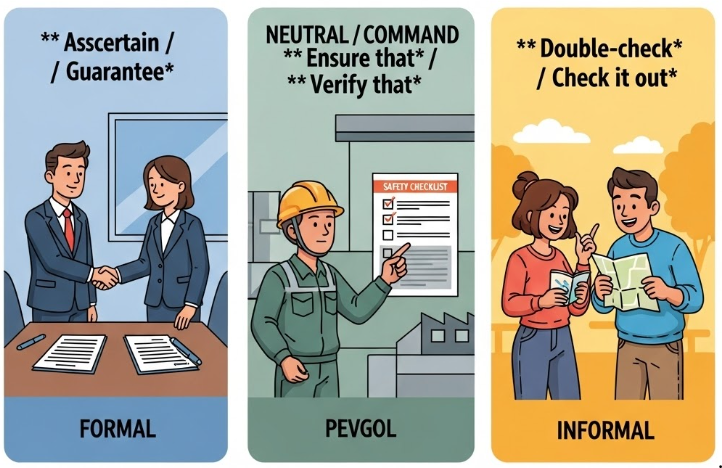
Formal Expressions
Formal expressions are suitable for professional or academic settings where a high level of politeness and precision is required. These expressions often involve more complex vocabulary and sentence structures, conveying a sense of authority and seriousness.
Examples include: “Ascertain” (discover with certainty), “Guarantee” (provide a formal assurance), and “Certify” (officially confirm). “We must ascertain the facts before proceeding” emphasizes the need for certainty.
“The company guarantees the quality of its products” provides a formal assurance. “I can certify that the document is authentic” confirms the document’s validity.
Informal Expressions
Informal expressions are appropriate for casual conversations with friends, family, or close colleagues. These expressions are often more relaxed and conversational, using simpler vocabulary and sentence structures.
Examples include: “Check it out” (investigate), “See if” (verify), and “Double-check” (verify again). “Check it out to see if the coast is clear” suggests investigating a situation.
“See if you can find my keys” implies verifying their location. “Double-check that you locked the door” emphasizes the importance of re-verifying.
Examples: Practical Applications of Each Expression
The following tables provide extensive examples of various ways to say “make sure,” categorized by their type and usage. Each example is designed to illustrate the specific context in which the expression is appropriate and how it can be used effectively.
Table 1: Imperative Forms
This table showcases imperative forms that can be used to replace “make sure” in various situations. Imperative sentences are direct commands, and the following examples emphasize the action that needs to be taken.
| Expression | Example Sentence | Context |
|---|---|---|
| See to it that… | See to it that all the windows are closed before you leave. | Ensuring building security |
| Ensure that… | Ensure that all data is backed up regularly. | Data management protocol |
| Verify that… | Verify that the payment has been processed. | Financial transaction confirmation |
| Confirm that… | Confirm that you have received the documents. | Document receipt acknowledgement |
| Guarantee that… | Guarantee that the product will arrive on time. | Customer service promise |
| Ascertain that… | Ascertain that all team members understand the new policy. | Policy implementation |
| Check that… | Check that the oven is turned off. | Household safety |
| Remember to… | Remember to take your medication. | Health reminder |
| Don’t forget to… | Don’t forget to submit your report by Friday. | Deadline reminder |
| Be sure to… | Be sure to lock the door when you leave. | Security measure |
| Make certain that… | Make certain that you have all the necessary equipment. | Preparation for an event |
| Assure that… | Assure that the package is delivered safely. | Logistics guarantee |
| Look to it that… | Look to it that the project stays on schedule. | Project management |
| Take care to… | Take care to handle the fragile items carefully. | Handling delicate items |
| Mind that… | Mind that you don’t leave any valuables in the car. | Preventing theft |
| Watch that… | Watch that you don’t spill the paint. | Avoiding accidents |
| Prioritize… | Prioritize checking the emergency exits. | Safety protocol |
| Supervise… | Supervise the loading of the truck carefully. | Logistics oversight |
| Oversee… | Oversee the entire process from start to finish. | Project management |
| Inspect… | Inspect the equipment before each use. | Safety inspection |
| Double-check… | Double-check that all the lights are off. | Energy conservation |
| Audit… | Audit the financial records quarterly. | Financial oversight |
| Monitor… | Monitor the system for any unusual activity. | Security monitoring |
| Scrutinize… | Scrutinize all applications carefully. | Selection process |
| Control… | Control the temperature in the server room. | Environmental regulation |
Table 2: Modal Verbs
This table provides examples of how modal verbs can be used to express certainty, obligation, or necessity. Modal verbs add a layer of nuance to the expression of ensuring, indicating the strength of the requirement.
| Expression | Example Sentence | Context |
|---|---|---|
| You must ensure that… | You must ensure that all safety regulations are followed. | Workplace safety |
| You should verify that… | You should verify that the information is accurate. | Information accuracy |
| You have to confirm that… | You have to confirm that you understand the instructions. | Instruction comprehension |
| We will guarantee that… | We will guarantee that your order will be delivered within 24 hours. | Delivery promise |
| They need to check that… | They need to check that the equipment is in good working order. | Equipment maintenance |
| You ought to ascertain that… | You ought to ascertain that all participants are aware of the risks. | Risk management |
| It is essential to verify… | It is essential to verify the source of the information. | Information credibility |
| It is important to confirm… | It is important to confirm the reservation in advance. | Reservation confirmation |
| We are required to ensure… | We are required to ensure compliance with all applicable laws. | Legal compliance |
| It is mandatory to check… | It is mandatory to check the expiration dates of all products. | Quality control |
| You are advised to verify… | You are advised to verify the details before proceeding. | Due diligence |
| We are obligated to guarantee… | We are obligated to guarantee the confidentiality of your data. | Data privacy |
| It is critical to confirm… | It is critical to confirm the identity of the user. | Security protocol |
| You are expected to ensure… | You are expected to ensure the smooth operation of the system. | System maintenance |
| We are committed to guaranteeing… | We are committed to guaranteeing customer satisfaction. | Customer service |
| It is vital that you check… | It is vital that you check the weather forecast before hiking. | Safety precaution |
| You are responsible for ensuring… | You are responsible for ensuring that all tasks are completed on time. | Task management |
| We are accountable for guaranteeing… | We are accountable for guaranteeing the safety of our employees. | Employee safety |
| It is your duty to verify… | It is your duty to verify the accuracy of the report. | Report accuracy |
| It is imperative that you confirm… | It is imperative that you confirm your attendance. | Event planning |
| You are authorized to ensure… | You are authorized to ensure that the regulations are followed. | Regulatory compliance |
| You are permitted to check… | You are permitted to check the inventory levels. | Inventory management |
| You are entitled to verify… | You are entitled to verify the accuracy of your bill. | Customer rights |
| You are empowered to guarantee… | You are empowered to guarantee the resolution of the issue. | Problem resolution |
| You are expected to confirm… | You are expected to confirm your understanding of the contract. | Contract agreement |
Table 3: Phrasal Verbs
This table illustrates the use of phrasal verbs as substitutes for “make sure.” Phrasal verbs add a conversational tone and often imply a specific action or investigation.
| Expression | Example Sentence | Context |
|---|---|---|
| Look into… | I’ll look into whether we have enough stock. | Inventory management |
| See about… | Can you see about getting the paperwork ready? | Document preparation |
| Follow up on… | Please follow up on the client’s request. | Customer service |
| Check up on… | I need to check up on the progress of the project. | Project management |
| See to… | Please see to the arrangements for the meeting. | Meeting organization |
| Go over… | Go over the details one more time to ensure everything is correct. | Detail review |
| Run through… | Let’s run through the checklist before we start. | Checklist verification |
| Sort out… | Can you sort out the logistics for the event? | Event planning |
| Get around to… | I’ll get around to checking the system logs later. | System monitoring |
| Take care of… | Please take care of the details of the contract. | Contract management |
| Look out for… | Look out for any potential errors in the report. | Error detection |
| Keep an eye on… | Keep an eye on the security cameras. | Security monitoring |
| Make certain of… | Make certain of the delivery date before promising it to the customer. | Delivery confirmation |
| Get to the bottom of… | We need to get to the bottom of this issue. | Problem resolution |
| Get a hold of… | Get a hold of the necessary documents. | Document acquisition |
| Iron out… | Iron out the details before the meeting. | Preparation |
| Look through… | Look through the report to catch any errors. | Review |
| Go through… | Go through the contract carefully. | Contract review |
| Take stock of… | Take stock of the situation. | Situation assessment |
| Pin down… | Pin down the details of the agreement. | Clarification |
| Zero in on… | Zero in on the cause of the error. | Problem solving |
| Get on top of… | Get on top of your tasks. | Task management |
| Put your finger on… | Put your finger on the problem. | Problem identification |
| Weigh up… | Weigh up the options. | Decision making |
| Wrap up… | Wrap up the details quickly. | Efficiency |
Usage Rules: Guidelines for Proper Application
The correct usage of these alternative expressions depends on the context, formality, and the specific nuance you want to convey. Imperative forms are direct and suitable for situations where you have authority or when giving clear instructions.
Modal verbs add a layer of obligation or certainty, while phrasal verbs provide a more conversational tone.
Formal expressions are appropriate for professional settings, while informal expressions are better suited for casual conversations. When choosing an alternative, consider your audience and the overall tone of the communication.
For instance, using “ascertain” in a casual conversation might sound overly formal, while using “check it out” in a formal presentation could be perceived as unprofessional.
Common Mistakes: Avoiding Pitfalls
One common mistake is using formal expressions in informal contexts or vice versa. This can lead to miscommunication or create an awkward tone.
Another common error is using the wrong preposition with phrasal verbs, which can change the meaning of the expression. For example, saying “look up the problem” instead of “look into the problem” alters the intended meaning.
It’s also important to pay attention to the grammatical structure of each expression. Some expressions require a “that” clause, while others are followed by an infinitive or a gerund.
Using the wrong structure can result in grammatically incorrect sentences. Here are some examples:
- Incorrect: Ensure to lock the door.
- Correct: Ensure that you lock the door.
- Incorrect: See to it the report is finished.
- Correct: See to it that the report is finished.
Practice Exercises: Testing Your Knowledge
The following exercises will help you practice using alternative expressions for “make sure.” Choose the most appropriate expression from the provided options to complete each sentence.
Exercise 1: Fill in the Blanks
Choose the best option from the list to complete each sentence. Options: *Ensure, Verify, See to it, Check, Confirm*
| Question | Answer |
|---|---|
| 1. Please ________ that all the lights are turned off before leaving. | Ensure |
| 2. ________ the details of the contract before signing. | Verify |
| 3. ________ that the guests are comfortable upon arrival. | See to it |
| 4. ________ the weather forecast before planning the trip. | Check |
| 5. ________ your attendance at the meeting by replying to this email. | Confirm |
| 6. ________ that all team members understand the new policy. | Ensure |
| 7. ________ the payment has been processed successfully. | Verify |
| 8. ________ that all safety protocols are followed. | See to it |
| 9. ________ the expiration dates of all products. | Check |
| 10. ________ your reservation details before the trip. | Confirm |
Exercise 2: Sentence Transformation
Rewrite the following sentences using an alternative expression for “make sure.”
| Original Sentence | Rewritten Sentence |
|---|---|
| 1. Make sure you submit your report on time. | Ensure that you submit your report on time. |
| 2. Make sure the door is locked before you leave. | See to it that the door is locked before you leave. |
| 3. Make sure you check the weather forecast. | Verify the weather forecast. |
| 4. Make sure you confirm your attendance. | Confirm your attendance. |
| 5. Make sure all the documents are signed. | Ensure that all the documents are signed. |
| 6. Make sure to review the contract carefully. | Ascertain that you have reviewed the contract carefully. |
| 7. Make sure you follow up on the client’s request. | Follow up on the client’s request. |
| 8. Make sure you look into the possibility of extending the deadline. | Look into the possibility of extending the deadline. |
| 9. Make sure to check up on the progress of the project. | Check up on the progress of the project. |
| 10. Make sure to take care of the details of the contract. | Take care of the details of the contract. |
Advanced Topics: Nuances and Subtleties
At an advanced level, understanding the subtle differences between these expressions becomes crucial. For instance, “ascertain” implies a thorough investigation to establish certainty, while “verify” suggests a simpler confirmation of existing information.
“Guarantee” carries a strong legal or contractual implication, while “ensure” is more general.
Furthermore, mastering the use of these expressions in different tenses and moods can add depth to your communication. For example, using the subjunctive mood can convey a sense of uncertainty or hypothetical situations.
Understanding these advanced nuances allows you to express yourself with greater precision and sophistication.
FAQ: Frequently Asked Questions
- What is the difference between “ensure” and “assure”?“Ensure” means to make certain that something will happen, while “assure” means to tell someone confidently that something is true, especially to remove doubt. “Ensure” focuses on the outcome, while “assure” focuses on the person receiving the information.
- When should I use formal expressions instead of informal ones?Use formal expressions in professional or academic settings where a high level of politeness and precision is required. Informal expressions are appropriate for casual conversations with friends, family, or close colleagues.
- How can I avoid sounding repetitive when using these expressions?Vary your vocabulary by using different expressions in different contexts. Pay attention to the subtle nuances of each expression and choose the one that best fits the specific situation. Instead of always saying “make sure,” alternate with “ensure,” “verify,” “confirm,” and other alternatives.
- What is the correct grammatical structure to use with “ensure”?“Ensure” is typically followed by a “that” clause (e.g., Ensure that you lock the door) or an infinitive (e.g., Ensure to lock the door – less common but grammatically correct). However, the “that” clause structure is generally preferred for clarity and formality.
- Is it always necessary to use “that” after these expressions?While using “that” after expressions like “ensure,” “verify,” and “confirm” is grammatically correct and often preferred for clarity, it is not always strictly necessary, especially in informal contexts. However, including “that” generally makes the sentence more formal and precise.
- How do I know which phrasal verb is most appropriate in a given situation?The best way to choose the right phrasal verb is to understand the specific nuance of each one. “Look into” implies investigation, “see about” suggests arrangement, and “follow up on” indicates checking progress. Consider the specific action you want to convey and choose the phrasal verb that best fits.
- Can I use these expressions in questions?Yes, these expressions can be used in questions. For example, “Can you ensure that the package arrives on time?” or “Did you verify the information before submitting it?” The structure of the question will depend on the specific expression and the context.
- What are some common synonyms for “guarantee” in a formal context?Some common synonyms for “guarantee” in a formal context include “certify,” “warrant,” “assure,” and “attest.” These words convey a strong level of assurance and are often used in legal or contractual settings.
Conclusion: Mastering Expressing Certainty
Mastering alternative expressions for “make sure” is a valuable skill for any English language learner. By expanding your vocabulary and understanding the nuances of each expression, you can communicate more effectively, add depth to your writing, and avoid sounding repetitive.
This article has provided a comprehensive guide to various alternatives, including imperative forms, modal verbs, phrasal verbs, and formal/informal expressions.
Remember to consider the context, formality, and your audience when choosing an alternative. Practice using these expressions in your daily interactions to improve your fluency and confidence.
With consistent effort, you can master the art of expressing certainty in English and enhance your overall communication skills. The key takeaways are to practice regularly, understand the nuances, and tailor your choice to the specific situation.
By doing so, you’ll enrich your language skills and be able to convey your intended meaning with precision.