
The word “mother” is deeply ingrained in our vocabulary, representing the fundamental figure of care, nurture, and guidance in our lives. However, the English language is rich with diverse ways to express this essential relationship.
Exploring these alternatives not only enhances our linguistic versatility but also allows us to convey nuances of affection, respect, and familiarity. This article delves into a comprehensive range of synonyms, nicknames, and formal titles for “mother,” providing context, examples, and practical exercises to broaden your vocabulary and deepen your understanding of this important aspect of language.
Whether you’re an English language learner or a native speaker looking to enrich your communication, this guide offers valuable insights into the multifaceted ways we refer to the woman who raised us.
Table of Contents
- Definition of “Mother”
- Structural Breakdown
- Types of Terms for “Mother”
- Examples of Alternative Terms
- Usage Rules for Alternative Terms
- Common Mistakes
- Practice Exercises
- Advanced Topics
- FAQ
- Conclusion
Definition of “Mother”
The word “mother” is a noun that refers to a female parent. It is one of the most fundamental and universally recognized words in the English language and across cultures.
A mother is typically the woman who carries and gives birth to a child, although the term can also refer to a woman who raises a child, regardless of biological relation. The term carries significant emotional and social weight, often associated with love, care, protection, and guidance.
In a broader context, “mother” can also be used metaphorically to describe something that provides care, support, or origin. For example, “Necessity is the mother of invention.” This metaphorical use extends the core meaning of nurturance and creation to other domains.
Structural Breakdown
The word “mother” is structurally simple, consisting of two syllables. It is a common noun, meaning it refers to a general category rather than a specific individual.
The word’s structure hasn’t changed significantly over time, reflecting its essential and enduring nature.
The etymology of “mother” traces back to Proto-Indo-European roots, highlighting its ancient origins and shared ancestry with similar words in many other languages. This shared linguistic heritage underscores the universal importance of the maternal role.
Types of Terms for “Mother”
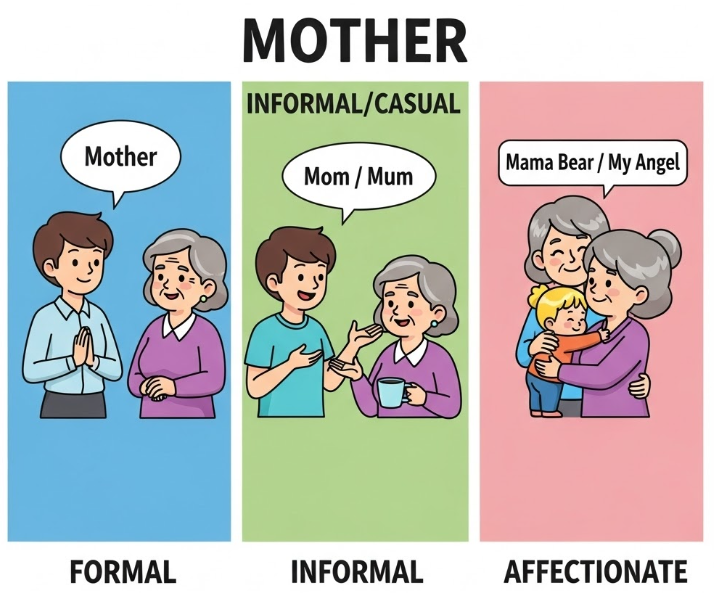
The English language offers a diverse range of terms for “mother,” varying in formality, affection, and regional usage. Understanding these nuances allows for more precise and meaningful communication.
Formal Terms
Formal terms are typically used in official settings, when addressing someone with respect, or when the relationship is not particularly close. These terms often convey a sense of distance or formality.
Examples include:
- Mother
- Madam (in very formal, old-fashioned contexts)
Informal Terms
Informal terms are used in casual settings, among family and close friends. They often reflect a comfortable and familiar relationship.
Examples include:
- Mom
- Mommy
- Ma
- Mum (British English)
- Mummy (British English)
Affectionate Terms
Affectionate terms are used to express love, warmth, and endearment. These terms are often personalized and unique to the individual relationship.
Examples include:
- Mama
- Momma
- Mother Dear
- My Dear Mother
- Sweet Mother
Regional Terms
Regional terms vary depending on geographic location and cultural background. These terms reflect local dialects and customs.
Examples include:
- Mam (Welsh English)
- Mater (Latin-derived, less common in everyday speech)
Terms Based on Relationship
These terms describe a mother figure in relation to other family members. These can include terms for grandmothers, stepmothers, and mothers-in-law.
Examples include:
- Grandmother
- Grandma
- Stepmother
- Mother-in-law
Examples of Alternative Terms
This section provides a comprehensive collection of examples, categorized to illustrate the diverse ways to refer to “mother” in different contexts.
Formal Terms Examples
The following table provides examples of formal terms used to address or refer to a mother, along with example sentences that illustrate their usage.
| Term | Example Sentence |
|---|---|
| Mother | “Mother requests that you attend the family dinner.” |
| Madam | “Madam, your presence is requested at the board meeting.” (Very formal, outdated) |
| Respected Mother | “We offer this award to our respected mother for her years of dedication.” |
| The Mother of | “She is known as the mother of modern physics.” |
| Our Mother | “We thank our mother for her unwavering support.” |
| Biological Mother | “She located her biological mother through a DNA ancestry test.” |
| Birth Mother | “The birth mother made the difficult decision to place her child for adoption.” |
| Foster Mother | “The foster mother provided a safe and nurturing environment for the child.” |
| Adoptive Mother | “The adoptive mother loved her child as if he were her own.” |
| Maternal Figure | “She served as a maternal figure in his life after his mother passed away.” |
| Female Parent | “The study focused on the experiences of female parents.” |
| Parent | “Each parent is responsible for their child’s education.” |
| Legal Guardian | “As her legal guardian, she made all the important decisions for the child.” |
| Primary Caregiver | “The mother was the primary caregiver for her children.” |
| Head of the Household | “The mother was the head of the household and managed all the finances.” |
| Matriarch | “The matriarch of the family was respected by all.” |
| Elder | “The elder of the family shared her wisdom with the younger generation.” |
| The Woman Who Raised Me | “I owe everything to the woman who raised me.” |
| Female Role Model | “She has always been a strong female role model for her daughter.” |
| The Lady of the House | “The lady of the house greeted the guests with a warm smile.” |
Informal Terms Examples
The following table provides examples of informal terms used to address or refer to a mother, along with example sentences that illustrate their usage.
| Term | Example Sentence |
|---|---|
| Mom | “Mom, can you help me with my homework?” |
| Mommy | “Mommy, I love you!” |
| Ma | “Ma, where are my keys?” |
| Mum (British English) | “Mum, can I go out with my friends?” |
| Mummy (British English) | “Mummy, read me a story!” |
| Mama | “Mama always knows best.” |
| Momma | “Momma’s cooking is the best.” |
| Mumsy (informal, affectionate) | “Thanks, Mumsy, for always being there for me.” |
| Old Mum (informal, affectionate) | “Love you, old Mum!” |
| My Mum | “My Mum makes the best Sunday roast.” |
| My Mom | “My Mom is my biggest supporter.” |
| The Mother | “The Mother is always right.” (informal, humorous) |
| My Old Lady | “My old lady always knows how to make me laugh.” (informal, affectionate) |
| The Guv’nor (British slang, humorous) | “The Guv’nor is in charge!” |
| The Boss (informal, humorous) | “The Boss said I need to clean my room.” |
| She Who Must Be Obeyed (humorous) | “She Who Must Be Obeyed wants me to take out the trash.” |
| The Head Honcho (informal, humorous) | “The Head Honcho has spoken!” |
| My Rock | “My Mom is my rock.” |
| My Best Friend | “My Mom is my best friend.” |
| My Confidante | “My Mom is my confidante.” |
Affectionate Terms Examples
The following table provides examples of affectionate terms used to address or refer to a mother, along with example sentences that illustrate their usage.
| Term | Example Sentence |
|---|---|
| Mama Bear | “She’s a real Mama Bear when it comes to protecting her children.” |
| Mommy Dearest (can be sarcastic or affectionate) | “Mommy Dearest, you’re the best!” (said with affection) |
| Sweet Mother | “Sweet Mother, thank you for everything you do.” |
| Mother Dear | “Mother Dear, I appreciate your guidance.” |
| My Angel | “My Mom is my angel.” |
| My Queen | “My Mom is my queen.” |
| My Everything | “My Mom is my everything.” |
| My Sunshine | “My Mom is my sunshine on a cloudy day.” |
| My Hero | “My Mom is my hero.” |
| My Inspiration | “My Mom is my inspiration.” |
| My Guiding Light | “My Mom is my guiding light.” |
| My Mentor | “My Mom is my mentor.” |
| My Role Model | “My Mom is my role model.” |
| My Rock | “My Mom is my rock.” |
| My Best Friend | “My Mom is my best friend.” |
| My Confidante | “My Mom is my confidante.” |
| My Supporter | “My Mom is my biggest supporter.” |
| My Cheerleader | “My Mom is my biggest cheerleader.” |
| My Guardian Angel | “My Mom is my guardian angel.” |
| My Protector | “My Mom is my protector.” |
Regional Terms Examples
The following table provides examples of regional terms used to address or refer to a mother, along with example sentences that illustrate their usage.
| Term | Region | Example Sentence |
|---|---|---|
| Mam | Wales | “Mam, can you make me some tea?” |
| Mater | Latin (rarely used in everyday speech) | “Mater, I have returned home.” |
| Ma | Various (often working-class British) | “Ma, I’m off to the shops.” |
| Momma | Southern United States | “Momma always said to be kind to strangers.” |
| Mère | French (used by English speakers with French heritage) | “Mère, I love you very much.” |
| Mutti | German (used by English speakers with German heritage) | “Mutti, can you bake me a cake?” |
| Mormor | Scandinavian (Swedish, Danish, Norwegian) | “Mormor, thank you for the gift!” |
| Nanay | Philippines (Tagalog) | “Nanay, I miss you so much!” |
| Okaasan | Japan (Japanese) | “Okaasan, I’m home!” |
| Eema | Hebrew (Israel) | “Eema, I need your advice.” |
| Uma | Hindi (India) | “Uma, bless me.” |
| Maa | Bengali (Bangladesh, India) | “Maa, I’m hungry.” |
| Mamaí | Greek (Greece) | “Mamaí, I love you.” |
| Matka | Polish (Poland) | “Matka, I’m grateful for everything.” |
| Madre | Spanish (Spain, Latin America) | “Madre, I need your help.” |
| Mãe | Portuguese (Portugal, Brazil) | “Mãe, thank you for your love.” |
| Ana | Arabic (Arab countries) | “Ana, I respect you.” |
| Ibu | Malay/Indonesian (Malaysia, Indonesia) | “Ibu, can you cook for me?” |
| Mea | Hawaiian (Hawaii) | “Mea, aloha nui loa.” |
| Ina | Scottish Gaelic (Scotland) | “Ina, tha gaol agam ort.” |
Usage Rules for Alternative Terms
Choosing the right term for “mother” depends on the context, relationship, and desired level of formality. Here are some guidelines:
- Formality: Use formal terms like “Mother” in official settings or when addressing someone you don’t know well.
- Informality: Use informal terms like “Mom,” “Mommy,” “Ma,” “Mum,” or “Mummy” among family and close friends.
- Affection: Use affectionate terms like “Mama,” “Momma,” “Mother Dear,” or personalized nicknames to express love and endearment.
- Regionality: Be mindful of regional variations. “Mum” and “Mummy” are common in British English, while “Momma” is more common in the Southern United States.
- Respect: Always use respectful language when addressing or referring to someone’s mother.
Common Mistakes
Here are some common mistakes to avoid when using alternative terms for “mother”:
| Incorrect | Correct | Explanation |
|---|---|---|
| “I’m going to address my mom as ‘Mother’ at home.” | “I’m going to call my mom ‘Mom’ at home.” | Using “Mother” in a casual setting can sound overly formal or sarcastic. |
| “My mum lives in America.” | “My mom lives in America.” | “Mum” is more common in British English. |
| “I love you, Madam!” (to your mother) | “I love you, Mom!” | “Madam” is generally reserved for very formal situations and would sound odd addressing your mother. |
| “My mother is a real ‘Mama Bear’ in a negative way.” | “My mother is very protective.” | “Mama Bear” is usually used affectionately, so using it negatively can be confusing. |
| “She is my mother-in-legislation.” | “She is my mother-in-law.” | “Mother-in-law” is the correct term for the mother of one’s spouse. |
Practice Exercises
Test your understanding with these practice exercises. Choose the most appropriate term for “mother” in each sentence.
Exercise 1: Choosing the Right Term
Select the most appropriate term for “mother” in each sentence, considering the context and relationship.
| Question | Options | Answer |
|---|---|---|
| 1. “____, can you pass the salt?” (at a family dinner) | a) Mother b) Mom c) Madam | b) Mom |
| 2. “____ requests your presence at the graduation ceremony.” (formal invitation) | a) Mum b) Mother c) Mommy | b) Mother |
| 3. “____ always knows how to make me feel better.” (affectionate) | a) Momma b) Madam c) Mother | a) Momma |
| 4. “____, I’m going to the store.” (British English) | a) Mom b) Mum c) Mama | b) Mum |
| 5. “____ is the best cook in the world!” (informal) | a) Mother b) Mommy c) Ma | c) Ma |
| 6. “I love you, ____!” (to a young child’s mother) | a) Mother b) Madam c) Mommy | c) Mommy |
| 7. “____ always told me to be kind.” (reminiscing about childhood) | a) Mother b) Mum c) Mama | c) Mama |
| 8. “____, I passed the exam!” (excitedly sharing news) | a) Mother b) Mom c) Madam | b) Mom |
| 9. “____ is the head of our family.” (respectful) | a) Mom b) Mother c) Mummy | b) Mother |
| 10. “I’m so grateful for my ____.” (expressing love) | a) Mother b) Mama c) Madam | b) Mama |
Exercise 2: Fill in the Blanks
Fill in the blanks with the most appropriate term for “mother.”
| Question | Answer |
|---|---|
| 1. In British English, children often call their mothers ____. | Mum/Mummy |
| 2. A formal way to refer to a female parent is ____. | Mother |
| 3. An affectionate term for mother, especially in the Southern US, is ____. | Momma |
| 4. If you want to sound very casual, you might call your mother ____. | Ma |
| 5. Some children call their mothers ____ when they are very young. | Mommy |
| 6. One might describe their mother as their ____, if she is very supportive. | Rock |
| 7. If you are writing a formal letter, it’s best to use the term ____. | Mother |
| 8. ____ is a term used in Wales. | Mam |
| 9. A ____ is someone who takes care of a child, even if she isn’t the biological parent. | Maternal Figure |
| 10. A humorous term for mother is ____. | She Who Must Be Obeyed |
Exercise 3: Sentence Rewriting
Rewrite the following sentences using alternative terms for “mother.”
| Original Sentence | Rewritten Sentence |
|---|---|
| 1. My mother is the most important person in my life. | My mom is the most important person in my life. / My mama is the most important person in my life. |
| 2. I asked my mother for advice. | I asked my mum for advice. / I asked my mom for advice. |
| 3. The mother of the bride looked radiant. | The bride’s mother looked radiant. / The bride’s mom looked radiant. |
| 4. I love my mother very much. | I love my mommy very much. / I love my mama very much. |
| 5. My mother is a great cook. | My mom is a great cook. / My ma is a great cook. |
| 6. I called my mother to wish her happy birthday. | I called my mom to wish her happy birthday. / I called my mum to wish her happy birthday. |
| 7. My mother always knows what to say. | My mom always knows what to say. / My mama always knows what to say. |
| 8. I learned everything from my mother. | I learned everything from my mom. / I learned everything from my mum. |
| 9. My mother is my best friend. | My mom is my best friend. / My mama is my best friend. |
| 10. I am grateful for my mother. | I am grateful for my mom. / I am grateful for my mama. |
Advanced Topics
For advanced learners, consider the following:
- Cultural Significance: Research the cultural significance of different terms for “mother” in various countries and languages.
- Historical Evolution: Explore the historical evolution of these terms and how their meanings have changed over time.
- Literary Usage: Analyze how authors use different terms for “mother” to convey character, emotion, and theme in literature.
FAQ
Here are some frequently asked questions about alternative terms for “mother”:
- Is it rude to call my mother by her first name?Generally, yes. Unless your mother has specifically requested it, calling her by her first name can be seen as disrespectful, especially in more traditional families. It’s best to stick to terms like “Mom,” “Mother,” or an affectionate nickname.
- What’s the difference between “Mom” and “Mommy”?“Mom” is a general, informal term for mother. “Mommy” is often used by younger children and can also be used affectionately by adults. However, overuse by adults can sometimes sound childish.
- Why is “Mum” more common in British English?The difference between “Mom” and “Mum” is largely due to variations in pronunciation across different dialects of English. Both terms originated from shortening “Mother,” but evolved differently in different regions.
- Is it appropriate to call my stepmother “Mom”?This depends on your relationship with your stepmother and her preferences. If you have a close and loving relationship, and she is comfortable with it, calling her “Mom” can be a sign of affection. However, it’s important to have an open conversation with her about it.
- What if I don’t have a good relationship with my mother? What terms should I use?Even if you don’t have a close relationship with your mother, it’s generally respectful to use terms like “Mother” or “Mom” in formal or neutral contexts. If you prefer to avoid using any term of endearment, you can refer to her by her first name if appropriate, or simply avoid using any term at all.
- Are there any negative connotations to using certain terms for “mother”?Some terms, like “Mommy Dearest,” can have negative connotations due to their association with specific cultural references (in this case, a film about a difficult mother-daughter relationship). It’s important to be aware of these connotations and use terms appropriately.
- Can I create my own nickname for my mother?Absolutely! Many people have unique and personal nicknames for their mothers that reflect their special bond. As long as the nickname is respectful and affectionate, it can be a wonderful way to express your love.
- What’s the most respectful way to refer to someone else’s mother?When referring to someone else’s mother, it’s generally best to use “Mother” or “Mom” unless you know that they prefer a different term. Avoid using overly familiar or informal terms unless you have a close relationship with the family.
Conclusion
Mastering the diverse ways to refer to “mother” enhances our ability to communicate with precision, warmth, and cultural sensitivity. From formal titles to affectionate nicknames, each term carries its own unique weight and significance.
By understanding the nuances of these alternatives, we can express our feelings more effectively and navigate social situations with greater confidence. Remember to consider the context, relationship, and regional variations when choosing the appropriate term, and always prioritize respect and affection in your communication.
Continue to explore the richness of the English language and its ability to convey the depth and complexity of human relationships. Practice using these alternative terms in your everyday conversations and writing to further solidify your understanding and expand your vocabulary.
With dedication and attention to detail, you can master the art of expressing your love and appreciation for the woman who raised you in a meaningful and impactful way.