Understanding how to use adjectives effectively is crucial for painting vivid pictures with words. When aiming to evoke feelings of unease or creepiness, selecting the right adjectives becomes even more important.
This article provides a deep dive into adjectives that amplify creepiness, their proper usage, common mistakes, and advanced applications. Whether you are a student, writer, or language enthusiast, this guide will enhance your ability to create chilling and memorable descriptions.
Table of Contents
- Introduction
- Definition of Adjectives for Creepy
- Structural Breakdown
- Types and Categories of Creepy Adjectives
- Examples of Adjectives for Creepy
- Usage Rules
- Common Mistakes
- Practice Exercises
- Advanced Topics
- FAQ
- Conclusion
Definition of Adjectives for Creepy
Adjectives for “creepy” are descriptive words used to evoke a sense of unease, fear, or general discomfort. They help to paint a picture of something that is unsettling or disturbing.
These adjectives can describe physical appearances, atmospheres, behaviors, and even emotional states. The effectiveness of these adjectives lies in their ability to tap into primal fears and anxieties, creating a palpable feeling of dread in the reader or listener.
In terms of grammatical classification, adjectives for “creepy” are simply adjectives. Their function is to modify nouns or pronouns, providing more specific information about the subject they describe.
The context in which these adjectives are used significantly impacts their effectiveness. For example, the adjective “shadowy” might be innocuous in a description of a forest, but highly unsettling when describing a figure lurking in an alleyway.
Structural Breakdown
The structural breakdown of using adjectives for “creepy” follows the standard adjective usage in English grammar. Adjectives typically precede the nouns they modify, but can also follow linking verbs such as “is,” “are,” “was,” and “were.” Understanding the placement of adjectives is crucial for creating clear and impactful sentences.
For instance, in the sentence “The sinister house stood on the hill,” the adjective “sinister” directly precedes and modifies the noun “house.” Alternatively, in the sentence “The house was sinister,” the adjective “sinister” follows the linking verb “was” and describes the subject “house.” Both structures are grammatically correct, but the choice between them can subtly alter the emphasis of the sentence.
Adjectives can also be modified themselves by adverbs to increase or decrease their intensity. For example, “very creepy,” “slightly unsettling,” or “incredibly eerie” all use adverbs to modify the degree of creepiness conveyed by the adjective.
Types and Categories of Creepy Adjectives
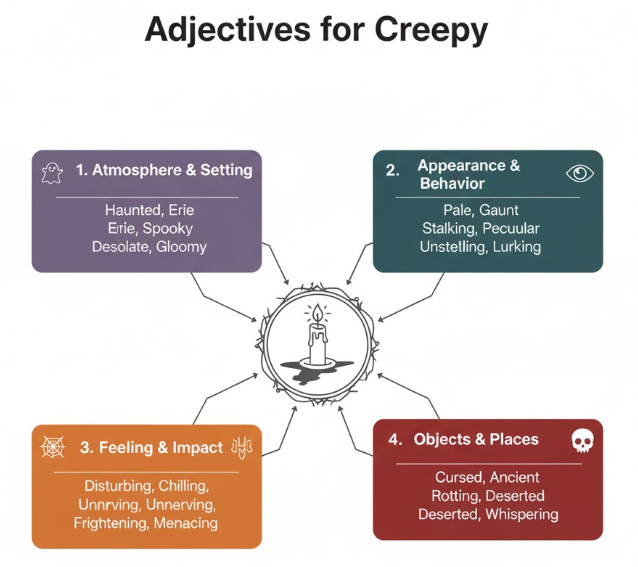
Adjectives that evoke creepiness can be categorized based on what they describe: physical appearance, atmosphere and setting, behavior and actions, and emotional state. Each category contributes uniquely to creating a sense of unease.
Describing Physical Appearance
These adjectives describe unsettling physical traits or appearances. They often focus on deformities, unnatural pallor, or disturbing features.
Words in this category aim to create a visual sense of unease, making the subject appear strange or threatening.
Describing Atmosphere and Setting
These adjectives focus on the environment, creating a sense of foreboding or unease through the description of the surroundings. They often involve darkness, decay, or isolation, setting the stage for a creepy narrative.
The goal is to make the location itself feel threatening and oppressive.
Describing Behavior and Actions
These adjectives describe actions or behaviors that are unsettling or strange. They can involve unpredictable movements, inappropriate reactions, or actions that suggest a hidden, malevolent intent.
These words add a layer of psychological unease, making the subject’s actions appear sinister.
Describing Emotional State
These adjectives describe inner feelings or emotional states that are disturbing or unsettling. They can involve a lack of empathy, an unnatural calm, or a hidden rage.
These words delve into the psychology of the subject, creating a sense of unease about their true intentions or mental state.
Examples of Adjectives for Creepy
The following examples illustrate how different adjectives can be used to create a sense of creepiness in various contexts. Each category—physical appearance, atmosphere and setting, behavior and actions, and emotional state—is represented with numerous examples.
Physical Appearance Examples
These examples demonstrate how adjectives can be used to describe physical traits that evoke a sense of unease or fear. Consider the impact of each adjective on the overall impression of the subject.
| Adjective | Example Sentence |
|---|---|
| Cadaverous | The cadaverous figure emerged from the shadows, its skin stretched tight over its bones. |
| Gaunt | His gaunt face and sunken eyes hinted at a troubled past. |
| Hollow-eyed | The doll’s hollow-eyed stare seemed to follow me around the room. |
| Withered | The withered hand reached out, its touch promising only decay. |
| Sallow | Her sallow complexion made her look as though she hadn’t seen sunlight in years. |
| Unblinking | The cat’s unblinking gaze was unnerving. |
| Distorted | The funhouse mirror showed a distorted reflection of his face. |
| Misshapen | The misshapen tree limbs looked like grasping claws. |
| Ashen | His face was ashen with fear when he saw the ghost. |
| Waxen | The waxen figure in the museum looked eerily lifelike. |
| Ghastly | The ghastly apparition floated through the room. |
| Grimacing | The gargoyle had a grimacing expression. |
| Skeletal | The skeletal remains were found in the old well. |
| Unnatural | The statue had an unnatural calmness about it. |
| Vacant | His eyes were vacant and devoid of emotion. |
| Glassy | The doll’s glassy eyes stared blankly ahead. |
| Disfigured | The villain had a disfigured face. |
| Grotesque | The grotesque statue was hidden in the garden. |
| Pallid | Her pallid skin contrasted with her dark hair. |
| Haggard | The old man looked haggard and worn. |
| Wan | Her wan face showed signs of illness. |
| Shriveled | The witch had a shriveled hand. |
| Twisted | The tree had a twisted trunk. |
| Haunted | The painting had a haunted look to it. |
| Unsettling | The clown had an unsettling smile. |
Atmosphere and Setting Examples
These examples show how adjectives can be used to create a creepy atmosphere or setting. The focus is on making the environment itself feel unsettling and threatening.
| Adjective | Example Sentence |
|---|---|
| Desolate | The desolate landscape stretched out before them, offering no signs of life. |
| Ominous | An ominous silence fell over the forest as they entered. |
| Shadowy | The shadowy corners of the room seemed to conceal hidden dangers. |
| Eerie | An eerie mist clung to the graveyard, obscuring the tombstones. |
| Forboding | The forboding atmosphere of the old mansion made them uneasy. |
| Bleak | The bleak moor offered no respite from the biting wind. |
| Ghastly | The ghastly light of the moon illuminated the abandoned asylum. |
| Macabre | A macabre display of taxidermied animals filled the museum. |
| Sinister | The sinister alleyway was shrouded in darkness. |
| Unnerving | An unnerving stillness permeated the old house. |
| Sepulchral | The sepulchral silence of the tomb was broken only by their footsteps. |
| Gloom | A heavy gloom hung over the haunted castle. |
| Damp | The damp, musty air of the cellar made her shiver. |
| Dismal | The dismal swamp was filled with strange noises. |
| Funereal | The funereal atmosphere of the wake was heavy with grief. |
| Morbid | The museum had a morbid collection of medical oddities. |
| Necrotic | The necrotic forest floor was covered in decaying leaves. |
| Stygian | The stygian darkness of the cave was absolute. |
| Unwholesome | There was something unwholesome about the old house. |
| Haunted | The haunted forest seemed to whisper secrets. |
| Despairing | The despairing silence spoke of a tragic history. |
| Doomed | The doomed village was abandoned long ago. |
| Ill-fated | The ill-fated expedition disappeared without a trace. |
| Oppressive | The oppressive heat added to the sense of dread. |
| Threatening | The threatening clouds gathered overhead. |
Behavior and Actions Examples
These examples illustrate how adjectives can describe behaviors or actions that contribute to a sense of creepiness. The focus is on making the subject’s actions seem unsettling or sinister.
| Adjective | Example Sentence |
|---|---|
| Unpredictable | His unpredictable behavior made everyone nervous. |
| Erratic | Her erratic movements suggested she was not in control. |
| Sinister | A sinister smile crept across his face. |
| Ominous | His ominous tone made her fear the worst. |
| Calculated | Every move he made seemed calculated and cold. |
| Stealthy | The stealthy figure moved silently through the shadows. |
| Menacing | His menacing glare sent shivers down her spine. |
| Predatory | A predatory gleam appeared in his eyes. |
| Secretive | Her secretive behavior raised suspicions. |
| Unnatural | There was an unnatural calmness to his movements. |
| Furtive | He cast a furtive glance over his shoulder. |
| Scheming | He had a scheming look on his face. |
| Deceptive | His deceptive smile hid his true intentions. |
| Manipulative | She had a manipulative way of getting what she wanted. |
| Aloof | His aloof demeanor kept everyone at a distance. |
| Brooding | He spent the evening in a brooding silence. |
| Haunting | The haunting melody seemed to follow her everywhere. |
| Obsessive | His obsessive attention to detail was unnerving. |
| Possessive | He had a possessive grip on her arm. |
| Twisted | His twisted sense of humor was disturbing. |
| Unsettling | His unsettling smile never reached his eyes. |
| Vindictive | She had a vindictive streak. |
| Wary | The animal kept a wary distance. |
| Evasive | He gave evasive answers to the questions. |
| Guarded | She had a guarded expression on her face. |
Emotional State Examples
These examples show how adjectives can describe unsettling emotional states or inner feelings. The focus is on creating unease about the subject’s mental state or intentions.
| Adjective | Example Sentence |
|---|---|
| Detached | His detached demeanor was unsettling, as if he felt nothing. |
| Apathetic | Her apathetic response to the tragedy was disturbing. |
| Callous | His callous disregard for others’ feelings was shocking. |
| Merciless | A merciless rage burned in his eyes. |
| Remorseless | The killer showed a remorseless lack of regret. |
| Ruthless | His ruthless ambition drove him to betray his friends. |
| Soulless | The soulless look in his eyes made her shudder. |
| Tormented | The artist was driven by a tormented imagination. |
| Vengeful | A vengeful spirit haunted the old house. |
| Wrathful | His wrathful outburst terrified everyone. |
| Bitter | A bitter resentment festered in his heart. |
| Cold | He had a cold and calculating mind. |
| Empty | An empty despair filled her soul. |
| Hateful | A hateful glare burned in his eyes. |
| Insidious | An insidious influence corrupted his mind. |
| Malevolent | A malevolent presence filled the room. |
| Nihilistic | He held a nihilistic view of the world. |
| Resentful | He was resentful of her success. |
| Silent | His silent rage was more terrifying than any outburst. |
| Uncaring | He had an uncaring attitude towards suffering. |
| Vacant | His face had a vacant expression. |
| Wretched | He felt wretched and alone. |
| Amiable | His amiable facade hid a dark secret. |
| Deceitful | His deceitful nature made him untrustworthy. |
| Hypocritical | His hypocritical actions offended many. |
Usage Rules
Using adjectives effectively requires understanding certain grammatical rules, including adjective agreement and the order of adjectives. Proper adherence to these rules ensures clarity and enhances the impact of your descriptions.
Adjective Agreement
In English, adjectives do not change form based on the number or gender of the noun they modify, unlike some other languages. This makes their usage relatively straightforward.
However, it’s essential to ensure that the adjective logically fits the noun it describes. For instance, you would say “a creepy house” (singular) and “creepy houses” (plural) without changing the adjective “creepy.”
Order of Adjectives
When using multiple adjectives to describe a noun, there is a generally accepted order. While not a strict rule, following this order makes sentences sound more natural.
The typical order is: opinion, size, age, shape, color, origin, material, and purpose. For example, “a creepy old wooden house” follows this order, where “creepy” is an opinion, “old” is age, and “wooden” is material.
Here’s an example of a sentence with multiple adjectives describing a creepy object, following the general order:
“The hideous old green mask hung on the wall.”
In this sentence:
- Hideous is an opinion adjective.
- Old is an age adjective.
- Green is a color adjective.
While deviations from this order are possible, adhering to it generally results in more natural and coherent sentences.
Common Mistakes
Several common mistakes can occur when using adjectives, particularly when trying to convey a sense of creepiness. Understanding these mistakes and how to correct them is crucial for effective communication.
| Incorrect | Correct | Explanation |
|---|---|---|
| The house was creepy very. | The house was very creepy. | Adverbs should generally precede the adjectives they modify. |
| A creepy old green it. | A creepy old green mask. | Adjectives must modify a noun or pronoun. |
| Creepier house. | Creepy house. | Unless making a comparison, use the base form of the adjective. |
| The mansion creepy. | The creepy mansion. | Adjectives typically precede the nouns they modify. |
| The ghost looked creepily. | The ghost looked creepy. | Use an adjective after linking verbs like “look,” not an adverb. |
Practice Exercises
These exercises will help you practice using adjectives for “creepy” effectively. Fill in the blanks with appropriate adjectives from the list provided or come up with your own.
Answers are provided below each exercise.
- The _________ forest seemed to whisper secrets in the wind.
- A _________ figure emerged from the shadows of the alleyway.
- Her _________ smile never quite reached her eyes.
- The _________ silence of the old house was unnerving.
- He had a _________ look in his eyes, as if he had seen something terrifying.
- The _________ doll sat motionless on the shelf.
- The _________ mist rolled in, obscuring the path ahead.
- His _________ behavior made everyone uneasy.
- There was something _________ about the abandoned mansion.
- The _________ graveyard was filled with crumbling tombstones.
Possible Answers:
- Haunted
- Shadowy, sinister
- Unsettling
- Sepulchral
- Haunted, vacant
- Glassy-eyed, creepy
- Eerie
- Erratic, unpredictable
- Unwholesome
- Desolate, eerie
- The _________ castle stood atop the hill, overlooking the town.
- She had a _________ way of staring that made people uncomfortable.
- The _________ laughter echoed through the empty halls.
- The _________ old book was filled with strange symbols.
- His _________ voice sent shivers down her spine.
- The _________ paintings seemed to watch you as you walked by.
- The _________ figure was silhouetted against the moon.
- He had a _________ obsession with collecting antique dolls.
- The _________ atmosphere made everyone feel uneasy.
- The _________ cellar was filled with strange noises.
Possible Answers:
- Ominous
- Penetrating
- Ghastly
- Ancient
- Hushed
- Haunted
- Gaunt
- Morbid
- Forboding
- Damp
- The _________ garden was overgrown with thorny bushes.
- She wore a _________ mask that concealed her identity.
- The _________ music created a feeling of suspense.
- The _________ creature lurked in the shadows.
- His _________ eyes seemed to pierce through her soul.
- The _________ silence of the room was broken only by the ticking clock.
- The _________ tale was enough to make anyone afraid of the dark.
- His _________ smile revealed a row of crooked teeth.
- The _________ face appeared in the window.
- He had a _________ desire for revenge.
Possible Answers:
- Desolate
- Grotesque
- Eerie
- Stealthy
- Hollow
- Sepulchral
- Macabre
- Sinister
- Ghastly
- Vindictive
Advanced Topics
For advanced learners, understanding the nuances of using adjectives for “creepy” can significantly enhance their writing and communication skills. This includes the use of figurative language and a deeper understanding of subtlety.
Figurative Language
Using figurative language such as similes, metaphors, and personification can amplify the impact of adjectives for “creepy.” For example, instead of saying “The house was creepy,” you could say “The house was as creepy as a graveyard at midnight” (simile) or “The house was a tomb of forgotten memories” (metaphor). These techniques add depth and imagery to your descriptions.
Nuance and Subtlety
Subtlety is key to creating truly unsettling descriptions. Overusing overtly “creepy” adjectives can become tiresome.
Instead, consider using more subtle adjectives that hint at something being wrong or off. For example, describing a character as having an “unnatural calm” can be more unsettling than describing them as “evil.”
Consider using adjectives that create a sense of unease without explicitly stating something is “creepy.” This can be achieved through carefully chosen words that imply a sense of foreboding, mystery, or psychological disturbance. For instance, describing the character’s smile as “too wide” or their laughter as “slightly off-key” can be more effective than simply stating they are “creepy.”
FAQ
- What is the difference between “creepy” and “scary”?
“Creepy” generally refers to something that causes unease or discomfort, often because it’s strange or unsettling. “Scary,” on the other hand, refers to something that causes fear or fright. Creepy things might not be immediately frightening, but they create a sense of unease, while scary things directly induce fear. The use of adjectives can help to define the level of the scare or creepiness.
- Can an adjective be “too creepy”?
Yes, overusing overtly creepy adjectives can diminish their impact. Subtlety is often more effective. Instead of constantly using words like “ghastly” or “sinister,” try using more nuanced adjectives that hint at unease or foreboding.
- How can I make my descriptions more vivid using creepy adjectives?
Use sensory details. Instead of just saying something is “creepy,” describe how it looks, sounds, smells, feels, or even tastes. For example, “The creepy house smelled of damp earth and decay,” engages multiple senses, making the description more vivid.
- What are some alternatives to the word “creepy”?
There are many alternatives, depending on the specific nuance you want to convey, including: unsettling, eerie, unnerving, ominous, sinister, macabre, and disturbing.
- How do cultural differences affect the perception of “creepiness”?
Cultural backgrounds can significantly influence what people find creepy. Certain symbols, images, or behaviors may be considered creepy in one culture but perfectly normal in another. Understanding these cultural differences is important when writing for a diverse audience.
- Is it possible to use adjectives for “creepy” in a humorous way?
Yes, using creepy adjectives in a humorous context can create a darkly comedic effect. This often involves juxtaposing creepy descriptions with lighthearted or absurd situations. For example, “The clown had a sinister smile and a surprisingly cheerful disposition.”
- How do I choose the right adjective for ‘creepy’ to describe a person’s behavior?
When describing behavior, consider the specific actions and the emotional impact they have. Adjectives like “unpredictable,” “secretive,” or “calculating” can be effective in conveying a sense of unease. The key is to choose adjectives that highlight the unsettling nature of the behavior without being overtly judgmental.
- How do I avoid clichés when using adjectives for ‘creepy’?
To avoid clichés, focus on originality and specificity. Instead of using overused adjectives like “dark” or “scary,” try to find unique and unexpected ways to describe the subject. For example, instead of describing a forest as “dark,” you could describe it as “suffocatingly still,” offering a fresh perspective.
Conclusion
Mastering the use of adjectives for “creepy” is a valuable skill for anyone looking to enhance their descriptive writing. By understanding the different categories of creepy adjectives, following usage rules, avoiding common mistakes, and exploring advanced techniques like figurative language, you can create truly unsettling and memorable descriptions.
Remember that subtlety and nuance are often more effective than overt creepiness. Practice these techniques and you will significantly improve your ability to evoke a sense of unease and captivate your audience.