Descriptive adjectives are the lifeblood of vivid and engaging language. They breathe color, texture, and depth into our sentences, allowing us to paint a picture with words.
Understanding how to effectively use adjectives of quality is crucial for anyone looking to improve their writing and speaking skills. This guide provides a comprehensive overview of descriptive adjectives, covering their definition, structure, types, usage rules, common mistakes, and advanced applications.
Whether you’re a student, a writer, or simply someone who wants to communicate more clearly, this article will equip you with the knowledge and tools you need to master the art of descriptive language.
This article will benefit English language learners of all levels, from beginners to advanced speakers. By understanding the nuances of descriptive adjectives, you can significantly enhance your ability to express yourself accurately and effectively.
Mastering these adjectives will not only improve your grammar but also enrich your vocabulary and make your communication more compelling.
Table of Contents
- Definition of Adjectives for Quality
- Structural Breakdown
- Types and Categories of Adjectives for Quality
- Examples of Adjectives for Quality
- Usage Rules for Adjectives
- Common Mistakes with Adjectives
- Practice Exercises
- Advanced Topics
- Frequently Asked Questions
- Conclusion
Definition of Adjectives for Quality
Adjectives of quality, also known as descriptive adjectives, are words that describe the characteristics or qualities of nouns and pronouns. They provide specific details about the size, shape, color, texture, taste, sound, age, condition, origin, material, or personality of the noun they modify.
These adjectives help to create a more vivid and detailed picture in the reader’s or listener’s mind, making the language more engaging and informative.
The primary function of an adjective of quality is to add information to a noun, making it more specific. For instance, instead of saying “a car,” you might say “a red car,” where “red” is the adjective of quality that describes the car’s color. Adjectives of quality can appear before the noun they modify (attributive position) or after a linking verb (predicative position). Understanding the different types and positions of these adjectives is essential for effective communication.
Structural Breakdown
Adjectives of quality typically come before the noun they modify. This is known as the attributive position. For example:
- The tall building.
- A beautiful flower.
- An old car.
However, adjectives can also appear after linking verbs such as be, seem, appear, look, become, and feel. This is known as the predicative position. In this case, the adjective describes the subject of the sentence.
- The building is tall.
- The flower is beautiful.
- The car seems old.
Adjectives can also be modified by adverbs to add further detail. For example:
- A very tall building.
- An incredibly beautiful flower.
- An extremely old car.
In these examples, the adverbs “very,” “incredibly,” and “extremely” intensify the meaning of the adjectives, making the description even more precise. The order of adjectives is also important, and there are general guidelines for how to order multiple adjectives modifying the same noun.
Types and Categories of Adjectives for Quality
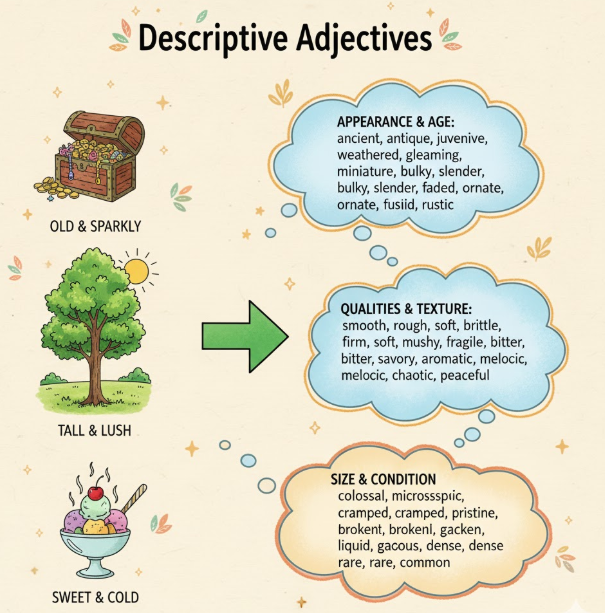
Adjectives of quality can be categorized based on the specific characteristic they describe. Here are some common categories:
Adjectives of Size and Shape
These adjectives describe the dimensions and form of a noun.
- Size: big, small, large, tiny, huge, enormous, little, tall, short, long, wide, narrow
- Shape: round, square, rectangular, circular, triangular, oval, flat, curved, straight
Adjectives of Color
These adjectives describe the hue of a noun.
- red, blue, green, yellow, orange, purple, pink, brown, black, white, gray, golden, silver
Adjectives of Texture
These adjectives describe how a noun feels to the touch.
- smooth, rough, soft, hard, silky, velvety, bumpy, coarse, slippery, sticky
Adjectives of Taste
These adjectives describe the flavor of a noun.
- sweet, sour, bitter, salty, spicy, savory, delicious, tasty, bland, tangy
Adjectives of Sound
These adjectives describe the auditory characteristics of a noun.
- loud, quiet, noisy, silent, melodious, harmonious, screeching, booming, faint
Adjectives of Age
These adjectives describe how old a noun is.
- old, young, new, ancient, modern, antique, youthful, elderly, mature
Adjectives of Condition
These adjectives describe the state or condition of a noun.
- clean, dirty, broken, damaged, healthy, sick, strong, weak, tired, energetic
Adjectives of Origin
These adjectives describe where a noun comes from.
- American, Italian, Chinese, French, Japanese, British, German, Spanish
Adjectives of Material
These adjectives describe what a noun is made of.
- wooden, metal, plastic, paper, glass, cotton, silk, wool, leather
Adjectives of Personality
These adjectives describe the character or qualities of a person or animal.
- kind, cruel, friendly, shy, brave, timid, intelligent, foolish, honest, dishonest
Examples of Adjectives for Quality
The following tables provide extensive examples of adjectives for quality in various contexts. These examples are organized by category to help you understand how each type of adjective can be used to describe nouns.
Table 1: Adjectives of Size and Shape
This table illustrates how adjectives of size and shape can be used to describe different objects and entities. These adjectives add detail and precision to your descriptions, allowing you to convey a more accurate image.
| Sentence |
|---|
| The big dog barked loudly. |
| She lives in a small house. |
| The large pizza was enough for everyone. |
| A tiny insect crawled on the leaf. |
| The huge elephant lumbered through the jungle. |
| An enormous wave crashed on the shore. |
| He has a little car. |
| The tall building dominates the skyline. |
| She is a short woman. |
| The long road stretched ahead. |
| The river is wide at this point. |
| A narrow path led to the secret garden. |
| The round table was perfect for the family. |
| He drew a square on the paper. |
| The rectangular box contained the gift. |
| A circular window let in the light. |
| The triangular sign warned of danger. |
| An oval mirror hung on the wall. |
| The flat surface was ideal for painting. |
| A curved road wound through the hills. |
| A straight line is the shortest distance between two points. |
| The gigantic asteroid threatened the planet. |
| The petite dancer moved gracefully. |
| A broad avenue led to the city center. |
Table 2: Adjectives of Color
This table showcases the use of adjectives of color to add vibrancy and detail to descriptions. These adjectives are essential for creating a vivid and engaging portrayal of the subject.
| Sentence |
|---|
| The red rose is beautiful. |
| He wore a blue shirt. |
| The grass is green. |
| She likes yellow flowers. |
| The sunset was orange. |
| A purple dress looked elegant. |
| She wore a pink ribbon in her hair. |
| He has a brown leather jacket. |
| The cat is black. |
| The snow is white. |
| The sky was gray and overcast. |
| A golden ring sparkled in the light. |
| The silver necklace was a gift. |
| She painted the wall beige. |
| The car had a scarlet paint job. |
| He admired the azure sea. |
| The leaves turned amber in the fall. |
| A violet hue filled the evening sky. |
| The room was decorated in ivory tones. |
| He chose a navy suit for the occasion. |
| The emerald earrings were stunning. |
| She wore a cerulean dress. |
| The crimson sunset was breathtaking. |
Table 3: Adjectives of Texture
This table illustrates the use of adjectives of texture to describe the tactile qualities of various objects. These adjectives are crucial for engaging the reader’s senses and creating a more immersive experience.
| Sentence |
|---|
| The smooth stone felt cool to the touch. |
| The rough bark of the tree was textured. |
| She wore a soft sweater. |
| The hard wood was difficult to cut. |
| The silky fabric felt luxurious. |
| She touched the velvety petals of the rose. |
| The bumpy road made the ride uncomfortable. |
| He used coarse sandpaper to smooth the surface. |
| The floor was slippery when wet. |
| The sticky candy coated his fingers. |
| The gritty sand filled his shoes. |
| The fluffy clouds drifted lazily. |
| The crisp leaves crunched underfoot. |
| The leathery skin of the alligator was tough. |
| The satiny dress shimmered in the light. |
| The prickly cactus was covered in spines. |
| The slick ice made walking dangerous. |
| The downy feathers were incredibly soft. |
| The wooly blanket kept her warm. |
| The fibrous texture of the plant was interesting. |
| The scratchy wool irritated his skin. |
| The glossy finish made the table shine. |
| The matte surface absorbed the light. |
Table 4: Adjectives of Taste
This table provides examples of adjectives of taste, which are used to describe the flavor and palatability of food and drinks. These adjectives help to convey the sensory experience of tasting something.
| Sentence |
|---|
| The cake was sweet and delicious. |
| The lemon was sour. |
| The coffee had a bitter taste. |
| The soup was salty. |
| The curry was very spicy. |
| The savory dish was full of flavor. |
| The meal was delicious and satisfying. |
| The food was tasty and well-prepared. |
| The soup was bland and needed salt. |
| The sauce had a tangy flavor. |
| The fruit was juicy and refreshing. |
| The bread was stale and hard. |
| The wine was fruity and aromatic. |
| The chocolate was rich and decadent. |
| The salad was crisp and fresh. |
| The sauce was pungent and flavorful. |
| The drink was acidic and sharp. |
| The aftertaste was lingering. |
| The snack was chewy and satisfying. |
| The meal was incredibly palatable. |
| The flavors were harmonious. |
| The dish was surprisingly piquant. |
| The soup was wonderfully zesty. |
Table 5: Adjectives of Personality
This table presents examples of adjectives that describe personality traits and characteristics. These adjectives are essential for portraying characters in stories or describing the nature of individuals.
| Sentence |
|---|
| She is a kind and generous person. |
| He can be cruel and insensitive. |
| The dog is very friendly. |
| She is shy around new people. |
| The knight was brave and fearless. |
| He is timid and easily frightened. |
| She is an intelligent student. |
| He made a foolish decision. |
| She is an honest and trustworthy person. |
| He was caught being dishonest. |
| The leader was compassionate. |
| He is known for being ambitious. |
| She is a creative artist. |
| He is a responsible employee. |
| She is a patient teacher. |
| He is a determined athlete. |
| She is a generous philanthropist. |
| He is a loyal friend. |
| She is a optimistic person. |
| He is a pessimistic person. |
| She is a curious child. |
| He is a cautious driver. |
| She is a confident speaker. |
Usage Rules for Adjectives
There are several rules to follow when using adjectives of quality:
- Order of Adjectives: When using multiple adjectives to describe a noun, there is a general order to follow:
- Opinion: beautiful, ugly, interesting
- Size: big, small, large
- Shape: round, square, rectangular
- Age: old, new, young
- Color: red, blue, green
- Origin: American, Italian, Chinese
- Material: wooden, metal, plastic
- Purpose: writing (desk), sleeping (bag)
For example: “a beautiful large old red Italian car.”
- Coordinate Adjectives: Coordinate adjectives are two or more adjectives that equally modify the same noun and are separated by a comma or the word “and.”For example: “a smart, kind student” or “a smart and kind student.”
- Cumulative Adjectives: Cumulative adjectives build upon each other to modify the noun and are not separated by a comma.For example: “a small wooden table.”
- Proper Adjectives: Proper adjectives are formed from proper nouns and are always capitalized.For example: “American history,” “Italian food.”
- Comparative and Superlative Forms: Adjectives can be used in comparative and superlative forms to compare two or more nouns.
- Comparative: used to compare two nouns (e.g., “taller,” “more beautiful”).
- Superlative: used to compare three or more nouns (e.g., “tallest,” “most beautiful”).
Common Mistakes with Adjectives
Here are some common mistakes to avoid when using adjectives of quality:
- Incorrect Order of Adjectives: Placing adjectives in the wrong order can sound awkward.
- Incorrect: “a red old car”
- Correct: “an old red car”
- Using Commas Incorrectly: Forgetting commas between coordinate adjectives or adding them between cumulative adjectives.
- Incorrect: “a smart kind student”
- Correct: “a smart, kind student”
- Incorrect: “a small, wooden table”
- Correct: “a small wooden table”
- Misusing Comparative and Superlative Forms: Using the wrong form of the adjective for comparison.
- Incorrect: “more taller”
- Correct: “taller”
- Incorrect: “most tallest”
- Correct: “tallest”
- Using Adjectives as Adverbs: Using an adjective instead of an adverb to modify a verb.
- Incorrect: “He runs quick.”
- Correct: “He runs quickly.”
Practice Exercises
Complete the following exercises to test your understanding of adjectives for quality.
Exercise 1: Identify the Adjectives
Identify the adjectives of quality in the following sentences.
| Question | Answer |
|---|---|
| 1. The old house stood on the hill. | old |
| 2. She wore a beautiful dress to the party. | beautiful |
| 3. The dog has brown fur. | brown |
| 4. The coffee was bitter. | bitter |
| 5. The road was long and winding. | long, winding |
| 6. He is a kind and generous man. | kind, generous |
| 7. The small cat slept on the chair. | small |
| 8. The delicious meal was well-prepared. | delicious |
| 9. The rough sea made the boat rock. | rough |
| 10. The tall tree provided shade. | tall |
Exercise 2: Fill in the Blanks
Fill in the blanks with appropriate adjectives of quality.
| Question | Answer |
|---|---|
| 1. The _______ car sped down the road. | fast |
| 2. She has _______ hair. | long |
| 3. The _______ flowers smelled wonderful. | fragrant |
| 4. He is a _______ student. | diligent |
| 5. The _______ movie made everyone cry. | sad |
| 6. The _______ house was filled with antiques. | historic |
| 7. The _______ child played in the park. | happy |
| 8. The _______ coffee woke me up. | strong |
| 9. The _______ snow glistened in the sun. | white |
| 10. The _______ music filled the room. | soothing |
Exercise 3: Correct the Mistakes
Correct the mistakes in the following sentences.
| Question | Answer |
|---|---|
| 1. She has a red old car. | She has an old red car. |
| 2. He is more taller than me. | He is taller than me. |
| 3. She sings good. | She sings well. |
| 4. The smart kind student excelled. | The smart, kind student excelled. |
| 5. This is the most tallest building. | This is the tallest building. |
| 6. The table wooden small was broken. | The small wooden table was broken. |
| 7. He spoke loud. | He spoke loudly. |
| 8. A interesting big book. | A big, interesting book. |
| 9. The water cold was refreshing. | The cold water was refreshing. |
| 10. She is a honest person. | She is an honest person. |
Advanced Topics
For advanced learners, here are some more complex aspects of adjectives of quality:
- Attributive vs. Predicative Adjectives: Understanding the nuances of using adjectives in attributive and predicative positions. Some adjectives can only be used in one position. For example, the adjective “alone” is typically used in the predicative position (e.g., “He is alone”), while other adjectives are more commonly used in the attributive position (e.g., “a lonely man”).
- Adjective Phrases: Using phrases that function as adjectives to provide more detailed descriptions. For example, “a house with a red roof” or “a man full of energy.”
- Participial Adjectives: Using participles (verb forms ending in -ing or -ed) as adjectives. For example, “a running stream” or “a broken window.”
- Compound Adjectives: Combining two or more words to form a single adjective, often hyphenated. For example, “a well-known author” or “a long-term project.”
- Subject Complements: Adjectives that follow a linking verb and describe the subject of the sentence. For example, “The sky is blue.”
Frequently Asked Questions
- What is the difference between an adjective of quality and an adjective of quantity?Adjectives of quality describe the characteristics or qualities of a noun (e.g., “a red car”), while adjectives of quantity describe the amount or number of a noun (e.g., “many cars”).
- Can an adjective modify another adjective?No, adjectives modify nouns and pronouns. To modify an adjective, you would use an adverb (e.g., “a very beautiful flower”).
- What is the correct order of adjectives when using multiple adjectives?The general order of adjectives is: Opinion, Size, Shape, Age, Color, Origin, Material, Purpose. For example: “a beautiful large old red Italian car.”
- What are coordinate adjectives?Coordinate adjectives are two or more adjectives that equally modify the same noun and are separated by a comma or the word “and” (e.g., “a smart, kind student”).
- What are cumulative adjectives?Cumulative adjectives build upon each other to modify the noun and are not separated by a comma (e.g., “a small wooden table”).
- How do I form the comparative and superlative forms of adjectives?For most short adjectives, add “-er” for the comparative and “-est” for the superlative (e.g., “tall,” “taller,” “tallest”). For longer adjectives, use “more” for the comparative and “most” for the superlative (e.g., “beautiful,” “more beautiful,” “most beautiful”).
- What is a proper adjective?A proper adjective is formed from a proper noun and is always capitalized (e.g., “American history,” “Italian food”).
- What is a participial adjective?A participial adjective is an adjective that is formed from a verb (e.g., a running stream, a broken window).
Conclusion
Mastering adjectives of quality is essential for effective communication in English. By understanding their definition, structure, types, usage rules, and common mistakes, you can significantly improve your ability to express yourself clearly and vividly.
This comprehensive guide has provided you with the knowledge and tools you need to enhance your descriptive language skills.
Remember to practice using adjectives in your writing and speaking to solidify your understanding. Pay attention to the order of adjectives, the use of commas, and the correct forms for comparison.
With consistent effort, you can become proficient in using adjectives of quality to create engaging and informative content. Keep exploring new adjectives and experimenting with different ways to describe the world around you.
Happy writing!