
Reflective adjectives offer a unique window into the world of language, allowing us to describe qualities that involve thought, consideration, and introspection. Mastering these adjectives not only enhances your vocabulary but also empowers you to express nuanced perspectives and deeper insights.
This comprehensive guide is designed for English learners of all levels, from beginners seeking to expand their descriptive toolkit to advanced speakers aiming to refine their expressive capabilities. Whether you’re a student, writer, or simply an enthusiast of language, understanding reflective adjectives will undoubtedly enrich your communication skills and deepen your appreciation for the art of self-expression and thoughtful analysis.
Table of Contents
- Introduction
- Definition of Reflective Adjectives
- Structural Breakdown
- Types and Categories of Reflective Adjectives
- Examples of Reflective Adjectives
- Usage Rules for Reflective Adjectives
- Common Mistakes with Reflective Adjectives
- Practice Exercises
- Advanced Topics
- Frequently Asked Questions
- Conclusion
Definition of Reflective Adjectives
Reflective adjectives are words that describe qualities associated with thought, contemplation, and introspection. These adjectives often indicate a state of mind, a process of deep thinking, or a tendency to consider things carefully.
Unlike descriptive adjectives that simply paint a picture of physical attributes or immediate feelings, reflective adjectives delve into the internal processes of evaluation, analysis, and understanding. They provide insight into how someone processes information, understands their emotions, and makes decisions based on thoughtful consideration.
Reflective adjectives help to add nuance and depth to your descriptions, providing a more complete and sophisticated portrayal of character, situations, and ideas.
In essence, reflective adjectives function to add layers of meaning by showing the mental or emotional processes involved. They are not merely describing what is, but also how something is perceived, understood, or acted upon after careful consideration.
They often imply a sense of wisdom, maturity, or a deliberate approach to life and its challenges. Understanding and utilizing these adjectives effectively can significantly enhance expressive writing and communication.
Structural Breakdown
Reflective adjectives, like all adjectives, typically modify nouns or pronouns, providing additional information about them. Structurally, they can appear in several positions within a sentence:
- Attributive Position: Placed directly before the noun they modify. For example: “The thoughtful student considered the question carefully.”
- Predicate Position: Following a linking verb (such as is, are, was, were, seems, becomes). For example: “Her response was very reflective.”
- Postpositive Position: Although less common, adjectives can follow the noun, especially in formal writing or when the adjective is part of a longer phrase. For example: “Students thoughtful of others are often appreciated.”
Many reflective adjectives are formed by adding suffixes like -ful, -ive, -able, -ent, or -ant to verbs or nouns. For instance, reflect becomes reflective, and thought becomes thoughtful. Understanding these formations can help you expand your vocabulary and recognize new reflective adjectives more easily. It’s also important to note that some adjectives can function as both descriptive and reflective depending on the context. For example, “a bright light” is descriptive, while “a bright student” can imply intelligence and thoughtfulness.
Furthermore, the intensity of a reflective adjective can be modified by adverbs. For example, you might say “very thoughtful” or “deeply reflective” to emphasize the degree of thoughtfulness or reflection.
Types and Categories of Reflective Adjectives
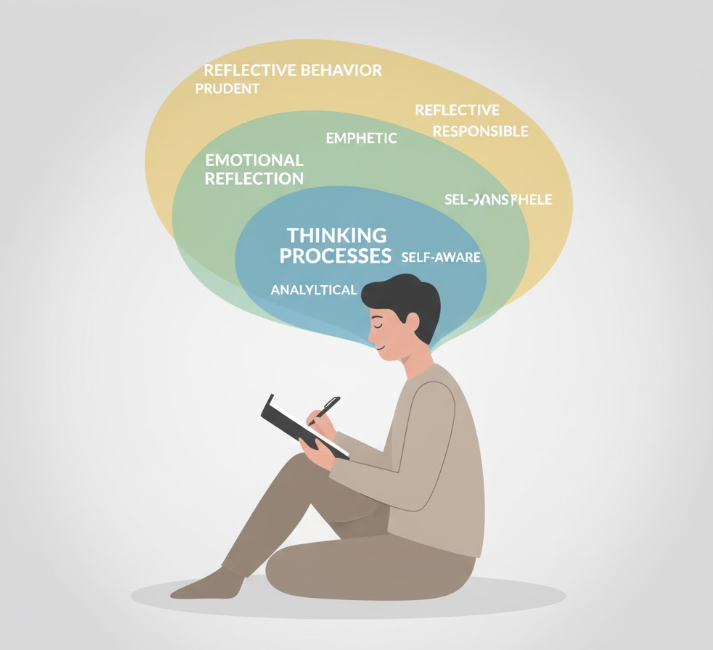
Reflective adjectives can be broadly categorized based on the aspect of reflection they describe. Here are three main categories:
Adjectives Describing Thinking Processes
These adjectives relate to the cognitive aspects of reflection, describing how someone thinks, analyzes, and evaluates information. They often indicate qualities such as intelligence, rationality, and a tendency to consider different perspectives.
Examples include: thoughtful, analytical, deliberate, rational, insightful, pensive, contemplative, circumspect, judicious, discerning, introspective, studious, logical, reasoned, reflective.
Adjectives Describing Emotional Reflection
These adjectives describe the emotional aspects of reflection, indicating how someone processes and understands their feelings and the feelings of others. They often convey empathy, sensitivity, and a deep understanding of human emotions.
Examples include: empathetic, compassionate, sensitive, understanding, considerate, sympathetic, introspective, self-aware, mindful, attentive, responsive, caring, benevolent, gracious, humane.
Adjectives Describing Reflective Behavior
These adjectives describe actions and behaviors that are characterized by reflection and thoughtfulness. They often indicate qualities such as responsibility, prudence, and a tendency to act with careful consideration.
Examples include: responsible, prudent, cautious, careful, mindful, conscientious, attentive, diligent, vigilant, scrupulous, circumspect, tactful, diplomatic, measured, controlled.
Examples of Reflective Adjectives
The following tables provide examples of reflective adjectives in various contexts. Understanding how these adjectives are used in sentences will help you to incorporate them into your own writing and speech.
Examples Describing Thinking Processes
The table below provides examples of adjectives that describe thinking processes. These adjectives are invaluable for expressing how someone analyzes and understands information.
| Reflective Adjective | Example Sentence |
|---|---|
| Thoughtful | The thoughtful analysis of the data revealed several unexpected trends. |
| Analytical | Her analytical approach to problem-solving made her an invaluable member of the team. |
| Deliberate | His deliberate pace suggested he was carefully considering his options. |
| Rational | A rational argument is more likely to persuade others than an emotional one. |
| Insightful | The professor’s insightful comments provided a new perspective on the topic. |
| Pensive | She sat in a pensive mood, contemplating the challenges ahead. |
| Contemplative | The monk spent his days in contemplative silence, seeking inner peace. |
| Circumspect | A circumspect investor always researches thoroughly before making a decision. |
| Judicious | The judge made a judicious decision, balancing the rights of all parties involved. |
| Discerning | A discerning critic can appreciate the subtle nuances of a work of art. |
| Introspective | Writing in a journal is a good way to become more introspective. |
| Studious | The studious researcher spent hours pouring over old documents. |
| Logical | His logical explanation made the complex topic understandable. |
| Reasoned | The lawyer presented a reasoned defense, based on facts and evidence. |
| Reflective | After the crisis, the company took a reflective approach to improving its procedures. |
| Considerate | It was considerate of him to bring flowers to the party. |
| Prudent | Making a budget is a prudent way to manage your finances. |
| Wise | She always gave wise advice based on experience. |
| Astute | The astute businessman saw the opportunity before anyone else. |
| Perceptive | Her perceptive comments showed that she really understood the situation. |
| Intellectual | The conversation was very intellectual and stimulating. |
| Philosophical | He had a philosophical approach to life, always questioning things. |
| Analytical | She had an analytical mind and was good at solving problems. |
| Scholarly | His writing was scholarly and well-researched. |
| Erudite | He was an erudite scholar, knowledgeable in many subjects. |
Examples Describing Emotional Reflection
The table below provides examples of adjectives that describe emotional reflection. These adjectives help convey empathy, understanding, and emotional intelligence.
| Reflective Adjective | Example Sentence |
|---|---|
| Empathetic | An empathetic listener can truly understand and share the feelings of others. |
| Compassionate | The compassionate doctor dedicated his life to helping the poor. |
| Sensitive | She is very sensitive to the needs of others, always offering support. |
| Understanding | An understanding friend will listen without judgment. |
| Considerate | It was considerate of him to offer his seat to the elderly woman. |
| Sympathetic | The sympathetic nurse comforted the patient with kind words. |
| Introspective | After the breakup, she became more introspective, trying to understand her own feelings. |
| Self-aware | A self-aware individual understands their own strengths and weaknesses. |
| Mindful | Practicing mindful meditation can help reduce stress and increase self-awareness. |
| Attentive | An attentive parent listens carefully to their child’s concerns. |
| Responsive | The government needs to be more responsive to the needs of its citizens. |
| Caring | A caring teacher creates a supportive and nurturing learning environment. |
| Benevolent | The benevolent donor gave generously to the charity. |
| Gracious | She was gracious in defeat, congratulating her opponent with sincerity. |
| Humane | The prison system should focus on humane treatment and rehabilitation. |
| Kind | It was very kind of you to help me with my bags. |
| Generous | She was a generous person, always willing to share. |
| Altruistic | His altruistic actions showed his concern for others. |
| Empathetic | She was an empathetic listener and a good friend. |
| Compassionate | The compassionate nurse cared for her patients with love. |
| Tender | He had a tender heart and was easily moved by stories of suffering. |
| Merciful | The judge was merciful and gave the young offender a second chance. |
| Tolerant | She was a tolerant person who accepted others as they were. |
| Patient | The teacher was very patient with the struggling student. |
| Forgiving | It is important to be forgiving when someone makes a mistake. |
Examples Describing Reflective Behavior
The table below provides examples of adjectives that describe behaviors characterized by reflection and thoughtfulness. These adjectives highlight responsibility, prudence, and careful consideration in actions.
| Reflective Adjective | Example Sentence |
|---|---|
| Responsible | A responsible citizen votes in every election and pays their taxes on time. |
| Prudent | It is prudent to save money for unexpected expenses. |
| Cautious | A cautious driver always checks their blind spots before changing lanes. |
| Careful | She was careful to avoid any actions that could be misinterpreted. |
| Mindful | He was mindful of his impact on the environment, reducing his carbon footprint. |
| Conscientious | A conscientious employee always completes their tasks to the best of their ability. |
| Attentive | An attentive student takes notes and asks questions in class. |
| Diligent | The diligent researcher spent years gathering data for the study. |
| Vigilant | A vigilant security guard can help prevent crime. |
| Scrupulous | The accountant was scrupulous in her handling of the company’s finances. |
| Circumspect | He was circumspect in his dealings with strangers, always cautious. |
| Tactful | A tactful diplomat can navigate sensitive negotiations with grace. |
| Diplomatic | She gave a diplomatic response, avoiding any controversial statements. |
| Measured | His measured tone conveyed a sense of calm and control. |
| Controlled | She maintained a controlled demeanor, even in stressful situations. |
| Disciplined | The disciplined athlete trained hard every day. |
| Purposeful | He took purposeful steps toward his goals, never wavering. |
| Deliberate | Her actions were deliberate and well thought out. |
| Intentional | The mistake was not intentional, it was an accident. |
| Refined | She had a refined taste in art and music. |
| Cultured | He was a cultured man who enjoyed literature and theater. |
| Polished | Her presentation was polished and professional. |
| Graceful | She moved with a graceful elegance. |
| Elegant | The party was an elegant affair. |
| Sophisticated | He had a sophisticated understanding of the subject. |
Usage Rules for Reflective Adjectives
Using reflective adjectives correctly involves understanding their nuances and applying them in appropriate contexts. Here are some key usage rules:
- Context Matters: The meaning of a reflective adjective can change depending on the context. For example, “bright” can mean intelligent (reflective) or shining (descriptive).
- Appropriate Placement: Ensure the adjective is placed correctly in relation to the noun it modifies, either before the noun (attributive) or after a linking verb (predicate).
- Avoid Redundancy: Don’t use reflective adjectives that repeat the meaning of the noun they modify. For example, saying “a thoughtful thinker” is redundant.
- Choose the Right Degree: Use adverbs like “very,” “extremely,” or “slightly” to modify the intensity of the adjective when necessary.
- Consider Connotations: Be aware of the subtle connotations of different adjectives. Some adjectives may carry a more positive or negative connotation than others.
It’s also crucial to understand the specific meanings of each adjective to avoid misusing them. For instance, “pensive” implies a state of deep and often melancholy thought, while “analytical” suggests a more systematic and logical approach to thinking.
Common Mistakes with Reflective Adjectives
Even experienced English speakers sometimes make mistakes with reflective adjectives. Here are some common errors and how to avoid them:
| Incorrect | Correct | Explanation |
|---|---|---|
| She is very understanding of the problem’s solution. | She is very understanding of the problem. | “Understanding” describes a person’s empathy, not their knowledge of a solution. |
| He is a thoughtful building. | He is a thoughtful architect. | “Thoughtful” describes a person’s qualities, not the attributes of an inanimate object. |
| The analytical emotion. | The intense emotion. | “Analytical” describes a thinking process, not an emotion itself. |
| She is very considerate of her own feelings only. | She is very self-centered. | “Considerate” implies caring about others, not just oneself. |
| He is a responsible weather. | He is a responsible meteorologist. | “Responsible” describes a person, not the weather. |
| The prudent car. | The fuel-efficient car. | “Prudent” describes people, not inanimate objects. |
| A cautious lightning. | A dangerous lightning. | “Cautious” describes people, not natural phenomena. |
| She is a mindful tree. | She is a nature-loving person. | “Mindful” describes a person’s awareness, not a tree. |
| The conscientious rock. | The heavy rock. | “Conscientious” describes people, not inanimate objects. |
| He is a vigilant sun. | He is a careful observer. | “Vigilant” describes people, not celestial bodies. |
Practice Exercises
Test your understanding of reflective adjectives with these exercises. Choose the best reflective adjective to complete each sentence.
| Question | Options | Answer |
|---|---|---|
| 1. She gave a ______ speech, carefully considering all sides of the issue. | a) bright b) thoughtful c) red | b) thoughtful |
| 2. He is an ______ student, always asking insightful questions. | a) empathetic b) analytical c) green | b) analytical |
| 3. It was ______ of you to remember my birthday. | a) blue b) considerate c) loud | b) considerate |
| 4. The ______ investor made a wise decision based on thorough research. | a) prudent b) yellow c) fast | a) prudent |
| 5. She is a very ______ person, always trying to understand others’ feelings. | a) empathetic b) square c) noisy | a) empathetic |
| 6. He took a ______ approach to the problem, considering all possible outcomes. | a) deliberate b) quick c) funny | a) deliberate |
| 7. The judge made a ______ decision, ensuring justice for all. | a) judicious b) purple c) slow | a) judicious |
| 8. The ______ guard noticed the suspicious activity and alerted the authorities. | a) vigilant b) soft c) round | a) vigilant |
| 9. She is a ______ employee, always completing her tasks with care and attention. | a) conscientious b) orange c) tall | a) conscientious |
| 10. He is very ______ of his impact on the environment, always trying to reduce waste. | a) mindful b) short c) sweet | a) mindful |
Exercise 2: Rewrite the following sentences using a reflective adjective to add more detail.
- The student thought about the problem. (Use “pensive”)
- She understood his feelings. (Use “sympathetic”)
- He acts carefully. (Use “circumspect”)
- She is a good listener. (Use “attentive”)
- He is a smart person. (Use “insightful”)
Answers:
- The student was in a pensive mood as he thought about the problem.
- She was sympathetic to his feelings.
- He acts in a circumspect manner.
- She is an attentive listener.
- He is an insightful person.
Advanced Topics
For advanced learners, exploring the nuances of reflective adjectives can lead to a deeper understanding of how language shapes perception and communication. Consider these advanced topics:
- The Role of Reflective Adjectives in Rhetoric: How can reflective adjectives be used to persuade and influence an audience?
- Cross-Cultural Differences: Do different cultures emphasize different aspects of reflection in their language and communication styles?
- The Connection to Philosophy: How do reflective adjectives relate to philosophical concepts such as self-awareness, ethics, and epistemology?
- Reflective Adjectives in Literature: Analyze how authors use reflective adjectives to develop characters and themes.
Exploring these advanced topics will not only enhance your understanding of reflective adjectives but also broaden your perspective on language and its role in shaping human thought and behavior. Analyzing literature and rhetoric, for instance, can reveal how skilled writers use these adjectives to create powerful and lasting impressions on their readers.
Frequently Asked Questions
- What is the difference between a descriptive adjective and a reflective adjective?
Descriptive adjectives describe physical attributes or immediate states, while reflective adjectives describe qualities related to thought, contemplation, or introspection. Descriptive adjectives provide factual information about what something *is*, while reflective adjectives offer insight into *how* something is perceived or understood.
- Can an adjective be both descriptive and reflective?
Yes, many adjectives can function as both descriptive and reflective depending on the context. For example, “bright” can describe a shining light (descriptive) or an intelligent person (reflective).
- How can I improve my use of reflective adjectives?
Read widely to see how skilled writers use these adjectives, practice using them in your own writing, and pay attention to the connotations of different adjectives to choose the most appropriate word for the context.
- Are there any reflective adjectives that should be avoided?
Avoid using reflective adjectives that are redundant or that don’t accurately reflect the situation. Also, be mindful of any negative connotations that some adjectives may carry.
- What are some common suffixes used to form reflective adjectives?
Common suffixes include -ful, -ive, -able, -ent, and -ant. These suffixes are often added to verbs or nouns to create new adjectives.
- How do reflective adjectives enhance writing?
Reflective adjectives add depth and nuance to writing by providing insight into the thoughts, feelings, and behaviors of characters or subjects. They help create a more complete and sophisticated portrayal.
- Can reflective adjectives be used in all types of writing?
Yes, reflective adjectives can be used in various types of writing, including fiction, non-fiction, and academic writing. However, it’s important to use them appropriately and in context.
- How do I choose the right reflective adjective for a particular situation?
Consider the specific aspect of reflection you want to emphasize (thinking, feeling, or behavior) and choose an adjective that accurately conveys that aspect. Pay attention to the connotations and nuances of different adjectives to select the most fitting word.
Conclusion
Mastering reflective adjectives is a valuable step in enhancing your English language skills. These adjectives not only enrich your vocabulary but also enable you to express deeper insights and more nuanced perspectives.
By understanding the different types of reflective adjectives, their usage rules, and common mistakes to avoid, you can effectively incorporate them into your writing and speech. Remember to practice regularly, pay attention to context, and be mindful of the subtle connotations of different adjectives.
With consistent effort, you’ll become more confident and skilled in using reflective adjectives to communicate your thoughts and ideas with greater precision and impact.
Continue to explore the advanced topics discussed, such as the role of reflective adjectives in rhetoric and their connection to philosophy, to further deepen your understanding. By doing so, you’ll not only improve your language skills but also gain a broader perspective on the power of language to shape human thought and behavior.
Keep practicing and refining your skills, and you’ll find that your ability to express yourself with clarity and depth will continue to grow.