Expressing emotions is a crucial part of communication, and knowing how to convey anger in French is invaluable for effective and nuanced interactions. This article provides a detailed exploration of the various ways to say “I’m angry” in French, ranging from simple expressions to more complex and idiomatic phrases.
Whether you’re a beginner or an advanced learner, this guide will equip you with the vocabulary and grammatical knowledge to express your anger appropriately and understand when others are expressing theirs. This comprehensive guide benefits students, travelers, and anyone interested in mastering French communication skills.
Table of Contents
- Introduction
- Definition: Expressing Anger in French
- Structural Breakdown of Anger Expressions
- Types and Categories of Anger Expressions
- Examples of Anger Expressions
- Usage Rules and Considerations
- Common Mistakes
- Practice Exercises
- Advanced Topics
- FAQ
- Conclusion
Definition: Expressing Anger in French
Expressing anger in French involves using a variety of phrases and expressions that convey different levels of frustration, annoyance, and rage. The choice of expression depends on the context, the relationship between the speakers, and the intensity of the emotion.
Understanding the nuances of these expressions is essential for effective communication and avoiding misunderstandings. Whether you use a simple statement like “Je suis fâché(e)” or a more colorful idiom, the goal is to accurately convey your emotional state.
Structural Breakdown of Anger Expressions
French anger expressions typically involve a subject (often ‘je’), a verb (often ‘être’ or ‘avoir’), and an adjective or noun that describes the feeling of anger. The structure can vary depending on the chosen expression.
For example, “Je suis en colère” follows a subject-verb-preposition-noun structure, while “J’en ai marre” uses a more idiomatic structure with a pronoun, verb, and noun. Understanding these structural differences can help you construct your own expressions and better comprehend those used by native speakers.
Types and Categories of Anger Expressions
Anger expressions in French can be categorized based on formality, intensity, and idiomatic nature. Formal expressions are suitable for professional or polite contexts, while informal expressions are used among friends and family.
Idiomatic expressions add color and nuance to your speech, but they should be used with caution, especially if you’re unsure of their meaning or appropriateness. Different expressions also convey varying degrees of anger, from mild annoyance to intense rage.
Formal Expressions
Formal expressions of anger are appropriate in professional settings or when speaking to someone you don’t know well. They tend to be more polite and less direct than informal expressions.
Examples include using conditional tenses or more restrained vocabulary.
Informal Expressions
Informal expressions are used among friends, family, and people you’re close to. They are often more direct and can include stronger language and idiomatic phrases.
These expressions can be very effective in conveying your feelings, but it’s important to be mindful of your audience.
Idiomatic Expressions
Idiomatic expressions add color and flavor to your language. They are often figurative and can be difficult to understand if you’re not familiar with them.
Using idioms correctly can make your French sound more natural and expressive, but it’s important to use them appropriately and in the right context.
Degrees of Anger: Mild to Intense
Just as in English, anger in French can range from mild annoyance to intense rage. Different expressions convey different levels of intensity.
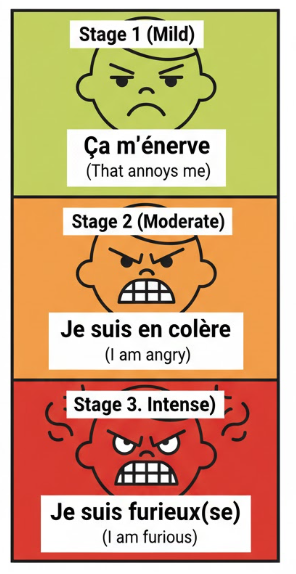
For example, “Je suis agacé(e)” expresses mild annoyance, while “Je suis furieux(se)” expresses intense anger or fury. Understanding these nuances allows you to communicate your feelings more precisely.
Examples of Anger Expressions
Here are some examples of how to express anger in French, categorized by simplicity and complexity. Each example includes the French phrase, its English translation, and a brief explanation of the context in which it might be used.
Simple Expressions
These are straightforward ways to say you’re angry, suitable for various situations. They’re easy to remember and use, making them a good starting point for beginners.
| French Expression | English Translation | Context |
|---|---|---|
| Je suis fâché(e). | I am angry. | General expression of anger. |
| Je suis en colère. | I am angry. | A common and versatile expression. |
| Ça m’énerve. | That annoys me. | Expressing annoyance with something. |
| Je suis agacé(e). | I am annoyed. | Expressing mild annoyance. |
| Je suis irrité(e). | I am irritated. | Expressing slight anger or frustration. |
| Je suis contrarié(e). | I am upset. | Expressing mild disappointment or frustration that leads to anger. |
| Je suis mécontent(e). | I am displeased. | Expressing dissatisfaction. |
| Ça me met en colère. | That makes me angry. | Expressing that something is causing anger. |
| Je n’apprécie pas ça. | I don’t appreciate that. | Expressing disapproval and anger. |
| C’est inacceptable. | That’s unacceptable. | Expressing strong disapproval and anger. |
| Ça suffit ! | That’s enough! | Expressing that you’ve reached your limit. |
| J’en ai assez. | I’ve had enough. | Similar to “Ça suffit !” |
| Je suis déçu(e). | I am disappointed. | Expressing disappointment that leads to anger. |
| Je suis exaspéré(e). | I am exasperated. | Expressing frustration and impatience. |
| Je suis frustré(e). | I am frustrated. | Expressing a feeling of being blocked or hindered. |
| C’est énervant. | That’s annoying. | Similar to “Ça m’énerve.” |
| C’est rageant. | That’s infuriating. | Expressing that something causes rage. |
| Je suis furieux(se). | I am furious. | Expressing intense anger. |
| Je suis hors de moi. | I am beside myself. | Expressing extreme anger or agitation. |
| Je suis indigné(e). | I am outraged. | Expressing strong anger at something unjust. |
| Quel culot ! | What nerve! | Expressing anger at someone’s audacity. |
| C’est le comble! | That’s the last straw! | Expressing that you’ve reached your limit. |
| Tu me tapes sur les nerfs! | You’re getting on my nerves! | Expressing that someone is irritating you. |
More Complex Expressions
These expressions use more advanced vocabulary and grammatical structures. They allow for a more nuanced and detailed expression of anger.
| French Expression | English Translation | Context |
|---|---|---|
| Je suis furieux(se) contre toi. | I am furious with you. | Expressing anger directly at someone. |
| Je suis en colère à cause de ça. | I am angry because of that. | Explaining the reason for your anger. |
| Je ne supporte plus ça. | I can’t stand this anymore. | Expressing that you’ve reached your limit with something. |
| Je suis vraiment déçu(e) par ton comportement. | I am really disappointed by your behavior. | Expressing disappointment and anger at someone’s actions. |
| Je suis profondément irrité(e) par ce manque de respect. | I am deeply irritated by this lack of respect. | Expressing irritation at someone’s disrespect. |
| Il est inadmissible de faire une chose pareille. | It is unacceptable to do such a thing. | Expressing strong disapproval and anger at an action. |
| Je suis outré(e) par cette injustice. | I am outraged by this injustice. | Expressing anger at an unfair situation. |
| Je ne peux plus tolérer cette situation. | I can no longer tolerate this situation. | Expressing that you can’t accept a situation anymore. |
| Je suis excédé(e) par tes mensonges. | I am fed up with your lies. | Expressing that you’re tired of someone’s lies. |
| Je suis navré(e) de devoir te dire ça, mais je suis en colère. | I am sorry to have to tell you this, but I am angry. | Expressing anger in a polite way. |
| Je suis tellement frustré(e) que je ne sais plus quoi faire. | I am so frustrated that I don’t know what to do anymore. | Expressing extreme frustration. |
| Je suis à bout de nerfs à cause de cette situation. | I am at the end of my rope because of this situation. | Expressing that you’re at your breaking point. |
| Je suis arrivé(e) à un point où je ne peux plus accepter ça. | I have reached a point where I can no longer accept this. | Expressing that you’ve reached your limit. |
| Je suis tellement en colère que j’ai envie de crier. | I am so angry that I want to scream. | Expressing a strong urge to release anger. |
| Si tu continues, je vais me fâcher tout rouge. | If you continue, I’m going to get very angry. | Warning someone that you’re about to lose your temper. |
| Je suis dégoûté(e) par ton comportement. | I am disgusted by your behavior. | Expressing disgust and anger at someone’s actions. |
| Je suis écœuré(e) de voir ça. | I am sick of seeing that. | Expressing that you’re tired of seeing something. |
| Je suis scandalisé(e) par cette situation. | I am scandalized by this situation. | Expressing strong disapproval and anger at a scandalous situation. |
| Je suis remonté(e) comme un coucou. | I am wound up like a cuckoo clock. | Expressing that you’re very angry and agitated. |
| Je suis hors de mes gonds. | I am off my hinges. | Expressing extreme anger and agitation. |
Idiomatic Expressions
These are colorful and expressive ways to convey anger, often with a figurative meaning. They can add a lot of personality to your speech, but it’s important to use them correctly.
| French Expression | English Translation | Context |
|---|---|---|
| J’en ai marre. | I’m fed up. | Expressing that you’re tired of something. |
| Ça me court sur le haricot. | That’s getting on my nerves. | Expressing that something is irritating you. |
| Ça me prend la tête. | That’s driving me crazy. | Expressing that something is driving you mad. |
| Je suis à bout. | I’m at the end of my rope. | Expressing that you’re at your breaking point. |
| J’ai les nerfs à vif. | My nerves are raw. | Expressing that you’re very sensitive and easily irritated. |
| Ça me fait sortir de mes gonds. | That makes me lose it. | Expressing that something makes you very angry. |
| Je suis monté(e) sur mes grands chevaux. | I’m on my high horse. | Expressing that you’re very angry and indignant. |
| Je vois rouge. | I see red. | Expressing intense anger. |
| Ça me met le sang à l’envers. | That makes my blood boil. | Expressing intense anger. |
| Je suis soupe au lait. | I have a short fuse. | Expressing that you get angry easily. |
| Il y a de quoi être en rogne. | There’s reason to be angry. | Expressing that there’s a valid reason for anger. |
| Je suis chafouin(e). | I’m grumpy. | Expressing mild anger and grumpiness. |
| Je suis de mauvais poil. | I’m in a bad mood. | Expressing general grumpiness and irritability. |
| Je suis tombé(e) sur les nerfs. | I’m on edge. | Expressing that you’re nervous and easily irritated. |
| Ça me fait bouillir le sang. | That makes my blood boil. | Expressing intense anger. |
| Je suis à cran. | I’m on edge. | Similar to “Je suis tombé(e) sur les nerfs.” |
| Je suis excédé(e) au plus haut point. | I’m extremely fed up. | Expressing that you’re extremely tired of something. |
| Je suis furax. | I’m furious. | A slang term for being very angry. |
| Je suis vénère. | I’m pissed off. | A slang term for being very angry (use with caution). |
| Ça me gonfle. | That pisses me off. | A very informal expression of annoyance (use with caution). |
Usage Rules and Considerations
Using anger expressions correctly involves understanding agreement rules, register, and cultural nuances. These factors can significantly impact how your message is received.
Agreement Rules
Adjectives in French must agree in gender and number with the noun they modify. This is particularly important when using expressions like “Je suis fâché(e)” or “Je suis irrité(e).” If you are male, use the masculine form (fâché, irrité); if you are female, use the feminine form (fâchée, irritée).
This agreement ensures grammatical correctness and clarity in your communication. Failure to adhere to these rules can lead to confusion or misinterpretation.
For example:
- Je suis fâché. (said by a male)
- Je suis fâchée. (said by a female)
Register and Formality
The register of your language should match the context of the situation. Formal expressions are appropriate for professional settings or when speaking to someone you don’t know well, while informal expressions are suitable for friends and family.
Using the wrong register can be seen as disrespectful or inappropriate. For example, using slang terms in a formal presentation would be highly inappropriate.
Cultural Nuances
Cultural nuances play a significant role in how anger is expressed and perceived. In some cultures, direct expressions of anger are considered rude or confrontational, while in others, they are more acceptable.
It’s important to be aware of these cultural differences and adjust your communication style accordingly. For instance, in France, while directness is appreciated, excessive displays of anger can be frowned upon, especially in formal settings.
Common Mistakes
Learners often make mistakes when expressing anger in French due to grammatical errors, incorrect word choice, or inappropriate register. Here are some common mistakes and how to avoid them:
| Incorrect | Correct | Explanation |
|---|---|---|
| Je suis fâché(e) (without agreement). | Je suis fâché (male) / Je suis fâchée (female). | Adjectives must agree in gender and number. |
| J’ai faim (when meaning “I’m angry”). | Je suis fâché(e) / Je suis en colère. | “J’ai faim” means “I’m hungry.” |
| Using informal expressions in formal settings. | Using formal expressions in formal settings. | Match the register to the context. |
| Misunderstanding idiomatic expressions. | Understanding the figurative meaning of idioms. | Idioms have specific meanings that may not be obvious. |
Practice Exercises
Test your understanding with these practice exercises. Fill in the blanks with the appropriate French expressions of anger.
| Question | Answer |
|---|---|
| 1. Je ______ parce que tu as menti. | suis fâché(e) |
| 2. Ça ______ quand les gens sont impolis. | m’énerve |
| 3. Je ______ de cette situation. | suis marre |
| 4. C’est ______ de voir tant d’injustice. | rageant |
| 5. Je ______ contre toi pour ce que tu as fait. | suis furieux(se) |
| 6. ______ ! Je ne peux plus supporter ça. | Ça suffit |
| 7. Je suis ______ par son comportement. | déçu(e) |
| 8. Il ______ quand il perd un match. | voit rouge |
| 9. Ne me ______ pas ! | tape pas sur les nerfs |
| 10. Je suis ______ à cause de tout ce bruit. | exaspéré(e) |
Translate the following sentences into French, expressing anger:
| Question | Answer |
|---|---|
| 1. I am angry because you are late. | Je suis fâché(e) parce que tu es en retard. |
| 2. I’m fed up with your excuses. | J’en ai marre de tes excuses. |
| 3. That’s getting on my nerves! | Ça me court sur le haricot ! |
| 4. I’m furious about what happened. | Je suis furieux(se) de ce qui s’est passé. |
| 5. I can’t stand this anymore. | Je ne supporte plus ça. |
| 6. You’re driving me crazy! | Tu me prends la tête ! |
| 7. I’m at the end of my rope! | Je suis à bout ! |
| 8. I see red! | Je vois rouge ! |
| 9. That makes my blood boil! | Ça me met le sang à l’envers ! |
| 10. I am outraged by this injustice! | Je suis indigné(e) par cette injustice! |
Advanced Topics
For advanced learners, exploring the subjunctive mood in the context of anger expressions can add depth to your understanding. For example, you might use the subjunctive to express doubt or uncertainty about the cause of your anger.
Additionally, studying the historical evolution of certain idiomatic expressions can provide fascinating insights into French culture and language.
Another advanced topic involves analyzing the use of sarcasm and irony in expressing anger. French speakers often use sarcasm to subtly convey their displeasure, and understanding these nuances requires a high level of linguistic and cultural competence.
FAQ
Here are some frequently asked questions about expressing anger in French:
- What’s the difference between “fâché” and “en colère?”
“Fâché” generally implies a milder form of anger or annoyance, while “en colère” suggests a stronger, more intense anger. Both are commonly used, but “en colère” carries more weight.
- How do I choose the right expression for the situation?
Consider the context, your relationship with the person you’re speaking to, and the intensity of your anger. Formal expressions are suitable for professional settings, while informal expressions are appropriate for friends and family. Choose the expression that accurately conveys your feelings without being overly aggressive or disrespectful.
- Are there any expressions I should avoid?
Avoid using vulgar or offensive language, especially in formal settings. Some idiomatic expressions can also be misinterpreted, so it’s best to use them with caution if you’re unsure of their meaning or appropriateness. Expressions like “Ça me gonfle” and “Je suis vénère” are very informal and should be used sparingly.
- How do I express anger politely?
Use indirect language, conditional tenses, and softening phrases. For example, you could say, “Je serais reconnaissant si vous pouviez…” (I would be grateful if you could…) or “Je suis un peu déçu(e) par…” (I am a little disappointed by…). This approach allows you to express your displeasure without being overly confrontational.
- How can I understand when someone else is angry at me?
Pay attention to their tone of voice, body language, and choice of words. If they use indirect language or sarcasm, it could be a sign that they’re angry. Also, be aware of cultural differences in how anger is expressed. Some people may be more direct than others.
- Is it rude to show anger in France?
While directness is often appreciated in France, excessive displays of anger can be frowned upon, especially in formal settings. It’s important to express your feelings respectfully and avoid being overly aggressive or confrontational.
- What do I do if I accidentally use the wrong expression?
Apologize and clarify your meaning. You could say, “Je suis désolé(e), je ne voulais pas dire ça de cette façon” (I’m sorry, I didn’t mean to say it that way). This shows that you’re aware of your mistake and are trying to correct it.
- How can I improve my understanding of idiomatic anger expressions?
Read French literature, watch French movies and TV shows, and listen to French music. Pay attention to how native speakers use these expressions in different contexts. You can also ask a native speaker to explain the meaning and usage of unfamiliar idioms.
Conclusion
Expressing anger in French is a multifaceted skill that requires understanding grammar, vocabulary, register, and cultural nuances. By mastering the various expressions and usage rules outlined in this article, you can effectively communicate your feelings and avoid misunderstandings.
Remember to practice regularly, pay attention to context, and be mindful of your audience. With dedication and effort, you can confidently express anger in French and enhance your overall communication skills.
Keep practicing, and you’ll find yourself navigating emotional conversations with greater ease and confidence.