Adjectives are the lifeblood of descriptive language, adding color and detail to our sentences. When it comes to discussing sessions, whether they are therapy sessions, training sessions, or even jam sessions, choosing the right adjectives can significantly enhance clarity and convey specific nuances.
This article provides a comprehensive guide to understanding and effectively using adjectives to describe sessions, covering various types, usage rules, common mistakes, and practical exercises. By mastering these modifiers, you can communicate more precisely and vividly about different types of sessions.
Table of Contents
- Introduction
- Definition of Adjectives for Sessions
- Structural Breakdown
- Types of Adjectives for Sessions
- Examples of Adjectives for Sessions
- Usage Rules for Adjectives in Session Descriptions
- Common Mistakes When Using Adjectives for Sessions
- Practice Exercises
- Advanced Topics: Nuances and Subtleties
- Frequently Asked Questions
- Conclusion
Definition of Adjectives for Sessions
An adjective is a word that modifies a noun or pronoun, providing additional information about it. When used to describe a “session,” adjectives help specify the type, quality, duration, or any other characteristic of that session. These words bring clarity and detail, allowing for more precise communication. The function of an adjective is to describe, identify, or quantify the noun or pronoun it modifies, and in the context of “sessions,” this can range from describing a productive therapy session to a brief training session.
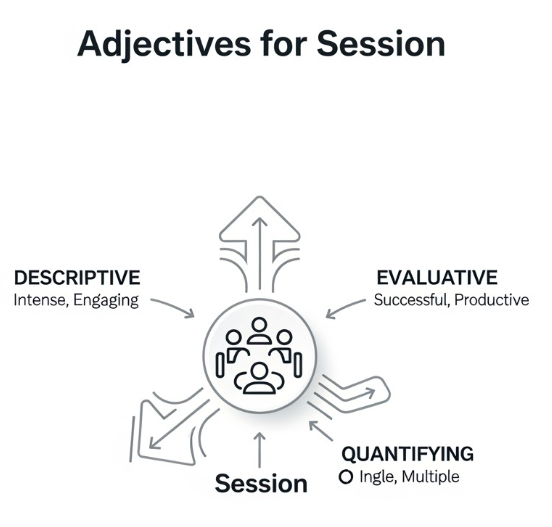
Adjectives can be classified into several categories based on their function. Descriptive adjectives provide information about the qualities or characteristics of the session (e.g., intense, interactive). Evaluative adjectives express an opinion or judgment about the session (e.g., successful, disappointing). Quantifying adjectives indicate the number or amount related to the session (e.g., multiple, single). Understanding these classifications helps in choosing the most appropriate adjective to convey the intended meaning.
Structural Breakdown
The structure of sentences using adjectives to describe sessions typically follows a fairly standard pattern. The adjective usually precedes the noun (“session”) it modifies. The basic structure is: Adjective + Session. For instance, “productive session,” “challenging session,” or “introductory session.”
However, adjectives can also appear after linking verbs such as “is,” “was,” “seems,” or “appears.” In this case, the structure is: Session + Linking Verb + Adjective. For example, “The session was productive,” or “The session seemed challenging.”
Multiple adjectives can also be used to describe a single session, adding layers of detail. When using multiple adjectives, they are usually separated by commas, with the last adjective preceded by “and.” For example, “a long, intense, and productive session.” The order of adjectives typically follows a general guideline: opinion, size, age, shape, color, origin, material, and purpose.
This is not a rigid rule, but it often leads to more natural-sounding sentences.
Types of Adjectives for Sessions
Descriptive Adjectives
Descriptive adjectives paint a picture of the session by providing information about its qualities or characteristics. These adjectives answer the question, “What kind of session is it?” They can describe the session’s atmosphere, content, or style.
Evaluative Adjectives
Evaluative adjectives convey an opinion or judgment about the session. These adjectives answer the question, “What was the session like?” They reflect the speaker’s or writer’s assessment of the session’s effectiveness, value, or impact.
Quantifying Adjectives
Quantifying adjectives specify the number or amount related to the session. These adjectives answer the question, “How many sessions?” or “How much of the session?” They provide numerical or quantitative information about the session.
Possessive Adjectives
Possessive adjectives show ownership or belonging. While less common with “session,” they could be used to indicate who the session belongs to or is primarily for.
Demonstrative Adjectives
Demonstrative adjectives point out specific sessions. The common demonstrative adjectives are “this,” “that,” “these,” and “those.”
Interrogative Adjectives
Interrogative adjectives are used to ask questions about sessions. The main interrogative adjectives are “which” and “whose.”
Examples of Adjectives for Sessions
Descriptive Adjective Examples
The following table provides examples of descriptive adjectives used to describe various types of sessions. These adjectives help to paint a more vivid picture of the session and its characteristics.
| Adjective | Example Sentence |
|---|---|
| Intense | The intense session left everyone feeling exhausted but fulfilled. |
| Interactive | The interactive session encouraged active participation from all attendees. |
| Informative | The informative session provided valuable insights into the latest industry trends. |
| Engaging | The engaging session kept the audience captivated from start to finish. |
| Practical | The practical session focused on hands-on exercises and real-world applications. |
| Theoretical | The theoretical session explored the underlying principles of the concept. |
| Lengthy | The lengthy session covered a wide range of topics in great detail. |
| Brief | The brief session provided a quick overview of the main points. |
| Detailed | The detailed session examined every aspect of the project. |
| Comprehensive | The comprehensive session covered all the essential information. |
| Dynamic | The dynamic session featured lively discussions and collaborative activities. |
| Structured | The structured session followed a clear agenda and timeline. |
| Unstructured | The unstructured session allowed for spontaneous conversations and exploration. |
| Collaborative | The collaborative session fostered teamwork and shared learning. |
| Individual | The individual session focused on personalized feedback and support. |
| Group | The group session encouraged peer interaction and collective problem-solving. |
| Introductory | The introductory session provided a basic understanding of the subject matter. |
| Advanced | The advanced session delved into complex concepts and techniques. |
| Online | The online session was conducted virtually via video conferencing. |
| In-person | The in-person session allowed for face-to-face interaction and networking. |
| Thematic | The thematic session explored a specific topic in depth. |
| Regular | The regular session is held every week. |
| Special | The special session was organized for a specific purpose. |
| Focused | The focused session helped students improve their writing skills. |
| General | The general session offered a broad overview of the subject. |
Evaluative Adjective Examples
The following table illustrates how evaluative adjectives can be used to express opinions about sessions. These adjectives reflect the speaker’s or writer’s judgment of the session’s quality or effectiveness.
| Adjective | Example Sentence |
|---|---|
| Successful | The successful session resulted in significant progress for the client. |
| Productive | The productive session generated several innovative ideas. |
| Effective | The effective session led to a noticeable improvement in performance. |
| Helpful | The helpful session provided valuable guidance and support. |
| Beneficial | The beneficial session had a positive impact on the team’s morale. |
| Valuable | The valuable session offered insights that were immediately applicable. |
| Excellent | The excellent session was well-organized and highly informative. |
| Outstanding | The outstanding session exceeded all expectations. |
| Impressive | The impressive session showcased the team’s expertise and dedication. |
| Positive | The positive session created a supportive and encouraging environment. |
| Disappointing | The disappointing session failed to meet the participants’ needs. |
| Unproductive | The unproductive session resulted in little progress and wasted time. |
| Ineffective | The ineffective session did not achieve its intended objectives. |
| Frustrating | The frustrating session was plagued by technical difficulties and interruptions. |
| Unhelpful | The unhelpful session offered no practical guidance or support. |
| Poor | The poor session was poorly organized and lacked clear direction. |
| Terrible | The terrible session was a complete waste of time and resources. |
| Awful | The awful session left everyone feeling discouraged and demotivated. |
| Subpar | The subpar session did not meet the expected standards. |
| Mediocre | The mediocre session was neither particularly good nor particularly bad. |
| Inspiring | The inspiring session motivated everyone to achieve their goals. |
| Transformative | The transformative session changed their perspectives. |
| Eye-opening | The eye-opening session revealed new information. |
| Humbling | The humbling session reminded them of their limitations. |
| Thought-provoking | The thought-provoking session stimulated new ideas. |
Quantifying Adjective Examples
The following table demonstrates the use of quantifying adjectives to specify the number or amount related to sessions. These adjectives provide numerical or quantitative information.
| Adjective | Example Sentence |
|---|---|
| Single | A single session is often not enough to address complex issues. |
| Multiple | Multiple sessions are usually required for long-term progress. |
| Several | Several sessions were dedicated to brainstorming new strategies. |
| Few | Only a few sessions were needed to achieve the initial goals. |
| Many | Many sessions were conducted over the course of the project. |
| Numerous | Numerous sessions were held to gather feedback from stakeholders. |
| First | The first session is typically an introductory meeting. |
| Second | The second session built upon the concepts introduced in the first. |
| Third | The third session focused on practical application of the skills learned. |
| Final | The final session summarized the key takeaways and next steps. |
| Half-day | The half-day session provided a condensed overview of the topic. |
| Full-day | The full-day session allowed for in-depth exploration and hands-on activities. |
| Weekly | The weekly session helps to keep everyone on track. |
| Monthly | The monthly session reviews overall progress. |
| Bi-weekly | The bi-weekly session strikes a balance for support. |
| Annual | The annual session allows for strategic planning. |
| Additional | An additional session was scheduled to address the unexpected challenges. |
| Regular | The regular sessions are an important part of the program. |
| Limited | A limited number of sessions are available. |
| Extended | An extended session was necessary to cover all the material. |
| One-hour | The one-hour session flew by quickly. |
| Two-hour | A two-hour session is planned for next week. |
| Minimum | A minimum of three sessions are required. |
| Maximum | A maximum of ten sessions can be scheduled. |
| Subsequent | Subsequent sessions will delve deeper. |
Usage Rules for Adjectives in Session Descriptions
When using adjectives to describe sessions, several rules should be followed to ensure clarity and accuracy. First, ensure that the adjective accurately reflects the characteristics of the session.
Avoid using vague or ambiguous adjectives that could be interpreted in multiple ways. For example, instead of saying “a good session,” specify what made the session good, such as “a productive session” or “an informative session.”
Second, pay attention to the order of adjectives when using multiple adjectives. While there isn’t a strict rule, a general guideline is to place opinion adjectives before fact adjectives.
For instance, “a valuable, interactive session” sounds more natural than “an interactive, valuable session.”
Third, be mindful of the connotations of the adjectives you choose. Some adjectives may carry unintended implications or biases.
For example, using the adjective “easy” to describe a session might suggest that it was not challenging or rigorous enough. Choose adjectives that accurately convey the intended meaning without introducing unintended negative connotations.
Fourth, ensure subject-verb agreement when using adjectives after linking verbs. If the subject (“session”) is singular, the verb should be singular, and vice versa.
For example, “The session was productive” (singular) and “The sessions were productive” (plural).
Finally, consider the context in which the adjective is being used. The same adjective can have different meanings depending on the context.
For example, “an intense session” could refer to a highly focused and productive session or a stressful and overwhelming session, depending on the situation.
Common Mistakes When Using Adjectives for Sessions
One common mistake is using adjectives that are too general or vague. For example, saying “It was a nice session” doesn’t provide much specific information.
Instead, use more descriptive adjectives like “informative,” “engaging,” or “productive” to give a clearer picture of what the session was like.
Another mistake is misusing adjectives that have similar meanings but different connotations. For instance, “strict” and “structured” both describe a session with clear rules, but “strict” implies a more rigid and potentially negative environment, while “structured” suggests organization and clarity.
Choosing the right word is crucial to conveying the intended message.
A third common mistake is using too many adjectives, which can make the description sound cluttered and unnatural. Instead of saying “a long, intense, challenging, and difficult session,” try to summarize the key aspects with fewer, more impactful adjectives, such as “a long and challenging session.”
Finally, incorrect placement of adjectives is a frequent error. Remember that adjectives usually come before the noun they modify.
Saying “session productive” instead of “productive session” is grammatically incorrect. However, when using a linking verb, the adjective comes after the verb: “The session was productive.”
Here are some examples of correct vs. incorrect usage:
| Incorrect | Correct | Explanation |
|---|---|---|
| Session good | Good session | Adjective should precede the noun. |
| The session was nicely | The session was nice | Use the correct form of the adjective. |
| A very session long | A very long session | Adjective order is important. |
| Session intense and long | An intense and long session | Use articles and correct word order. |
| The session was productively | The session was productive | Use the adjective form, not the adverb form. |
Practice Exercises
Complete the following sentences by filling in the blank with an appropriate adjective.
- The _______ session helped me understand the topic better.
- It was a very _______ session, and I learned a lot.
- We had a _______ session to discuss the project’s progress.
- The _______ session was designed for beginners.
- The _______ session focused on advanced techniques.
- The _______ session was a complete waste of time.
- The _______ session motivated me to work harder.
- The _______ session provided a clear overview of the subject.
- We scheduled an _______ session to address the remaining issues.
- The _______ session was very interactive and engaging.
Here are the answers to the practice exercises:
- The informative session helped me understand the topic better.
- It was a very productive session, and I learned a lot.
- We had a brief session to discuss the project’s progress.
- The introductory session was designed for beginners.
- The advanced session focused on advanced techniques.
- The unproductive session was a complete waste of time.
- The inspiring session motivated me to work harder.
- The comprehensive session provided a clear overview of the subject.
- We scheduled an additional session to address the remaining issues.
- The engaging session was very interactive and engaging.
Exercise 2: Rewrite the following sentences using more descriptive adjectives:
- It was a good session.
- The session was interesting.
- We had a long session.
- The session was helpful.
- It was a bad session.
Possible Answers:
- It was a productive and informative session.
- The session was captivating and thought-provoking.
- We had a lengthy and detailed session.
- The session was beneficial and supportive.
- It was a frustrating and unproductive session.
Exercise 3: Identify the type of adjective (descriptive, evaluative, or quantifying) used in each sentence:
- The intense session left everyone exhausted.
- The successful session resulted in significant progress.
- Multiple sessions are required for long-term goals.
- The collaborative session fostered teamwork.
- The disappointing session failed to meet expectations.
Answers:
- Intense: Descriptive
- Successful: Evaluative
- Multiple: Quantifying
- Collaborative: Descriptive
- Disappointing: Evaluative
Exercise 4: Choose the best adjective to complete the following sentences:
- This was a very (challenging/easy) session for the students.
- We had a (brief/lengthy) session to cover all the topics.
- The session was (organized/chaotic) and productive.
- The (first/last) session is usually an introduction.
- The (final/initial) session will determine if we made progress.
- The training was a very (helpfully/helpful) session.
- That (session/sectional) was very difficult to plan.
- The (productive/productively) session allowed us to finish the project.
- The (strict/structure) of the session was very helpful.
- The (online/offline) session was a success.
Answers:
- This was a very challenging session for the students.
- We had a lengthy session to cover all the topics.
- The session was organized and productive.
- The first session is usually an introduction.
- The final session will determine if we made progress.
- The training was a very helpful session.
- That session was very difficult to plan.
- The productive session allowed us to finish the project.
- The structure of the session was very helpful.
- The online session was a success.
Advanced Topics: Nuances and Subtleties
For advanced learners, understanding the subtle nuances of adjective usage can significantly enhance their writing and speaking skills. One advanced topic is the use of figurative language, such as metaphors and similes, to describe sessions.
For example, instead of saying “The session was intense,” you could say “The session was like a pressure cooker.”
Another advanced topic is the use of adjectives to create a specific tone or mood. Depending on the intended audience and purpose, you can choose adjectives that evoke certain emotions or attitudes.
For example, using adjectives like “innovative” and “groundbreaking” can create a sense of excitement and anticipation, while using adjectives like “serious” and “solemn” can create a more somber and reflective tone.
Furthermore, advanced learners should be aware of the cultural connotations of certain adjectives. Some adjectives may have different meanings or implications in different cultures.
For example, the adjective “direct” may be considered positive in some cultures, indicating honesty and clarity, but negative in others, suggesting rudeness or aggression.
Finally, mastering the art of combining adjectives effectively is an advanced skill. This involves not only choosing the right adjectives but also arranging them in a way that sounds natural and impactful.
Experiment with different combinations and pay attention to how the order of adjectives affects the overall meaning and tone of the sentence.
Frequently Asked Questions
- What is the difference between a descriptive and an evaluative adjective?Descriptive adjectives provide factual information about the session’s characteristics (e.g., “The session was long“). Evaluative adjectives express an opinion or judgment about the session (e.g., “The session was excellent“).
- How do I choose the right adjective to describe a session?Consider the specific characteristics of the session you want to highlight. Think about the session’s content, atmosphere, and outcome. Choose adjectives that accurately reflect these aspects and convey the intended meaning.
- Can I use multiple adjectives to describe a session?Yes, you can use multiple adjectives to provide a more detailed description. However, avoid using too many adjectives, as this can make the description sound cluttered and unnatural. Aim for a concise and impactful combination of adjectives.
- Where should I place adjectives in relation to the noun “session”?Adjectives usually precede the noun they modify (e.g., “a productive session”). However, when using a linking verb, the adjective comes after the verb (e.g., “The session was productive“).
- Are there any adjectives I should avoid using when describing sessions?Avoid using vague or ambiguous adjectives that could be interpreted in multiple ways. Also, be mindful of the connotations of the adjectives you choose and avoid using adjectives that may carry unintended negative implications.
- How can I improve my use of adjectives in session descriptions?Practice using a variety of adjectives in different contexts. Pay attention to how different adjectives affect the meaning and tone of your descriptions. Read widely and observe how skilled writers use adjectives to create vivid and impactful descriptions.
- What are some synonyms for ‘productive session’?Some synonyms for ‘productive session’ include: fruitful session, effective session, successful session, worthwhile session, and valuable session. The best choice depends on the specific nuance you want to convey.
- How can I make my session descriptions more engaging?Use strong and vivid adjectives that paint a clear picture in the reader’s mind. Consider using sensory details and figurative language to make your descriptions more memorable and impactful.
Conclusion
Mastering the use of adjectives to describe sessions is essential for effective communication. By understanding the different types of adjectives, following usage rules, avoiding common mistakes, and practicing regularly, you can significantly enhance your ability to convey precise and vivid descriptions of various types of sessions.
A rich and varied vocabulary of adjectives allows you to accurately represent the nuances of each particular session.
Remember to choose adjectives that accurately reflect the characteristics of the session, pay attention to the order of adjectives, be mindful of connotations, and consider the context in which the adjective is being used. As you continue to practice and refine your skills, you will become more confident and adept at using adjectives to create compelling and informative session descriptions.
Keep expanding your vocabulary and experimenting with different combinations to achieve the desired effect.