Knowing how to ask “Where is the bathroom?” in French is crucial for any traveler or language learner. This seemingly simple question can save you from awkward situations and ensure you can navigate your surroundings comfortably.
Mastering the various ways to phrase this question, along with understanding the nuances of French politeness, will greatly enhance your communication skills and cultural awareness. This article provides a comprehensive guide to answering this essential need, catering to beginners and advanced learners alike, ensuring you’re always prepared.
Whether you are a tourist, a student, or simply someone interested in expanding their linguistic abilities, this guide will equip you with the necessary vocabulary, grammar, and cultural insights to confidently ask for directions to the restroom in French. We will cover formal and informal expressions, common variations, and potential pitfalls to avoid, ensuring you can communicate effectively in any situation.
Table of Contents
- Introduction
- Definition: Asking for the Bathroom in French
- Structural Breakdown of Key Phrases
- Types and Categories of Expressions
- Examples: Asking Where the Bathroom Is
- Usage Rules and Politeness
- Common Mistakes to Avoid
- Practice Exercises
- Advanced Topics: Nuances and Regional Variations
- Frequently Asked Questions
- Conclusion
Definition: Asking for the Bathroom in French
Asking “Where is the bathroom?” in French involves more than just translating the words directly. It requires understanding the appropriate level of formality and choosing the right vocabulary for the context. The most common and widely accepted translation is “Où sont les toilettes ?”. However, several other phrases can be used depending on the situation and your relationship with the person you are asking. The core function is to politely inquire about the location of the restroom, and the goal is to do so in a way that is clear, respectful, and culturally appropriate.
The phrase “Où sont les toilettes ?” literally translates to “Where are the toilets?”. While “toilette” in French refers specifically to the toilet or restroom, it’s crucial to note that in many European contexts, including France, this term is commonly used and understood without being considered impolite or crude. The use of the plural “toilettes” is standard practice. Other terms, such as “salle de bains” (bathroom) or “cabinet” (room) might be used but are less specific and could refer to a bathroom with a bathtub or shower.
Structural Breakdown of Key Phrases
Understanding the structure of the key phrases will make it easier to use and adapt them. Let’s break down the most common expressions:
- Où sont les toilettes ?
- Où: Where
- sont: are (conjugation of the verb être, to be)
- les: the (plural definite article)
- toilettes: toilets (plural noun)
- Où est la salle de bains ?
- Où: Where
- est: is (conjugation of the verb être, to be)
- la: the (feminine singular definite article)
- salle de bains: bathroom (feminine noun)
- Où est le cabinet ?
- Où: Where
- est: is (conjugation of the verb être, to be)
- le: the (masculine singular definite article)
- cabinet: room (masculine noun – in this context, referring to the restroom)
The verb être (to be) is essential in these phrases. Its conjugation changes depending on whether you are asking about a singular or plural noun. For singular nouns like salle de bains or cabinet, use est. For the plural noun toilettes, use sont.
Types and Categories of Expressions
French, like any language, offers a spectrum of formality. Choosing the right expression depends on the context, your relationship with the person you are addressing, and the setting.
Here are some categories to consider:
Formal Expressions
Formal expressions are suitable for use with strangers, in professional settings, or when you want to show respect. These phrases are generally more polite and avoid any ambiguity.
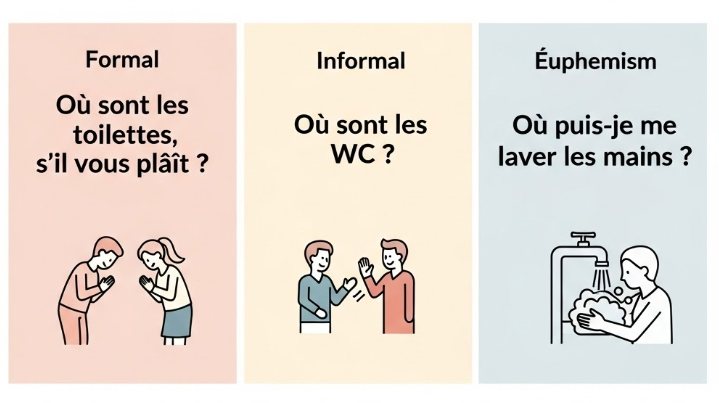
The most common formal expression is “Où sont les toilettes, s’il vous plaît ?” (Where are the toilets, please?). The addition of “s’il vous plaît” (please) is a key element of politeness in French.
Informal Expressions
Informal expressions are appropriate for use with friends, family, or people you know well. These phrases are more casual and may include slang or colloquial terms.
Examples include “Où sont les WC ?” (Where are the WCs?) or simply “Les toilettes, c’est où ?” (The toilets, where is it?). Note that “WC” is a common abbreviation for “water closet” and is widely understood.
Euphemisms
Euphemisms are indirect or less explicit ways of asking about the bathroom. These can be useful in situations where you want to be discreet or avoid being too direct.
Examples include “Excusez-moi, où est-ce que je pourrais me rafraîchir ?” (Excuse me, where could I freshen up?) or “Où puis-je me laver les mains ?” (Where can I wash my hands?). These phrases are less direct and can be useful in more formal or delicate situations.
Examples: Asking Where the Bathroom Is
Here are several examples of how to ask “Where is the bathroom?” in French, categorized by formality.
Formal Example Tables
The following table provides examples of formal ways to ask where the bathroom is. These phrases are suitable for use in restaurants, hotels, shops, or when addressing strangers.
| French Phrase | English Translation | Context |
|---|---|---|
| Où sont les toilettes, s’il vous plaît ? | Where are the toilets, please? | General formal inquiry |
| Excusez-moi, où sont les toilettes ? | Excuse me, where are the toilets? | Polite inquiry in a public place |
| Pourriez-vous m’indiquer les toilettes, s’il vous plaît ? | Could you show me the toilets, please? | Asking for directions in a formal setting |
| Madame/Monsieur, où se trouvent les toilettes ? | Madam/Sir, where are the toilets located? | Very formal, showing respect |
| Où est la salle d’eau, s’il vous plaît ? | Where is the washroom, please? | A slightly more formal alternative |
| Serait-il possible de savoir où se trouvent les toilettes ? | Would it be possible to know where the toilets are located? | Extremely polite and formal |
| Je suis désolé(e), mais où sont les toilettes ? | I am sorry, but where are the toilets? | Apologetic and polite |
| Pourriez-vous me diriger vers les toilettes, s’il vous plaît ? | Could you direct me to the toilets, please? | Polite request for directions |
| Excusez-moi de vous déranger, mais où sont les toilettes ? | Excuse me for bothering you, but where are the toilets? | Polite and considerate |
| S’il vous plaît, pourriez-vous m’indiquer l’emplacement des toilettes ? | Please, could you indicate the location of the toilets? | Very formal and precise |
| Je cherche les toilettes, s’il vous plaît. | I am looking for the toilets, please. | Polite and direct |
| Pourriez-vous me dire où se trouvent les sanitaires, s’il vous plaît ? | Could you tell me where the restrooms are located, please? | Using a more formal term for restrooms |
| Où puis-je trouver les toilettes, s’il vous plaît ? | Where can I find the toilets, please? | Polite and seeking assistance |
| Excusez-moi, sauriez-vous où sont les toilettes ? | Excuse me, would you know where the toilets are? | Polite and indirect |
| Auriez-vous l’amabilité de m’indiquer les toilettes, s’il vous plaît ? | Would you be kind enough to show me the toilets, please? | Very polite and formal |
| Je me permets de vous demander où sont les toilettes. | I take the liberty of asking you where the toilets are. | Highly formal and respectful |
| Pourriez-vous m’aider à trouver les toilettes, s’il vous plaît ? | Could you help me find the toilets, please? | Polite and seeking assistance |
| Où sont les lieux d’aisances, s’il vous plaît ? | Where are the lavatories, please? | An older, more formal term |
| S’il vous plaît, où se situe la toilette ? | Please, where is the toilet located? | A more literal translation, still polite |
| Pourriez-vous m’informer de l’emplacement des toilettes, s’il vous plaît ? | Could you inform me of the location of the toilets, please? | Very formal and proper |
| Excusez-moi, où se trouve le cabinet de toilette, s’il vous plaît ? | Excuse me, where is the washroom, please? | Using “cabinet de toilette” for washroom |
| Je souhaiterais savoir où se trouvent les toilettes, s’il vous plaît. | I would like to know where the toilets are, please. | Formal and polite |
| Pourriez-vous m’indiquer le chemin vers les toilettes, s’il vous plaît ? | Could you show me the way to the toilets, please? | Asking for directions with politeness |
These examples provide a range of formal options for asking about the location of the bathroom, ensuring you can maintain politeness and respect in various situations.
Informal Example Tables
The following table illustrates informal ways to ask where the bathroom is. These phrases are suitable for use with friends, family, or in casual settings.
| French Phrase | English Translation | Context |
|---|---|---|
| Où sont les WC ? | Where are the toilets/WCs? | Common informal question |
| Les toilettes, c’est où ? | The toilets, where is it? | Casual way of asking |
| Où est-ce qu’on peut se soulager ? | Where can one relieve oneself? | Slightly humorous and informal |
| Je peux aller aux toilettes ? | Can I go to the toilets? | Asking for permission |
| C’est où, les cabinets ? | Where is it, the restrooms? | Informal and direct |
| Où je peux pisser/faire pipi ? (very informal) | Where can I pee? | Very informal, use with caution |
| T’as vu les toilettes ? | Have you seen the toilets? | Asking someone if they know the location |
| Les WC, c’est par où ? | The WCs, which way is it? | Asking for directions informally |
| Je cherche les toilettes, tu sais où c’est ? | I’m looking for the toilets, do you know where it is? | Asking for help informally |
| Où est le petit coin ? | Where is the little corner? | A euphemistic and informal term |
| C’est où que je peux me vider la vessie ? (very informal) | Where can I empty my bladder? | Very informal and humorous |
| Où est-ce qu’on fait ses besoins ici ? | Where does one do their business here? | Informal and somewhat blunt |
| Tu sais où sont les chiottes ? (very informal) | Do you know where the toilets are? (very vulgar) | Very informal and vulgar, avoid unless among close friends |
| Les toilettes, elles sont où ? | The toilets, where are they? | Informal way of asking |
| Je dois aller aux toilettes, tu peux m’aider ? | I need to go to the toilets, can you help me? | Informal request for help |
| Où se trouve le trône ? (humorous) | Where is the throne located? | Humorous and informal |
| C’est par là les toilettes ? | Is it that way for the toilets? | Informal confirmation request |
| Y a des toilettes ici ? Elles sont où ? | Are there toilets here? Where are they? | Informal and direct |
| Où est-ce qu’on peut se débarrasser du surplus ? (humorous) | Where can we get rid of the surplus? | Humorous and informal |
| Je dois me soulager, tu sais où aller ? | I need to relieve myself, do you know where to go? | Informal and direct |
| Où est-ce que je peux me délester d’un poids ? (humorous) | Where can I unload some weight? | Humorous and informal |
| C’est où que je peux me garer pour faire le plein d’essence ? (humorous) | Where can I park to refuel? | Humorous and very informal |
| Tu sais où je peux aller me vider la vessie ? | Do you know where I can go to empty my bladder? | Informal and somewhat blunt |
These informal examples provide a range of options for asking about the location of the bathroom in casual settings. Be mindful of your audience and the context when using these phrases.
Variations and Additional Information Tables
This table includes variations and additional information that can be useful when asking about the bathroom in French.
| French Phrase | English Translation | Additional Information |
|---|---|---|
| Y a-t-il des toilettes ici ? | Are there toilets here? | Useful if you’re unsure if there are any facilities. |
| Où sont les toilettes pour hommes/femmes ? | Where are the men’s/women’s toilets? | Specifying the gender, if needed. |
| Est-ce qu’il y a des toilettes accessibles aux personnes handicapées ? | Are there toilets accessible to disabled people? | Asking about accessibility. |
| Les toilettes sont-elles payantes ? | Are the toilets paying? | Asking if there is a fee to use the toilets. |
| Comment aller aux toilettes ? | How to get to the toilets? | Asking for directions. |
| Où se trouve la clé des toilettes ? | Where is the key to the toilets? | Useful if the toilets are locked. |
| Où puis-je trouver du papier toilette ? | Where can I find toilet paper? | Useful if there is no toilet paper available. |
| Est-ce que les toilettes sont propres ? | Are the toilets clean? | Asking about the cleanliness of the toilets (less common). |
| Où est la poubelle dans les toilettes ? | Where is the trash can in the toilets? | Asking about the location of the trash can. |
| Est-ce qu’il y a un endroit pour changer les bébés ? | Is there a place to change babies? | Asking about baby changing facilities. |
| Où puis-je jeter mes déchets après avoir utilisé les toilettes ? | Where can I dispose of my waste after using the toilets? | Asking about waste disposal. |
| Est-ce que les toilettes sont ouvertes ? | Are the toilets open? | Useful if you are unsure if the toilets are accessible. |
| Y a-t-il un lavabo près des toilettes ? | Is there a sink near the toilets? | Asking about the availability of a sink. |
| Où puis-je me sécher les mains après m’être lavé les mains ? | Where can I dry my hands after washing them? | Asking about hand-drying facilities. |
| Est-ce qu’il y a du savon dans les toilettes ? | Is there soap in the toilets? | Asking about the availability of soap. |
| Où est le sèche-mains dans les toilettes ? | Where is the hand dryer in the toilets? | Asking about the location of the hand dryer. |
| Est-ce qu’il y a un miroir dans les toilettes ? | Is there a mirror in the toilets? | Asking about the presence of a mirror. |
| Où puis-je me débarrasser de mes serviettes hygiéniques ? | Where can I dispose of my sanitary napkins? | Asking about sanitary waste disposal (more personal). |
| Est-ce qu’il y a un distributeur de serviettes hygiéniques dans les toilettes ? | Is there a sanitary napkin dispenser in the toilets? | Asking about the availability of sanitary products. |
| Où puis-je trouver une prise de courant dans les toilettes ? | Where can I find an electrical outlet in the toilets? | Asking about the presence of an electrical outlet. |
| Est-ce qu’il y a une lumière dans les toilettes ? | Is there a light in the toilets? | Asking about the presence of lighting. |
| Où puis-je signaler un problème avec les toilettes ? | Where can I report a problem with the toilets? | Asking about reporting issues with the facilities. |
This table provides useful variations and additional information that can be helpful when asking about the bathroom, covering a range of practical scenarios and needs.
Usage Rules and Politeness
In French, politeness is paramount. Always use “s’il vous plaît” (please) when asking a question, especially to someone you don’t know. When addressing someone formally, use “Madame” (Madam) or “Monsieur” (Sir) before your question.
It’s also important to use the correct verb tense. The present tense is generally used when asking for directions. For example, “Où sont les toilettes ?” (Where are the toilets?) is correct, while “Où étaient les toilettes ?” (Where were the toilets?) would be incorrect unless you are asking about a past location.
Be aware of your tone of voice and body language. Maintain a respectful and courteous demeanor.
Avoid being too loud or demanding.
Common Mistakes to Avoid
One common mistake is using the singular form of “toilette” when asking for directions. Remember that the plural form, “toilettes”, is almost always used.
Another mistake is omitting “s’il vous plaît” when asking a stranger. This can come across as rude or demanding. Always remember to include this key phrase.
Using overly informal language in formal situations is also a common error. Avoid using slang or colloquial terms when addressing someone you don’t know or in a professional setting.
Here are some examples of common mistakes and their corrections:
| Incorrect | Correct | Explanation |
|---|---|---|
| Où est la toilette ? | Où sont les toilettes ? | Use the plural form “toilettes.” |
| Où sont les toilettes ? (without “s’il vous plaît”) | Où sont les toilettes, s’il vous plaît ? | Always include “s’il vous plaît” when asking a stranger. |
| Où sont les chiottes ? (to a stranger) | Où sont les toilettes, s’il vous plaît ? | Avoid using vulgar language in formal situations. |
| Je veux aller aux toilettes. | Je voudrais aller aux toilettes, s’il vous plaît. | Use “je voudrais” (I would like) for a more polite request. |
Practice Exercises
Test your knowledge with these practice exercises. Translate the following sentences into French, using the appropriate level of formality.
- Where are the toilets, please? (formal)
- Where are the WCs? (informal)
- Excuse me, where are the toilets? (polite)
- The toilets, where is it? (casual)
- Could you show me the toilets, please? (formal)
- Where can I wash my hands? (euphemism)
- Where are the restrooms? (general)
- I am looking for the toilets, do you know where it is? (informal)
- Madam, where are the toilets located? (very formal)
- Is there a toilet here? (general)
Answers:
- Où sont les toilettes, s’il vous plaît ?
- Où sont les WC ?
- Excusez-moi, où sont les toilettes ?
- Les toilettes, c’est où ?
- Pourriez-vous m’indiquer les toilettes, s’il vous plaît ?
- Où puis-je me laver les mains ?
- Où sont les toilettes/les sanitaires ?
- Je cherche les toilettes, tu sais où c’est ?
- Madame, où se trouvent les toilettes ?
- Y a-t-il des toilettes ici ?
Exercise 2: Fill in the Blanks
Complete the following sentences with the correct words.
- ________ sont les toilettes, ________ vous plaît ? (formal)
- Les ________, c’est ________ ? (informal)
- Où ________ les WC ? (informal)
- Excusez-________, où ________ les toilettes ? (polite)
- ________-vous m’indiquer les toilettes, ________ vous plaît ? (formal)
- Où puis-________ me laver les ________ ? (euphemism)
- Madame, où ________ ________ les toilettes ? (very formal)
- Je ________ les toilettes, tu ________ où c’est ? (informal)
- ________-il des toilettes ________ ? (general)
- Je ________ aller aux toilettes, ________ vous plaît. (polite request)
Answers:
- Où sont les toilettes, s’il vous plaît ?
- Les toilettes, c’est où ?
- Où sont les WC ?
- Excusez-moi, où sont les toilettes ?
- Pourriez-vous m’indiquer les toilettes, s’il vous plaît ?
- Où puis-je me laver les mains ?
- Madame, où se trouvent les toilettes ?
- Je cherche les toilettes, tu sais où c’est ?
- Y-il des toilettes ici ?
- Je voudrais aller aux toilettes, s’il vous plaît.
Exercise 3: Matching
Match the French phrase with its English translation.
- Où sont les toilettes, s’il vous plaît ?
- Où sont les WC ?
- Excusez-moi, où sont les toilettes ?
- Les toilettes, c’est où ?
- Y a-t-il des toilettes ici ?
A. Are there toilets here?
B. Where are the toilets, please?
C. Excuse me, where are the toilets?
D. Where are the WCs?
E. The toilets, where is it?
Answers:
- B
- D
- C
- E
- A
Advanced Topics: Nuances and Regional Variations
In some regions of France, you might hear different terms for the bathroom. For example, in certain rural areas, “le petit coin” (the little corner) might be used as a euphemism. Additionally, the level of formality can vary depending on the region. In more traditional areas, a higher level of politeness might be expected.
Understanding the cultural context is also important. In France, it is generally considered polite to avoid discussing bodily functions in public.
Therefore, using euphemisms or being discreet when asking about the bathroom is often appreciated.
Furthermore, it’s useful to know how to ask for other related items or facilities, such as soap, paper towels, or a baby changing station. Knowing these phrases can be particularly helpful when traveling with children or if you have specific needs.
Frequently Asked Questions
- Is it rude to ask “Où sont les toilettes ?”No, it is not inherently rude, especially if you add “s’il vous plaît.” However, be mindful of your tone and body language. Politeness is key in French culture.
- What is the difference between “salle de bains” and “toilettes”?“Salle de bains” refers to a bathroom, which typically includes a bathtub or shower. “Toilettes” specifically refers to the restroom or toilet.
- Is “WC” a common term in France?Yes, “WC” is a common abbreviation for “water closet” and is widely understood as referring to the toilet.
- What should I do if I don’t understand the directions I am given?Politely ask the person to repeat the directions or to write them down for you. You can say, “Pourriez-vous répéter, s’il vous plaît ?” (Could you repeat, please?) or “Pourriez-vous l’écrire, s’il vous plaît ?” (Could you write it down, please?).
- How do I ask if there is a toilet for disabled people?You can ask, “Est-ce qu’il y a des toilettes accessibles aux personnes handicapées ?” (Are there toilets accessible to disabled people?).
- What if the toilets are locked?Ask for the key by saying, “Où est la clé des toilettes ?” (Where is the key to the toilets?).
- How can I ask if the toilets are free or if I need to pay?You can ask, “Est-ce que les toilettes sont payantes ?” (Are the toilets paying?).
- What is a very polite way to ask where the bathroom is?A very polite way to ask is: “Auriez-vous l’amabilité de m’indiquer les toilettes, s’il vous plaît?” (Would you be kind enough to show me the toilets, please?).
Conclusion
Mastering how to ask “Where is the bathroom?” in French is a vital skill for effective communication and cultural sensitivity. By understanding the different levels of formality, common phrases, and potential pitfalls, you can confidently navigate various situations and ensure your needs are met politely and respectfully.
Remember to always prioritize politeness by using “s’il vous plaît” and adapting your language to the context.
This guide has provided you with a comprehensive overview of the necessary vocabulary, grammar, and cultural insights. Keep practicing these phrases and expanding your knowledge of French language and culture.
With a little effort and attention to detail, you’ll be well-equipped to ask for directions to the restroom in any French-speaking environment, enhancing your travel experiences and linguistic capabilities. Bon voyage!