
Understanding antonyms, or words with opposite meanings, is crucial for effective communication. It enriches your vocabulary, sharpens your comprehension skills, and allows you to express yourself with greater precision.
This article provides a comprehensive guide to antonyms, exploring their definition, types, usage rules, common mistakes, and practical exercises. Whether you’re a student, a professional, or simply someone who loves language, this guide will help you unlock the power of opposites and enhance your mastery of the English language.
By the end of this article, you’ll be equipped with the knowledge and tools to identify, understand, and effectively use antonyms in your writing and speech. This skill will not only improve your vocabulary but also your critical thinking and analytical abilities, making you a more confident and articulate communicator.
Table of Contents
- Definition of Antonyms
- Structural Breakdown
- Types of Antonyms
- Examples of Antonyms
- Usage Rules for Antonyms
- Common Mistakes with Antonyms
- Practice Exercises
- Advanced Topics in Antonyms
- Frequently Asked Questions (FAQ)
- Conclusion
Definition of Antonyms
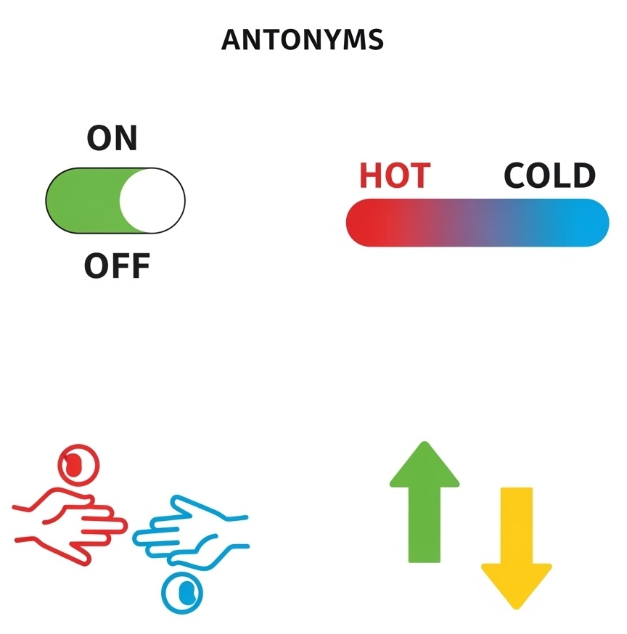
An antonym is a word that expresses the opposite meaning of another word. Antonyms are essential components of language, providing contrast and allowing for nuanced expression. They help us define terms, clarify concepts, and create balance in our communication. Understanding antonyms is not just about knowing opposite words; it’s about understanding the relationship between words and how they function within a sentence.
Antonyms can be categorized based on the nature of their opposition. This classification helps us understand the specific type of relationship between two words and how they can be used effectively.
For instance, some antonyms are absolute opposites, while others represent degrees of a spectrum. The context in which antonyms are used also plays a crucial role in determining their appropriateness and effectiveness.
Structural Breakdown
The structure of antonyms can be understood through various linguistic perspectives. Many antonyms are formed by adding prefixes to existing words. Common prefixes that create antonyms include un-, in-, im-, dis-, non-, and a-. For example, “happy” becomes “unhappy” with the addition of the prefix un-. Similarly, “visible” becomes “invisible” with the prefix in-.
However, not all antonyms are formed with prefixes. Many are entirely different words that have evolved to represent opposite meanings. These are often referred to as lexical antonyms. Examples include “good” and “bad,” “hot” and “cold,” and “day” and “night.” Understanding whether an antonym is formed through prefixation or is a lexical antonym can aid in vocabulary building and comprehension.
Types of Antonyms
Antonyms are not all created equal. They fall into several categories based on the nature of their opposition.
Recognizing these categories will enhance your understanding and use of antonyms.
Complementary Antonyms
Complementary antonyms are pairs where the existence of one implies the non-existence of the other. There is no middle ground or overlap. If one is true, the other must be false. Common examples include “alive” and “dead,” “on” and “off,” and “male” and “female.”
In this type of antonymy, one term completely negates the other. There are no intermediate states or degrees.
The relationship is binary, with one option excluding the other. This type of antonym is often used in logical statements and categorical distinctions.
Gradable Antonyms
Gradable antonyms represent opposite ends of a spectrum. There are intermediate degrees between the two terms. Examples include “hot” and “cold,” “big” and “small,” and “happy” and “sad.” These antonyms allow for comparisons and varying degrees of intensity.
Unlike complementary antonyms, gradable antonyms permit a range of values between the two extremes. One can be “warm,” which is neither “hot” nor “cold.” This type of antonymy is common in descriptive language and subjective assessments.
The context often determines the specific point on the spectrum that a term represents.
Relational Antonyms
Relational antonyms describe a relationship from opposite perspectives. One word implies the existence of the other, but they represent different roles or viewpoints. Examples include “buy” and “sell,” “teacher” and “student,” and “give” and “receive.”
These antonyms are interdependent; one cannot exist without the other. They define a reciprocal relationship, where each term describes a different side of the same interaction.
Understanding relational antonyms is crucial for comprehending the dynamics of social and economic interactions.
Reverse Antonyms
Reverse antonyms indicate movement or a process in opposite directions. They describe actions that undo each other. Examples include “enter” and “exit,” “increase” and “decrease,” and “ascend” and “descend.”
These antonyms often involve a change in state or position, with one term reversing the effect of the other. They are commonly used in describing physical actions and quantitative changes.
The relationship between reverse antonyms highlights the dynamic nature of processes and transformations.
Examples of Antonyms
To solidify your understanding of antonyms, let’s explore a wide range of examples, categorized by type. This will help you recognize and use antonyms effectively in various contexts.
The following tables provide extensive examples of antonyms, categorized by type. Each table includes a variety of common and less common antonym pairs to broaden your vocabulary and understanding.
Complementary Antonyms Examples
This table showcases complementary antonyms, where one word’s existence completely negates the other. These pairs have no middle ground.
| Word | Antonym |
|---|---|
| Alive | Dead |
| On | Off |
| Male | Female |
| True | False |
| Single | Married |
| Present | Absent |
| Guilty | Innocent |
| Pass | Fail |
| Open | Closed |
| Start | Finish |
| Push | Pull |
| In | Out |
| Up | Down |
| Yes | No |
| Even | Odd |
| Accept | Reject |
| Arrive | Depart |
| Begin | End |
| Connect | Disconnect |
| Include | Exclude |
| Import | Export |
| Inflate | Deflate |
| Occupy | Vacate |
| Remember | Forget |
| Succeed | Fail |
Gradable Antonyms Examples
This table provides examples of gradable antonyms, which lie on a spectrum. Words can fall between these opposites.
| Word | Antonym |
|---|---|
| Hot | Cold |
| Big | Small |
| Happy | Sad |
| Tall | Short |
| Good | Bad |
| Fast | Slow |
| Easy | Difficult |
| Rich | Poor |
| Strong | Weak |
| Light | Dark |
| Loud | Quiet |
| Old | Young |
| Near | Far |
| Beautiful | Ugly |
| Expensive | Cheap |
| Kind | Cruel |
| Brave | Cowardly |
| Clever | Stupid |
| Generous | Stingy |
| Healthy | Sick |
| Important | Trivial |
| Interesting | Boring |
| Optimistic | Pessimistic |
| Polite | Rude |
| Safe | Dangerous |
Relational Antonyms Examples
The following table illustrates relational antonyms, where the words describe opposing roles in a relationship.
| Word | Antonym |
|---|---|
| Buy | Sell |
| Teacher | Student |
| Give | Receive |
| Doctor | Patient |
| Parent | Child |
| Employer | Employee |
| Landlord | Tenant |
| Lender | Borrower |
| Husband | Wife |
| Predator | Prey |
| Question | Answer |
| Send | Receive |
| Above | Below |
| Before | After |
| Front | Back |
| Leader | Follower |
| Owner | Renter |
| Speaker | Listener |
| Subject | Object |
| Winner | Loser |
| Author | Reader |
| Director | Actor |
| Manufacturer | Consumer |
| Prosecutor | Defendant |
| Supplier | Customer |
Reverse Antonyms Examples
This table highlights reverse antonyms, where the words describe actions that undo each other.
| Word | Antonym |
|---|---|
| Enter | Exit |
| Increase | Decrease |
| Ascend | Descend |
| Advance | Retreat |
| Build | Destroy |
| Construct | Demolish |
| Tighten | Loosen |
| Open | Close |
| Fill | Empty |
| Ignite | Extinguish |
| Inhale | Exhale |
| Lock | Unlock |
| Repair | Break |
| Start | Stop |
| Straighten | Bend |
| Add | Subtract |
| Attach | Detach |
| Confirm | Deny |
| Encode | Decode |
| Expand | Contract |
| Include | Exclude |
| Join | Separate |
| Pack | Unpack |
| Raise | Lower |
| Reveal | Conceal |
Usage Rules for Antonyms
Using antonyms effectively involves understanding the nuances of their meanings and the contexts in which they are appropriate. Here are some key rules to consider:
- Context is Key: The meaning of a word can change depending on the context. Therefore, the appropriate antonym also depends on the context. For example, the antonym of “heavy” might be “light” in the context of weight, but “easy” in the context of a task.
- Consider the Degree: With gradable antonyms, consider the degree of opposition you want to convey. “Cool” is an antonym of “hot,” but it’s less extreme than “freezing.”
- Avoid False Antonyms: Be careful not to assume that every word has a perfect antonym. Sometimes, the opposite meaning is expressed through a phrase or a more complex construction.
- Use Antonyms for Emphasis: Antonyms can be used to create emphasis and highlight contrasts in your writing or speech. For example, “It was not hot; it was freezing.”
- Be Aware of Connotations: Some antonyms may have different connotations. For example, “thrifty” and “stingy” are both antonyms of “wasteful,” but “thrifty” has a more positive connotation.
Understanding these rules will help you use antonyms with greater accuracy and effectiveness, enhancing your communication skills.
Common Mistakes with Antonyms
Even experienced language users can make mistakes when using antonyms. Here are some common errors to watch out for:
- Incorrect Prefix Usage: Adding the wrong prefix to create an antonym (e.g., “unpossible” instead of “impossible”).
- Choosing the Wrong Type of Antonym: Using a gradable antonym when a complementary antonym is more appropriate (e.g., saying something is “not alive” when it is clearly “dead”).
- Ignoring Context: Selecting an antonym that doesn’t fit the specific context of the sentence (e.g., using “short” as the antonym of “long” when referring to a movie, instead of “brief”).
- Over-Reliance on Thesauruses: While thesauruses can be helpful, they may not always provide the most accurate antonym. Always consider the nuances of meaning and context.
- Using Antonyms Inconsistently: Switching between different antonyms for the same word within a piece of writing, leading to confusion.
Here are some examples of common mistakes and their corrections:
| Incorrect | Correct | Explanation |
|---|---|---|
| The door was unopen. | The door was closed. | “Unopen” is not a standard word; “closed” is the correct antonym of “open.” |
| He was not happy, he was okay. | He was not happy, he was sad. | “Okay” is a neutral term, not a direct antonym of “happy.” |
| The movie was long, so I found it short. | The movie was long, so I found it brief. | “Brief” is a more appropriate antonym for “long” when referring to the duration of a movie. |
| She is very untidy. | She is very neat. | “Neat” is a more common and natural antonym for “untidy” than “tidy”. |
| The food was not hot; it was warm. | The food was not hot; it was cold. | While “warm” is related to “hot,” “cold” is the direct opposite on the temperature spectrum. |
Practice Exercises
Test your understanding of antonyms with these practice exercises. Each exercise focuses on different aspects of antonymy, from identifying antonyms to using them in sentences.
Exercise 1: Identifying Antonyms
Choose the best antonym for each word from the options provided.
| Question | Word | Option A | Option B | Option C | Option D | Answer |
|---|---|---|---|---|---|---|
| 1 | Happy | Joyful | Sad | Content | Excited | B |
| 2 | Big | Large | Huge | Small | Enormous | C |
| 3 | Fast | Quick | Rapid | Slow | Swift | D |
| 4 | Good | Excellent | Bad | Wonderful | Great | B |
| 5 | Hot | Warm | Boiling | Cold | Toasty | C |
| 6 | Light | Bright | Dark | Radiant | Shining | B |
| 7 | Easy | Simple | Difficult | Effortless | Straightforward | B |
| 8 | Start | Begin | Commence | Finish | Initiate | C |
| 9 | True | Correct | Accurate | False | Right | D |
| 10 | Up | Above | High | Down | Over | C |
Exercise 2: Completing Sentences with Antonyms
Fill in the blank with the best antonym for the word in parentheses.
| Question | Sentence | Answer |
|---|---|---|
| 1 | The weather was not ________ (cold), it was hot. | cold |
| 2 | The answer was not ________ (right), it was wrong. | right |
| 3 | The room was not ________ (clean), it was dirty. | clean |
| 4 | The test was not ________ (easy), it was difficult. | easy |
| 5 | The movie was not ________ (short), it was long. | short |
| 6 | The door was not ________ (open), it was closed. | open |
| 7 | The glass was not ________ (full), it was empty. | full |
| 8 | The shirt was not ________ (new), it was old. | new |
| 9 | The car was not ________ (fast), it was slow. | fast |
| 10 | The building was not ________ (tall), it was short. | tall |
Exercise 3: Identifying Types of Antonyms
Identify the type of antonym (complementary, gradable, relational, or reverse) for each pair of words.
| Question | Word Pair | Type of Antonym |
|---|---|---|
| 1 | Alive/Dead | Complementary |
| 2 | Hot/Cold | Gradable |
| 3 | Buy/Sell | Relational |
| 4 | Enter/Exit | Reverse |
| 5 | Happy/Sad | Gradable |
| 6 | On/Off | Complementary |
| 7 | Teacher/Student | Relational |
| 8 | Increase/Decrease | Reverse |
| 9 | Big/Small | Gradable |
| 10 | Male/Female | Complementary |
Exercise 4: Using Antonyms in Context
Rewrite each sentence using an antonym for the underlined word to create a sentence with the opposite meaning.
| Question | Original Sentence | Rewritten Sentence |
|---|---|---|
| 1 | The coffee is hot. | The coffee is cold. |
| 2 | The book is interesting. | The book is boring. |
| 3 | The task is easy. | The task is difficult. |
| 4 | The room is bright. | The room is dark. |
| 5 | The answer is correct. | The answer is wrong. |
| 6 | The door is open. | The door is closed. |
| 7 | The road is wide. | The road is narrow. |
| 8 | The shirt is clean. | The shirt is dirty. |
| 9 | The water is deep. | The water is shallow. |
| 10 | The food is delicious. | The food is disgusting. |
Advanced Topics in Antonyms
For advanced learners, exploring more complex aspects of antonymy can further refine their understanding and usage. These topics include:
- Multiple Antonyms: Some words have multiple antonyms, depending on the specific meaning or context. For example, the antonym of “increase” can be “decrease,” “reduce,” or “lessen.”
- Antonyms in Figurative Language: Antonyms can be used in metaphors, similes, and other figures of speech to create vivid imagery and convey complex ideas.
- Antonyms in Rhetoric: Antonyms are powerful tools in rhetoric, used to create contrast, emphasize points, and persuade audiences.
- Cross-Lingual Antonyms: Exploring antonyms in different languages can reveal cultural differences and nuances in meaning.
Delving into these advanced topics will enhance your ability to use antonyms creatively and effectively in various forms of communication.
Frequently Asked Questions (FAQ)
Here are some frequently asked questions about antonyms, along with detailed answers to help clarify any remaining points.
- What is the difference between an antonym and a synonym?An antonym is a word that has the opposite meaning of another word, while a synonym is a word that has a similar meaning. Antonyms create contrast, while synonyms provide alternative ways to express the same idea.
- How can I improve my vocabulary of antonyms?Reading widely, using a thesaurus, and practicing with exercises are all effective ways to improve your vocabulary of antonyms. Pay attention to how antonyms are used in context and try to incorporate them into your own writing and speech.
- Are there any words that don’t have antonyms?Yes, some words do not have direct antonyms. These are often highly specific or technical terms. In such cases, you may need to use a phrase or a more complex construction to express the opposite meaning.
- Can a word have more than one antonym?Yes, a word can have multiple antonyms, depending on the context and the specific meaning you want to convey. For example, the antonym of “good” can be “bad,” “evil,” or “poor,” depending on the situation.
- How important are antonyms in writing?Antonyms are very important in writing. They help to create contrast, emphasize points, and add depth to your writing. Using antonyms effectively can make your writing more engaging and persuasive.
- What is the best way to use a thesaurus to find antonyms?When using a thesaurus, always consider the context of your sentence. Read the definitions and examples provided to ensure that the antonym you choose is appropriate and conveys the intended meaning. Don’t rely solely on the thesaurus; use your own judgment and understanding of the language.
- How do prefixes like “un-,” “in-,” and “dis-” create antonyms?Prefixes like “un-,” “in-,” and “dis-” are added to the beginning of words to negate their meaning, effectively creating antonyms. For example, “happy” becomes “unhappy,” “visible” becomes “invisible,” and “agree” becomes “disagree.” However, not all words can be negated with these prefixes, and some may require different prefixes or entirely different words to form antonyms.
- What are some common mistakes to avoid when using antonyms?Common mistakes include using incorrect prefixes, choosing the wrong type of antonym for the context, ignoring the nuances of meaning, and over-relying on thesauruses without considering the specific context. Always double-check your choices and consider the overall meaning of your sentence.
Conclusion
Mastering antonyms is a valuable skill that enhances your vocabulary, improves your communication, and sharpens your critical thinking. By understanding the different types of antonyms, their usage rules, and common mistakes to avoid, you can effectively use opposites to express yourself with greater precision and impact.
Continue to practice identifying and using antonyms in your daily reading and writing. The more you engage with these powerful words, the more fluent and confident you will become in your use of the English language.
Embrace the power of opposites and unlock new possibilities in your communication.