The English language is rich with descriptive words, and understanding how to use adjectives effectively is crucial for vivid and precise communication. Describing a smirk, a subtle and often ambiguous facial expression, requires a nuanced vocabulary.
This article provides a comprehensive guide to adjectives that can be used to describe a smirk, exploring their meanings, usage, and the subtle differences between them. Whether you’re a student, writer, or simply looking to improve your command of English, this guide will equip you with the tools to depict a smirk with accuracy and flair.
This guide will benefit anyone seeking to enhance their descriptive writing skills, including students, authors, ESL learners, and anyone with an interest in language. By understanding the nuances of these adjectives, you can add depth and precision to your descriptions, making your writing more engaging and impactful.
Table of Contents
- What is a Smirk? Defining the Expression
- Structural Considerations: Adjectives and Placement
- Types of Adjectives for Describing a Smirk
- Examples of Adjectives in Use
- Usage Rules and Considerations
- Common Mistakes to Avoid
- Practice Exercises
- Advanced Topics: Nuances and Context
- Frequently Asked Questions
- Conclusion
What is a Smirk? Defining the Expression
A smirk is a facial expression characterized by a slight smile, often conveying smugness, self-satisfaction, or a hint of irony. It is a subtle expression, more pronounced than a simple smile but less overt than a full grin. The meaning of a smirk is highly dependent on context and the individual displaying it. It can range from playful amusement to outright disdain. Understanding the nuances of a smirk is critical to choosing the right adjectives to describe it accurately.
A smirk is not merely a physical phenomenon; it’s a communicative act. It can signal agreement, disagreement, superiority, or even secret knowledge.
The interpretation of a smirk often relies heavily on non-verbal cues such as eye contact, body language, and the surrounding situation. The adjectives used to describe a smirk can significantly shape the reader’s perception of the character or situation being described.
Structural Considerations: Adjectives and Placement
When describing a smirk, adjectives typically precede the noun they modify. The standard structure is: Adjective + Noun (Smirk). However, adjectives can also follow a linking verb (e.g., “to be,” “to seem,” “to appear”) to describe the subject. For instance, “His smirk was knowing.” The choice of placement can subtly alter the emphasis of the sentence.
Adjectives can also be modified by adverbs to further refine their meaning. For example, “a slightly sardonic smirk” or “a genuinely amused smirk.” The use of adverbs allows for a more precise and nuanced description of the smirk. Pay attention to the cumulative effect of adjectives and adverbs to create the desired impression.
Types of Adjectives for Describing a Smirk
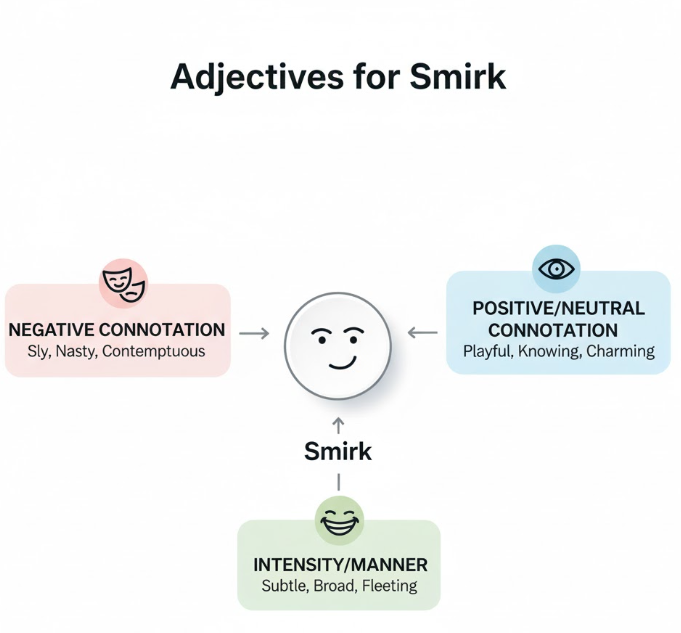
Adjectives that describe a smirk can be broadly categorized into those with positive, negative, and neutral connotations. These categories help to understand the overall impression that the smirk conveys.
Positive Connotations
Adjectives with positive connotations suggest amusement, playfulness, or a sense of lightheartedness. These adjectives often imply that the character is good-natured or simply enjoying a moment of levity. Examples include: amused, playful, knowing, mischievous, wry, teasing, gentle, delighted, impish, and secretive.
Negative Connotations
Adjectives with negative connotations convey feelings of smugness, arrogance, contempt, or disdain. These adjectives often suggest that the character is condescending or malicious. Examples include: smug, arrogant, condescending, contemptuous, disdainful, cynical, sardonic, scornful, superior, and mocking.
Neutral Connotations
Adjectives with neutral connotations simply describe the physical appearance of the smirk without implying any particular emotion or judgment. These adjectives focus on the shape or quality of the expression itself. Examples include: slight, subtle, faint, crooked, wry, enigmatic, ambiguous, peculiar, and unreadable.
Examples of Adjectives in Use
The following tables provide examples of how different adjectives can be used to describe a smirk, categorized by their connotation.
Positive Smirks
This table showcases adjectives with positive connotations, illustrating how they can be used to describe a smirk that conveys amusement, playfulness, or a sense of lightheartedness. Each example aims to demonstrate the subtle nuances these adjectives bring to the description.
| Adjective | Example Sentence |
|---|---|
| Amused | He gave an amused smirk as she recounted the embarrassing story. |
| Playful | A playful smirk danced on her lips as she considered his offer. |
| Knowing | She offered a knowing smirk, suggesting she was in on the secret. |
| Mischievous | A mischievous smirk crept across his face as he planned his prank. |
| Wry | He delivered a wry smirk, acknowledging the absurdity of the situation. |
| Teasing | With a teasing smirk, she challenged him to a race. |
| Gentle | A gentle smirk softened his features as he watched the children play. |
| Delighted | A delighted smirk appeared when she opened the unexpected gift. |
| Impish | An impish smirk suggested he was up to no good. |
| Secretive | He wore a secretive smirk, guarding his private thoughts. |
| Cheeky | A cheeky smirk told her he wasn’t taking her seriously. |
| Bemused | He watched with a bemused smirk, unsure what to make of the scene. |
| Jocular | A jocular smirk accompanied his lighthearted jab. |
| Saucy | She gave him a saucy smirk, daring him to respond. |
| Roguish | A roguish smirk hinted at his adventurous past. |
| Whimsical | A whimsical smirk added to his eccentric charm. |
| Coy | She glanced at him with a coy smirk, feigning disinterest. |
| Merry | A merry smirk lit up his face as he shared the joke. |
| Innocent | She gave him an innocent smirk, hiding her true intentions. |
| Lighthearted | A lighthearted smirk suggested he didn’t take the matter too seriously. |
| Waggish | He offered a waggish smirk, clearly enjoying his own cleverness. |
| Facetious | A facetious smirk accompanied his sarcastic remark. |
| Jesting | With a jesting smirk, he downplayed the seriousness of the situation. |
Negative Smirks
This table presents adjectives with negative connotations, demonstrating their use in describing a smirk that conveys smugness, arrogance, contempt, or disdain. The examples illustrate how these adjectives can add a layer of negativity and judgment to the description, creating a more critical or disapproving tone.
| Adjective | Example Sentence |
|---|---|
| Smug | A smug smirk spread across his face as he accepted the award. |
| Arrogant | His arrogant smirk made it clear he thought he was superior. |
| Condescending | She gave a condescending smirk, implying she knew better. |
| Contemptuous | A contemptuous smirk betrayed his true feelings about the project. |
| Disdainful | He looked at her with a disdainful smirk, showing his lack of respect. |
| Cynical | A cynical smirk twisted his lips as he heard the politician’s promises. |
| Sardonic | His sardonic smirk revealed his bitter outlook on life. |
| Scornful | She shot him a scornful smirk, dismissing his efforts. |
| Superior | A superior smirk indicated he believed he was above the rules. |
| Mocking | His mocking smirk fueled her anger. |
| Derisive | A derisive smirk suggested he found her efforts laughable. |
| Haughty | He wore a haughty smirk, emphasizing his elevated status. |
| Pompous | A pompous smirk betrayed his inflated sense of self-importance. |
| Snide | She gave him a snide smirk, delivering her insult subtly. |
| Supercilious | A supercilious smirk showed his utter lack of regard for her opinion. |
| Ironic | An ironic smirk suggested he didn’t believe a word he was saying. |
| Skeptical | He raised an eyebrow with a skeptical smirk, doubting the claim. |
| Taunting | A taunting smirk challenged her to retaliate. |
| Disapproving | She gave him a disapproving smirk, signaling her displeasure. |
| Judgmental | A judgmental smirk revealed her critical assessment of the situation. |
| Belittling | His belittling smirk undermined her confidence. |
| Contradictory | A contradictory smirk made his intentions unclear. |
| Skeptical | He offered a skeptical smirk, clearly unconvinced by the explanation. |
Neutral Smirks
This table provides examples of adjectives with neutral connotations, focusing on describing the physical appearance of the smirk without implying any particular emotion or judgment. These adjectives are useful for painting a picture of the smirk’s appearance, shape, or quality, allowing the reader to interpret the expression based on the context and other cues.
| Adjective | Example Sentence |
|---|---|
| Slight | A slight smirk played on the corner of his mouth. |
| Subtle | The subtle smirk was almost imperceptible. |
| Faint | A faint smirk hinted at amusement. |
| Crooked | A crooked smirk gave him a rakish appearance. |
| Wry | A wry smirk suggested a dry sense of humor. |
| Enigmatic | An enigmatic smirk left her wondering what he was thinking. |
| Ambiguous | The ambiguous smirk could have meant anything. |
| Peculiar | A peculiar smirk made her uneasy. |
| Unreadable | His unreadable smirk gave no clue to his thoughts. |
| Controlled | His controlled smirk suggested he was carefully managing his emotions. |
| Reserved | A reserved smirk hinted at a deeper understanding. |
| Telltale | The telltale smirk gave away his secret. |
| Brief | A brief smirk flashed across his face. |
| Fleeting | The fleeting smirk was gone as quickly as it appeared. |
| Inscrutable | His inscrutable smirk hid his true intentions. |
| Mysterious | A mysterious smirk deepened the intrigue. |
| Quiet | A quiet smirk suggested inner amusement. |
| Restrained | A restrained smirk hinted at a suppressed emotion. |
| Unrevealing | His unrevealing smirk kept his thoughts hidden. |
| Masked | A masked smirk made it difficult to discern his true feelings. |
| Guarded | He offered a guarded smirk, unwilling to reveal too much. |
| Neutral | A neutral smirk gave no indication of his attitude. |
| Passive | His passive smirk suggested indifference. |
Usage Rules and Considerations
When choosing adjectives to describe a smirk, consider the following rules and considerations:
- Context is Key: The context of the scene and the character’s personality should heavily influence your choice of adjectives. A smirk in a tense negotiation will require different adjectives than a smirk during a friendly game.
- Avoid Overuse: While descriptive language is important, avoid overusing adjectives. Too many adjectives can make your writing clunky and detract from the impact. Choose the most effective adjective and use it sparingly.
- Show, Don’t Tell: Instead of simply stating that a character is “smug,” use descriptive language that shows their smugness through their smirk. For example, “His lips curled into a smug smirk as he watched his opponent falter.”
- Consider the Reader: Think about how your reader will interpret the chosen adjective. Ensure that the adjective accurately reflects the intended meaning and avoids unintended connotations.
- Specificity: Opt for specific adjectives that capture the unique quality of the smirk. Instead of “a good smirk,” consider “an amused smirk” or “a knowing smirk.”
Furthermore, be mindful of the potential for misinterpretation. A smirk is a subtle expression, and the wrong adjective can drastically alter its perceived meaning.
Pay close attention to the nuances of each adjective and choose the one that best fits the context.
Common Mistakes to Avoid
Here are some common mistakes to avoid when using adjectives to describe a smirk:
| Incorrect | Correct | Explanation |
|---|---|---|
| He had a happy smirk. | He had an amused smirk. | “Happy” is too broad; “amused” is more specific and fitting for a smirk. |
| She gave a bad smirk. | She gave a contemptuous smirk. | “Bad” is vague; “contemptuous” provides a clear emotional context. |
| His smirk was very. | His smirk was slight. | “Very” is unnecessary; “slight” describes the smirk directly. |
| The smirk smirked. | The smirk was smug. | Avoid using the noun as a verb. Use an adjective to describe the smirk. |
| He did a smirk. | He wore a smirk. | Use “wore” or “gave” instead of “did” for a more natural phrasing. |
Another common mistake is using redundant adjectives. For example, “a very smug smirk” can often be simplified to just “a smug smirk,” as the adjective already implies a degree of intensity.
Always strive for conciseness and clarity in your writing.
Practice Exercises
Test your understanding of adjectives for describing a smirk with these practice exercises.
| Question | Answer |
|---|---|
| 1. Which adjective best describes a smirk that shows secret knowledge? | Knowing |
| 2. Which adjective suggests a smirk filled with contempt? | Contemptuous |
| 3. Which adjective describes a smirk that’s hard to interpret? | Ambiguous |
| 4. What adjective would you use for a smirk that’s barely noticeable? | Subtle |
| 5. Which adjective suggests a smirk that is mocking or ridiculing? | Mocking |
| 6. Which adjective fits a smirk that is playfully teasing? | Teasing |
| 7. What adjective describes a smirk that is cynical and distrustful? | Cynical |
| 8. Which adjective would you use for a smirk that seems superior or haughty? | Arrogant |
| 9. Which adjective is best for a smirk that is generally mysterious? | Enigmatic |
| 10. Which adjective describes a smirk that is slightly twisted? | Crooked |
| Question | Your Answer |
|---|---|
| 1. Fill in the blank: He offered a ______ smirk, suggesting he was up to something. | |
| 2. The bully wore a ______ smirk as he snatched the smaller boy’s lunch. | |
| 3. She gave a ______ smirk, hinting that she knew more than she let on. | |
| 4. His ______ smirk made her feel uneasy, as if he knew her deepest secrets. | |
| 5. Despite the serious situation, a ______ smirk played on his lips. | |
| 6. With a ______ smirk, she accepted the challenge, ready to prove herself. | |
| 7. The detective gave a ______ smirk, confident he had solved the case. | |
| 8. A ______ smirk appeared on his face as he unveiled his mischievous plan. | |
| 9. The politician offered a ______ smirk, unwilling to commit to a straight answer. | |
| 10. Her ______ smirk suggested she found the whole situation rather amusing. |
Answers:
- Mischievous
- Smug
- Knowing
- Peculiar
- Wry
- Teasing
- Knowing
- Impish
- Guarded
- Amused
Advanced Topics: Nuances and Context
For advanced learners, understanding the subtleties of language and context is crucial for accurately describing a smirk. Consider the character’s background, their relationship with the other characters, and the overall tone of the scene.
A smirk can mean different things depending on these factors.
Furthermore, explore the use of figurative language, such as metaphors and similes, to add depth and imagery to your descriptions. For example, “His smirk was as sharp as a knife,” or “Her smirk was a mask, hiding her true emotions.” These techniques can elevate your writing and create a more lasting impression on the reader.
Also, pay attention to the micro-expressions that accompany a smirk. The subtle movements of the eyes, eyebrows, and other facial muscles can provide additional clues about the character’s true feelings.
Incorporating these details into your descriptions can make your writing more vivid and realistic.
Frequently Asked Questions
- Q: What is the difference between a smirk and a smile?A: A smile is generally a broader expression of happiness or friendliness, while a smirk is a more subtle, often ambiguous expression that can convey smugness, irony, or secret amusement. A smile typically involves the upturning of the corners of the mouth, often accompanied by crinkling around the eyes. A smirk is a smaller, more controlled movement, often involving only one side of the mouth. The context and accompanying body language are crucial in distinguishing between the two.
- Q: How can I avoid misinterpreting a smirk?A: Pay attention to the overall context, the character’s personality, and other non-verbal cues. Consider their relationship with the other characters and the tone of the scene. Look for micro-expressions that might provide additional clues about their true feelings. If possible, observe the individual’s typical behavior to establish a baseline for comparison.
- Q: Are there cultural differences in the interpretation of a smirk?A: Yes, facial expressions, including smirks, can be interpreted differently across cultures. What might be seen as playful in one culture could be considered disrespectful in another. Be mindful of these cultural differences when writing about characters from different backgrounds.
- Q: Can a smirk be genuine?A: Yes, a smirk can be genuine, particularly when expressing amusement or a sense of shared understanding. However, it is often associated with less sincere emotions, such as smugness or condescension. The key is to consider the context and the character’s intentions.
- Q: How can I use adjectives to make a smirk more impactful in my writing?A: Choose specific and evocative adjectives that accurately reflect the intended meaning of the smirk. Consider the connotations of each adjective and how it will shape the reader’s perception of the character and situation. Use adverbs to further refine the meaning of the adjectives and create a more nuanced description.
- Q: What are some alternatives to using the word “smirk” altogether?A: Instead of “smirk,” you could use phrases like “a twist of the lips,” “a knowing look,” “a hint of a smile,” or “a wry expression.” These alternatives can provide a fresh perspective and avoid repetition. The best choice will depend on the specific context and the desired effect.
- Q: Is it better to describe a character’s feelings or their smirk?A: Ideally, do both. Describing the smirk provides a visual cue for the reader, while describing the character’s feelings adds depth and context. The combination of both creates a more complete and engaging portrayal. Show the smirk and tell the emotion behind it.
- Q: How important is body language when describing a smirk?A: Body language is extremely important. A smirk rarely exists in isolation. The way a character holds themselves, their eye contact (or lack thereof), and their gestures all contribute to the overall message being conveyed. Incorporating these details into your description will make the smirk more believable and impactful. For instance, “He leaned back, arms crossed, a smug smirk on his face,” provides a much richer image than simply, “He had a smug smirk.”
Conclusion
Mastering the art of describing a smirk involves understanding the nuances of adjectives and their connotations. By carefully selecting the right adjectives, you can convey a wide range of emotions and intentions, adding depth and complexity to your writing.
Remember to consider the context, avoid overuse, and show, don’t tell. With practice and attention to detail, you can effectively use adjectives to depict a smirk with accuracy and flair.
This guide has provided a comprehensive overview of adjectives for describing a smirk, including their definitions, categories, examples, and usage rules. By applying the knowledge and techniques presented here, you can enhance your descriptive writing skills and create more compelling and engaging narratives.
Continue to explore the rich vocabulary of the English language and experiment with different adjectives to find the perfect words to capture the subtle yet powerful expression of a smirk.