Learning how to ask for help is a fundamental skill in any language, and German is no exception. This article provides a comprehensive guide to expressing “Can you help me?” in German, covering various phrases, their nuances, and appropriate contexts.
Whether you’re a beginner or an advanced learner, understanding these expressions will significantly enhance your ability to communicate effectively and navigate everyday situations in German-speaking environments. Mastering these phrases will not only boost your confidence but also open doors to more meaningful interactions with native speakers.
This guide is designed for anyone learning German, from absolute beginners to more advanced students. It breaks down the different ways to ask for help, explains their grammatical structure, and provides numerous examples to illustrate their usage.
By the end of this article, you’ll be equipped with the knowledge and practice to confidently ask for assistance in German.
Table of Contents
- Introduction
- Definition: Asking for Help in German
- Structural Breakdown of Key Phrases
- Types of Requests and Corresponding Phrases
- Examples of Asking for Help in German
- Usage Rules and Considerations
- Common Mistakes to Avoid
- Practice Exercises
- Advanced Topics: Politeness and Formality
- Frequently Asked Questions (FAQ)
- Conclusion
Definition: Asking for Help in German
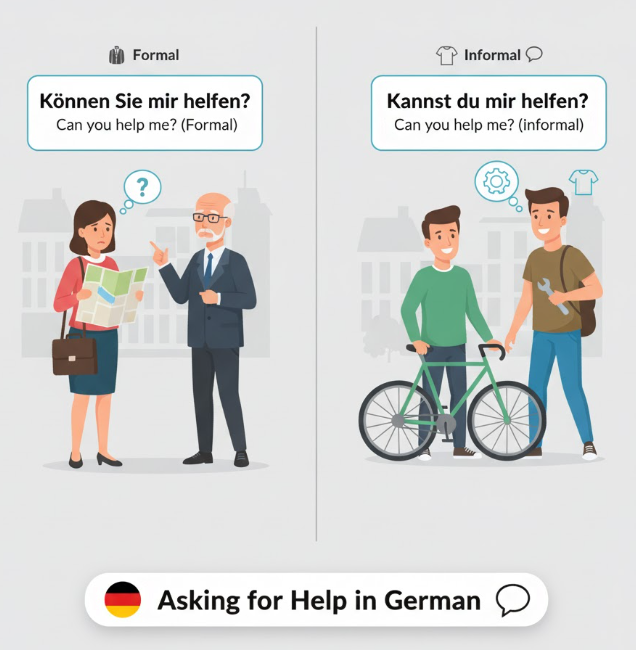
Asking for help in German involves using specific phrases that translate to “Can you help me?” or similar requests. The most common and direct translations include:
- Können Sie mir helfen? (Formal “you”)
- Kannst du mir helfen? (Informal “you”)
These phrases utilize the modal verb können (can) to express the ability to help, coupled with the dative case pronoun mir (to me). Understanding the formality levels and grammatical structures of these phrases is crucial for effective communication.
Structural Breakdown of Key Phrases
The basic structure of asking for help in German typically follows this pattern:
Modal Verb (Können/Könnten) + Subject (Sie/du) + Dative Pronoun (mir) + Verb (helfen) + ?
Formal: Können Sie mir helfen?
- Können: Modal verb “can” (ability).
- Sie: Formal “you” (nominative case).
- mir: Dative pronoun “to me.”
- helfen: Verb “to help.”
Informal: Kannst du mir helfen?
- Kannst: Conjugated form of “können” for “du” (informal “you”).
- du: Informal “you” (nominative case).
- mir: Dative pronoun “to me.”
- helfen: Verb “to help.”
The modal verb können is essential for expressing the possibility or ability to help. The dative pronoun mir indicates that the help is being given to the speaker. The verb helfen remains in its infinitive form at the end of the sentence because it is used with a modal verb.
Types of Requests and Corresponding Phrases
The way you ask for help can vary depending on the situation and the level of formality required. Here are some common scenarios and corresponding phrases:
General Request for Assistance
These phrases are suitable for most situations where you need general help.
- Können Sie mir bitte helfen? (Formal, “Can you please help me?”)
- Kannst du mir bitte helfen? (Informal, “Can you please help me?”)
Specific Request for Assistance
These phrases are used when you need help with a specific task.
- Können Sie mir dabei helfen? (Formal, “Can you help me with that?”)
- Kannst du mir dabei helfen? (Informal, “Can you help me with that?”)
- Können Sie mir mit dieser Aufgabe helfen? (Formal, “Can you help me with this task?”)
- Kannst du mir mit dieser Aufgabe helfen? (Informal, “Can you help me with this task?”)
Polite and Indirect Requests
These phrases are more polite and indirect, suitable for situations where you want to be extra cautious or respectful.
- Würden Sie mir vielleicht helfen? (Formal, “Would you perhaps help me?”)
- Würdest du mir vielleicht helfen? (Informal, “Would you perhaps help me?”)
Emergency Situations
In urgent situations, you might need to be more direct.
- Hilfe! (Help!)
- Ich brauche Hilfe! (I need help!)
Examples of Asking for Help in German
Here are several examples of how to ask for help in German, categorized by formality and situation. Each table contains a variety of scenarios to help you understand the nuances of each phrase.
Table 1: Formal Requests for Assistance
This table presents formal ways of asking for help, suitable for addressing strangers, superiors, or people you don’t know well. These phrases emphasize politeness and respect.
| German Phrase | English Translation | Context |
|---|---|---|
| Können Sie mir bitte helfen? | Can you please help me? | Asking a stranger for directions. |
| Können Sie mir mit diesem Formular helfen? | Can you help me with this form? | Asking a clerk at a government office. |
| Könnten Sie mir vielleicht helfen, diese Koffer zu tragen? | Could you perhaps help me carry these suitcases? | Asking someone at the train station. |
| Würden Sie mir freundlicherweise helfen? | Would you kindly help me? | Making a formal request in a business setting. |
| Können Sie mir sagen, wo die Bibliothek ist? | Can you tell me where the library is? | Asking for directions in a formal setting. |
| Können Sie mir erklären, wie das funktioniert? | Can you explain to me how this works? | Asking a colleague for help with a software. |
| Könnten Sie mir bei der Reparatur helfen? | Could you help me with the repair? | Asking a technician for assistance. |
| Würden Sie mir einen Rat geben? | Would you give me some advice? | Seeking advice from a professional. |
| Können Sie mir das bitte wiederholen? | Can you please repeat that? | Asking someone to repeat information. |
| Können Sie mir das aufschreiben? | Can you write that down for me? | Asking someone to write down information. |
| Können Sie mir zeigen, wie das geht? | Can you show me how to do that? | Asking for a demonstration of a task. |
| Könnten Sie mir einen Gefallen tun? | Could you do me a favor? | Requesting a favor in a formal manner. |
| Würden Sie mir aushelfen können? | Would you be able to help me out? | Asking for assistance in a professional situation. |
| Können Sie mir sagen, wie ich zum Bahnhof komme? | Can you tell me how to get to the train station? | Asking for directions from a stranger. |
| Könnten Sie mir bitte das Fenster öffnen? | Could you please open the window for me? | Asking someone politely to open a window. |
| Würden Sie mir bitte einen Moment Zeit geben? | Would you please give me a moment of your time? | Asking for someone’s attention politely. |
| Können Sie mir das bitte erklären? | Can you please explain that to me? | Asking for clarification on a topic. |
| Könnten Sie mir bitte helfen, das zu verstehen? | Could you please help me understand that? | Requesting help to comprehend something. |
| Würden Sie mir bitte das übersetzen? | Would you please translate that for me? | Asking for a translation of a text. |
| Können Sie mir bitte einen Stift leihen? | Can you please lend me a pen? | Asking to borrow a pen politely. |
| Könnten Sie mir bitte das Licht einschalten? | Could you please turn on the light? | Asking politely for someone to turn on the light. |
| Würden Sie mir bitte helfen, den Tisch zu decken? | Would you please help me set the table? | Offering help with setting the table formally. |
Table 2: Informal Requests for Assistance
This table provides informal ways to ask for help, suitable for friends, family, or people you know well. These phrases are more casual and direct.
| German Phrase | English Translation | Context |
|---|---|---|
| Kannst du mir bitte helfen? | Can you please help me? | Asking a friend to help with homework. |
| Kannst du mir mal helfen? | Can you help me out? | Asking a sibling for a quick favor. |
| Kannst du mir dabei helfen? | Can you help me with that? | Asking a friend to help with a project. |
| Hilfst du mir kurz? | Will you help me for a sec? | Asking a close friend for a small favor. |
| Kannst du mir sagen, wo die Toilette ist? | Can you tell me where the restroom is? | Asking a friend for directions. |
| Kannst du mir erklären, wie das geht? | Can you explain how that works? | Asking a friend for help with technology. |
| Kannst du mir bei dieser Aufgabe helfen? | Can you help me with this task? | Asking a classmate for help with an assignment. |
| Gibst du mir mal einen Tipp? | Can you give me a hint? | Asking for a suggestion from a friend. |
| Kannst du mir das mal zeigen? | Can you show me that? | Asking a friend to demonstrate something. |
| Kannst du mir kurz aushelfen? | Can you help me out quickly? | Asking for a brief assistance from a friend. |
| Kannst du mir das mal leihen? | Can you lend me that? | Asking to borrow something from a friend. |
| Kannst du mir einen Gefallen tun? | Can you do me a favor? | Requesting a favor from a friend. |
| Kannst du mir sagen, wie spät es ist? | Can you tell me what time it is? | Asking a friend for the time. |
| Kannst du mir bitte das Buch geben? | Can you please give me the book? | Asking a friend to hand over a book. |
| Kannst du mir bitte die Tür aufhalten? | Can you please hold the door for me? | Asking a friend to hold the door. |
| Kannst du mir bitte das Fenster zumachen? | Can you please close the window for me? | Asking a friend to close the window. |
| Kannst du mir bitte das Licht anmachen? | Can you please turn on the light for me? | Asking a friend to turn on the light. |
| Kannst du mir bitte helfen, den Tisch zu decken? | Can you please help me set the table? | Asking a friend to help with setting the table. |
| Kannst du mir bitte das Salz reichen? | Can you please pass me the salt? | Asking a friend to pass the salt. |
| Kannst du mir bitte helfen, das zu tragen? | Can you please help me carry this? | Asking a friend to help carry something. |
| Kannst du mir bitte das erklären? | Can you please explain this to me? | Asking a friend to explain something. |
Table 3: Emergency Situations
This table illustrates how to ask for help in emergency situations, where directness and urgency are paramount.
| German Phrase | English Translation | Context |
|---|---|---|
| Hilfe! | Help! | Shouting for help in a dangerous situation. |
| Ich brauche Hilfe! | I need help! | Calling for assistance after an accident. |
| Ruft die Polizei! | Call the police! | Informing others to call the police during a crime. |
| Ruft einen Arzt! | Call a doctor! | Requesting medical assistance immediately. |
| Feuer! | Fire! | Alerting people about a fire. |
| Ich habe mich verletzt! | I am injured! | Informing others that you are hurt. |
| Kann mir jemand helfen? | Can someone help me? | Seeking assistance in a chaotic situation. |
| Es ist ein Notfall! | It’s an emergency! | Declaring that the situation is urgent. |
| Schnell! | Quickly! | Urging others to act fast. |
| Beeilung! | Hurry! | Emphasizing the need for immediate action. |
| Ich habe mich verlaufen! | I am lost! | Seeking assistance due to being lost. |
| Ich habe meinen Pass verloren! | I lost my passport! | Informing others about a lost passport and seeking help. |
| Mein Auto ist kaputt! | My car broke down! | Indicating a car breakdown and needing assistance. |
| Ich bin überfallen worden! | I have been mugged! | Reporting a mugging incident. |
| Ich fühle mich nicht gut! | I don’t feel well! | Expressing feeling unwell and needing assistance. |
Usage Rules and Considerations
When asking for help in German, it’s important to consider the following rules and nuances:
- Formality: Use Sie with strangers, superiors, and older people. Use du with friends, family, and people you know well.
- Politeness: Always use bitte (please) to be polite.
- Dative Case: Remember that mir is the dative form of ich (I) and is used because helfen takes a dative object.
- Modal Verbs: Modal verbs like können change the word order, placing the infinitive verb (e.g., helfen) at the end of the sentence.
Exceptions and Special Cases
- Imperative: In very informal situations, you might use the imperative form of helfen, but this is less common and can sound demanding. For example: Hilf mir! (Help me!).
- Reflexive Verbs: If you need help with something you’re doing to yourself, you might use a reflexive verb. For example: Kannst du mir helfen, mich anzuziehen? (Can you help me get dressed?).
Common Mistakes to Avoid
Here are some common mistakes that learners make when asking for help in German and how to correct them:
Mistake 1: Incorrect Pronoun
- Incorrect: Kannst ich dir helfen?
- Correct: Kannst du mir helfen? (Can you help me?)
- Explanation: Using the nominative ich instead of the dative mir.
Mistake 2: Forgetting “Bitte”
- Incorrect: Können Sie mir helfen?
- Correct: Können Sie mir bitte helfen? (Can you please help me?)
- Explanation: Omitting bitte makes the request sound less polite.
Mistake 3: Incorrect Word Order
- Incorrect: Sie können helfen mir?
- Correct: Können Sie mir helfen? (Can you help me?)
- Explanation: The modal verb must come at the beginning of the sentence.
Mistake 4: Using the Wrong Form of “Können”
- Incorrect: Kann Sie mir helfen?
- Correct: Können Sie mir helfen? (Can you help me?)
- Explanation: Using the correct conjugation of the modal verb können is essential.
Table 4: Correct vs Incorrect Examples
This table provides a clear comparison between common mistakes and their corrected versions, highlighting the correct grammar and usage.
| Incorrect German | Correct German | English Translation | Explanation |
|---|---|---|---|
| Ich kann helfen Sie? | Können Sie mir helfen? | Can you help me? | Incorrect word order and pronoun. |
| Du kannst helfen ich? | Kannst du mir helfen? | Can you help me? | Incorrect word order and pronoun. |
| Hilfen Sie mir? | Können Sie mir helfen? | Can you help me? | Missing modal verb ‘können’. |
| Helfen mir du? | Kannst du mir helfen? | Can you help me? | Incorrect word order and missing modal verb. |
| Können ich helfen? | Können Sie mir helfen? | Can you help me? | Incorrect subject pronoun. |
| Kann ich helfen? | Kannst du mir helfen? | Can you help me? | Incorrect subject pronoun and formality. |
| Hilfe mir! | Hilf mir bitte! | Help me! | Too direct; ‘bitte’ adds politeness. |
| Sie hilfen mir? | Können Sie mir helfen? | Can you help me? | Incorrect verb form and missing modal verb. |
| Du hilfst mir? | Kannst du mir helfen? | Can you help me? | Missing modal verb for request. |
| Ich brauche Hilfe dich! | Ich brauche deine Hilfe! | I need your help! | Incorrect use of pronoun and possessive. |
| Können Sie helfen ich mit das? | Können Sie mir dabei helfen? | Can you help me with that? | Incorrect word order and pronoun. |
| Kannst du helfen mich mit das? | Kannst du mir dabei helfen? | Can you help me with that? | Incorrect word order and pronoun. |
| Sie können mir nicht helfen? | Können Sie mir nicht helfen? | Can’t you help me? | Correct placement of ‘nicht’ |
| Du kannst mir nicht helfen? | Kannst du mir nicht helfen? | Can’t you help me? | Correct placement of ‘nicht’ |
| Helft mir! | Hilf mir bitte! | Help me! | Corrected imperative form with politeness. |
| Ich brauche helfen! | Ich brauche Hilfe! | I need help! | Corrected to use the noun ‘Hilfe’. |
Practice Exercises
Test your understanding with these practice exercises. Fill in the blanks with the correct German phrases to ask for help.
Exercise 1: Formal Requests
Complete the following sentences using formal requests for help. Remember to use Sie and bitte.
| Question | Answer |
|---|---|
| Excuse me, ______ mir ______ helfen? (Can you please help me?) | Können Sie mir bitte helfen? |
| _______ mir _______ sagen, wo die Post ist? (Can you please tell me where the post office is?) | Können Sie mir bitte sagen, wo die Post ist? |
| _______ mir _______ mit dieser Aufgabe helfen? (Can you please help me with this task?) | Können Sie mir bitte mit dieser Aufgabe helfen? |
| _______ mir _______ das erklären? (Can you please explain that to me?) | Können Sie mir bitte das erklären? |
| _______ mir _______ diesen Koffer tragen? (Can you please help me carry this suitcase?) | Können Sie mir bitte diesen Koffer tragen? |
| _______ mir _______ einen Stift leihen? (Can you please lend me a pen?) | Können Sie mir bitte einen Stift leihen? |
| _______ mir _______ die Tür aufhalten? (Can you please hold the door?) | Können Sie mir bitte die Tür aufhalten? |
| _______ mir _______ das Licht einschalten? (Can you please turn on the light?) | Können Sie mir bitte das Licht einschalten? |
| _______ mir _______ den Weg zeigen? (Can you please show me the way?) | Können Sie mir bitte den Weg zeigen? |
| _______ mir _______ das wiederholen? (Can you please repeat that?) | Können Sie mir bitte das wiederholen? |
Exercise 2: Informal Requests
Complete the following sentences using informal requests for help. Remember to use du.
| Question | Answer |
|---|---|
| ____ du ____ bitte helfen? (Can you please help me?) | Kannst du mir bitte helfen? |
| ____ du ____ sagen, wo die Toilette ist? (Can you tell me where the restroom is?) | Kannst du mir sagen, wo die Toilette ist? |
| ____ du ____ dabei helfen? (Can you help me with that?) | Kannst du mir dabei helfen? |
| ____ du ____ kurz aushelfen? (Can you help me out quickly?) | Kannst du mir kurz aushelfen? |
| ____ du ____ mal einen Tipp geben? (Can you give me a hint?) | Kannst du mir mal einen Tipp geben? |
| ____ du ____ das mal zeigen? (Can you show me that?) | Kannst du mir das mal zeigen? |
| ____ du ____ mal leihen? (Can you lend me that?) | Kannst du mir das mal leihen? |
| ____ du ____ einen Gefallen tun? (Can you do me a favor?) | Kannst du mir einen Gefallen tun? |
| ____ du ____ sagen, wie spät es ist? (Can you tell me what time it is?) | Kannst du mir sagen, wie spät es ist? |
| ____ du ____ bitte das Buch geben? (Can you please give me the book?) | Kannst du mir bitte das Buch geben? |
Exercise 3: Emergency Situations
Translate the following emergency phrases into German.
| Question | Answer |
|---|---|
| Help! | Hilfe! |
| I need help! | Ich brauche Hilfe! |
| Call the police! | Ruft die Polizei! |
| Call a doctor! | Ruft einen Arzt! |
| Fire! | Feuer! |
| I am injured! | Ich habe mich verletzt! |
| Can someone help me? | Kann mir jemand helfen? |
| It’s an emergency! | Es ist ein Notfall! |
| Quickly! | Schnell! |
| Hurry! | Beeilung! |
Advanced Topics: Politeness and Formality
Mastering politeness and formality in German requires understanding subtle nuances beyond basic phrases. Here are some advanced considerations:
Using “Würden” for Extra Politeness
The subjunctive form of werden (to become), würden, adds an extra layer of politeness. It’s similar to saying “Would you mind…” in English.
- Würden Sie mir vielleicht helfen? (Would you perhaps help me?)
- Würden Sie mir freundlicherweise helfen? (Would you kindly help me?)
Addressing People with Titles
In formal situations, address people with their titles (e.g., Herr Doktor, Frau Professorin) when asking for help.
- Herr Doktor, könnten Sie mir bitte helfen? (Dr., could you please help me?)
- Frau Professorin, würden Sie mir freundlicherweise helfen? (Professor, would you kindly help me?)
Offering Explanations
Providing a brief explanation of why you need help can make your request more effective and polite.
- Entschuldigen Sie, können Sie mir bitte helfen? Ich habe mich verlaufen. (Excuse me, can you please help me? I’m lost.)
- Entschuldigen Sie, könnten Sie mir bitte helfen? Mein Auto ist kaputt. (Excuse me, could you please help me? My car broke down.)
Frequently Asked Questions (FAQ)
Here are some common questions that learners often have about asking for help in German:
- Q: What’s the difference between können Sie and könnten Sie?A: Könnten Sie is the subjunctive II form of können, making it a more polite and indirect way to ask for help. It’s similar to saying “Could you…” instead of “Can you…” in English.
- Q: Is it rude to ask for help in German without saying “bitte”?A: Yes, omitting “bitte” can make your request sound demanding or impolite. It’s always best to include “bitte” to show respect and courtesy.
- Q: How do I respond if someone asks me for help in German?A: You can respond with phrases like Gerne! (Gladly!), Ja, natürlich! (Yes, of course!), or Wie kann ich Ihnen helfen? (How can I help you?). If you can’t help, you can say Es tut mir leid, ich kann Ihnen leider nicht helfen (I’m sorry, I can’t help you).
- Q: When should I use the formal “Sie” and when should I use the informal “du”?A: Use “Sie” with people you don’t know well, older people, and in professional settings. Use “du” with friends, family, and people you are close to. When in doubt, it’s always better to start with “Sie” to avoid being disrespectful.
- Q: What if I need help in an emergency situation?A: In emergency situations, use direct phrases like Hilfe! (Help!) or Ich brauche Hilfe! (I need help!). You can also specify the type of help needed, such as Ruft die Polizei! (Call the police!) or Ruft einen Arzt! (Call a doctor!).
- Q: How can I ask for help with a specific task?A: You can use phrases like Können Sie mir dabei helfen? (Can you help me with that?) or Können Sie mir mit dieser Aufgabe helfen? (Can you help me with this task?). Be specific about what you need help with to avoid confusion.
- Q: What are some other ways to express needing assistance besides directly asking “Can you help me?”A: You could say “Ich brauche Ihre Hilfe” (I need your help), or “Ich bin nicht sicher, wie das geht. Könnten Sie mir das zeigen?” (I’m not sure how this works. Could you show me?). These alternatives can be helpful depending on the context.
- Q: Is it common to offer help to others in German culture?A: Yes, offering help is generally appreciated in German culture. If you see someone struggling, offering assistance with a phrase like “Kann ich Ihnen helfen?” (Can I help you?) is considered polite and helpful.
Conclusion
Learning to ask for help in German is an essential step in becoming a confident and effective communicator. By understanding the different phrases, their grammatical structures, and the appropriate contexts for their use, you can navigate various situations with ease and politeness.
Remember to consider the level of formality required and always use “bitte” to show respect.
Continue practicing these phrases in real-life conversations to solidify your understanding. Don’t be afraid to make mistakes – they are a natural part of the learning process.
With consistent effort and attention to detail, you’ll be well-equipped to ask for and receive assistance in German-speaking environments, enhancing your overall language proficiency and cultural awareness.