Expressing tiredness is a fundamental part of everyday conversation. In Spanish, there are several ways to convey this common feeling, each with its own nuance and context.
Understanding these variations will not only enhance your vocabulary but also allow you to communicate more effectively and naturally in Spanish. This article provides a comprehensive guide to expressing tiredness in Spanish, suitable for learners of all levels, from beginners to advanced students.
We will explore various phrases, their grammatical structures, and practical examples to help you master this essential aspect of the Spanish language.
Table of Contents
- Introduction
- Definition of Tiredness in Spanish
- Structural Breakdown
- Types and Categories of Tiredness
- Examples of Expressing Tiredness
- Usage Rules
- Common Mistakes
- Practice Exercises
- Advanced Topics
- FAQ
- Conclusion
Definition of Tiredness in Spanish
In Spanish, expressing tiredness goes beyond a simple translation of “I’m tired.” It involves understanding different verbs and expressions that convey varying degrees of fatigue and the reasons behind it. Tiredness can be physical, mental, or emotional, and the Spanish language offers a rich palette to express these nuances.
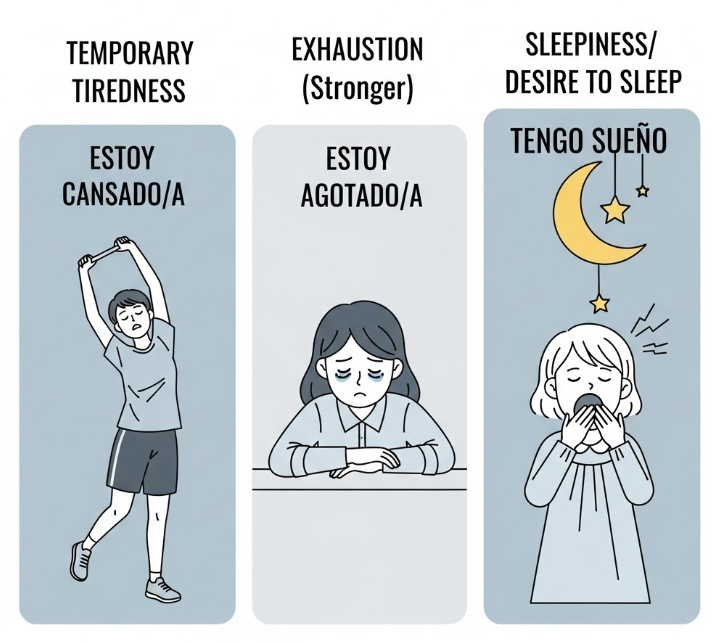
The most common ways to say “I’m tired” in Spanish are using the verbs estar and tener, each with its own connotations. Estar cansado/a (or cansada for a female speaker) literally translates to “to be tired” and is the most direct and widely used expression. Tener sueño means “to be sleepy” or “to have sleepiness,” focusing on the desire to sleep rather than the feeling of fatigue itself. Other expressions, such as estar agotado/a (to be exhausted) and estar hecho/a polvo (to be shattered), add further depth to conveying different levels of tiredness.
Structural Breakdown
The structure of expressing tiredness in Spanish typically involves a verb (either estar or tener) followed by an adjective or a noun that describes the state of being tired. Understanding the grammatical structure of these phrases is crucial for accurate and fluent communication.
Using “Estar” + Adjective
The verb estar is used to describe temporary states or conditions. When expressing tiredness, it is followed by an adjective like cansado/a (tired), agotado/a (exhausted), or rendido/a (worn out). The adjective must agree in gender and number with the subject. For example:
- Yo estoy cansado (I am tired – male)
- Ella está cansada (She is tired)
- Nosotros estamos cansados (We are tired – male or mixed group)
- Ellas están cansadas (They are tired – female)
Using “Tener” + Noun
The verb tener is used to express possession or to have something. In the context of tiredness, it is followed by a noun like sueño (sleepiness). The structure is “tener + noun.” For example:
- Yo tengo sueño (I am sleepy)
- Él tiene sueño (He is sleepy)
- Nosotros tenemos sueño (We are sleepy)
Reflexive Verbs
Reflexive verbs can also be used to express tiredness, often indicating the cause or intensity of the fatigue. For instance, despertarse (to wake up) can be used in a sentence like “Me desperté cansado/a” (I woke up tired).
Types and Categories of Tiredness
The Spanish language offers a rich variety of expressions to describe different types and degrees of tiredness. Understanding these nuances will allow you to communicate your feelings more precisely.
Physical Tiredness
Physical tiredness refers to fatigue caused by physical exertion or lack of sleep. Common expressions include:
- Estar cansado/a: The most common way to say “I’m tired.”
- Estar agotado/a: To be exhausted, implying a higher degree of fatigue.
- Estar rendido/a: To be worn out, often after a long day or strenuous activity.
- Estar hecho/a polvo: To be shattered or completely worn out.
Mental Tiredness
Mental tiredness results from prolonged mental effort or stress. Expressions include:
- Estar saturado/a: To be overwhelmed or saturated, often with information or tasks.
- Estar quemado/a: To be burnt out, often due to prolonged stress or overwork.
- No poder más: To not be able to take it anymore, indicating mental exhaustion.
Emotional Tiredness
Emotional tiredness arises from emotional stress or trauma. Expressions include:
- Estar harto/a: To be fed up or sick of something, often leading to emotional exhaustion.
- Estar desanimado/a: To be discouraged or disheartened, contributing to emotional fatigue.
- No tener ganas de nada: To not feel like doing anything, indicating emotional depletion.
Examples of Expressing Tiredness
To fully grasp how to express tiredness in Spanish, it’s essential to see these phrases in action. The following tables provide numerous examples categorized by the expressions used.
Examples Using “Estar Cansado/a”
This table illustrates the use of “estar cansado/a” in various contexts. Notice how the adjective changes to agree in gender and number with the subject.
| Spanish | English |
|---|---|
| Estoy cansado después del trabajo. | I’m tired after work. |
| Ella está cansada de estudiar. | She is tired of studying. |
| Estamos cansados de esperar. | We are tired of waiting. |
| ¿Estás cansado? | Are you tired? |
| No estoy cansado, gracias. | I’m not tired, thank you. |
| Mi hermano está cansado de la escuela. | My brother is tired of school. |
| Mi hermana está cansada del viaje. | My sister is tired of the trip. |
| Los niños están cansados de jugar. | The children are tired of playing. |
| Las niñas están cansadas de bailar. | The girls are tired of dancing. |
| Estoy cansada de esta situación. | I’m tired of this situation. |
| Él está cansado de escuchar las mismas historias. | He is tired of hearing the same stories. |
| Nosotros estamos cansados de la rutina. | We are tired of the routine. |
| Ellos están cansados de las malas noticias. | They are tired of the bad news. |
| Estoy cansado de limpiar la casa. | I’m tired of cleaning the house. |
| ¿Estás cansado de trabajar en la computadora? | Are you tired of working on the computer? |
| Estoy cansado de conducir por horas. | I’m tired of driving for hours. |
| Ella está cansada de cocinar todos los días. | She is tired of cooking every day. |
| Estamos cansados de ver la televisión. | We are tired of watching television. |
| Ellos están cansados de ir al mismo lugar. | They are tired of going to the same place. |
| Estoy cansado de las discusiones. | I’m tired of the arguments. |
| Estoy cansado de tener que repetir todo. | I’m tired of having to repeat everything. |
| María está cansada de su trabajo. | Maria is tired of her job. |
| Estoy cansado de quejarme todo el tiempo. | I’m tired of complaining all the time. |
| Estamos cansados de vivir en la ciudad. | We are tired of living in the city. |
| Estoy cansado de esperar el fin de semana. | I’m tired of waiting for the weekend. |
Examples Using “Tener Sueño”
This table shows how to use “tener sueño” to express sleepiness or the desire to sleep.
| Spanish | English |
|---|---|
| Tengo mucho sueño después de la cena. | I’m very sleepy after dinner. |
| Él tiene sueño porque no durmió bien. | He is sleepy because he didn’t sleep well. |
| Tenemos sueño y queremos ir a la cama. | We are sleepy and want to go to bed. |
| ¿Tienes sueño? Deberías descansar. | Are you sleepy? You should rest. |
| No tengo sueño todavía. | I’m not sleepy yet. |
| Mi gato tiene sueño todo el día. | My cat is sleepy all day. |
| Después de comer, siempre tengo sueño. | After eating, I’m always sleepy. |
| Los bebés siempre tienen sueño. | Babies are always sleepy. |
| Tengo sueño después de leer. | I am sleepy after reading. |
| Siempre tengo sueño por la mañana. | I’m always sleepy in the morning. |
| Tengo sueño cuando hace calor. | I’m sleepy when it’s hot. |
| Tengo sueño cuando llueve. | I’m sleepy when it rains. |
| Tengo sueño después de correr. | I’m sleepy after running. |
| Tengo sueño después de nadar. | I’m sleepy after swimming. |
| Tengo sueño después de estudiar. | I’m sleepy after studying. |
| Tengo sueño después de trabajar. | I’m sleepy after working. |
| Tengo sueño después de viajar. | I’m sleepy after traveling. |
| Tengo sueño después de ver una película. | I’m sleepy after watching a movie. |
| Tengo sueño después de escuchar música. | I’m sleepy after listening to music. |
| Tengo sueño después de hablar mucho. | I’m sleepy after talking a lot. |
Examples Using “Estar Agotado/a”
This table provides examples of using “estar agotado/a” to convey a strong sense of exhaustion.
| Spanish | English |
|---|---|
| Estoy agotado después de correr la maratón. | I’m exhausted after running the marathon. |
| Ella está agotada después de cuidar a los niños todo el día. | She is exhausted after taking care of the children all day. |
| Estamos agotados de trabajar sin descanso. | We are exhausted from working without rest. |
| ¿Estás agotado? Deberías tomar unas vacaciones. | Are you exhausted? You should take a vacation. |
| Estoy agotada después de la fiesta. | I am exhausted after the party. |
| Él está agotado después de la reunión. | He is exhausted after the meeting. |
| Después del partido, estoy agotado. | After the game, I’m exhausted. |
| Después de la mudanza, estamos agotados. | After the move, we are exhausted. |
| Estoy agotado después de subir la montaña. | I’m exhausted after climbing the mountain. |
| Estoy agotado después de limpiar la casa. | I’m exhausted after cleaning the house. |
| Estoy agotado después de trabajar en el jardín. | I’m exhausted after working in the garden. |
| Estoy agotado después de estudiar para el examen. | I’m exhausted after studying for the exam. |
| Estoy agotado después de cuidar al enfermo. | I’m exhausted after taking care of the sick person. |
| Estoy agotado después de viajar todo el día. | I’m exhausted after traveling all day. |
| Estoy agotado después de asistir a la conferencia. | I’m exhausted after attending the conference. |
| Estoy agotado después de organizar la fiesta. | I’m exhausted after organizing the party. |
| Estoy agotado después de hacer ejercicio. | I’m exhausted after exercising. |
| Estoy agotado después de conducir por horas. | I’m exhausted after driving for hours. |
| Estoy agotado después de trabajar en el proyecto. | I’m exhausted after working on the project. |
| Estoy agotado después de resolver problemas. | I’m exhausted after solving problems. |
Other Expressions of Tiredness
This table includes various other ways to express tiredness, providing a broader range of options.
| Spanish | English |
|---|---|
| Estoy rendido/a después del entrenamiento. | I’m worn out after the training. |
| Estoy hecho/a polvo después de este día. | I’m shattered after this day. |
| No puedo más con este trabajo. | I can’t take this job anymore. |
| Estoy harto/a de la rutina. | I’m fed up with the routine. |
| Estoy desanimado/a por los resultados. | I’m discouraged by the results. |
| No tengo ganas de hacer nada hoy. | I don’t feel like doing anything today. |
| Me siento sin energía. | I feel without energy. |
| Necesito descansar. | I need to rest. |
| Estoy exhausto/a. | I am exhausted. |
| Estoy molido/a. | I’m beat. |
| Estoy sin fuerzas. | I’m without strength. |
| Estoy que no puedo más. | I’m at my limit. |
Usage Rules
Understanding the rules governing the use of these expressions is crucial for accurate communication. Here are some key points to remember:
- Gender and Number Agreement: When using estar with adjectives like cansado/a, agotado/a, and rendido/a, the adjective must agree in gender and number with the subject.
- Choosing Between “Estar” and “Tener”: Use estar to describe a temporary state of being tired and tener to express sleepiness or the desire to sleep.
- Context Matters: The specific expression you choose should reflect the degree and type of tiredness you want to convey. Estar agotado/a is stronger than estar cansado/a.
- Formal vs. Informal: All the expressions mentioned are generally acceptable in both formal and informal contexts. However, be mindful of your audience and choose the expression that best suits the situation.
Common Mistakes
Learners often make mistakes when expressing tiredness in Spanish. Here are some common errors and how to avoid them:
| Incorrect | Correct | Explanation |
|---|---|---|
| Yo tener cansado. | Yo estoy cansado. | The verb estar is used to describe the state of being tired, not tener. |
| Estoy cansado mujer. | Estoy cansada. | The adjective must agree in gender with the speaker. |
| Tengo cansado. | Estoy cansado. | Tener is not used with the adjective cansado. |
| Estoy sueño. | Tengo sueño. | Tener is used to express sleepiness, not estar. |
| Nosotros estamos cansado. | Nosotros estamos cansados. | The adjective must agree in number with the subject. |
| Soy cansado. | Estoy cansado. | Use “estar” to describe a temporary state. “Ser” is for permanent characteristics. |
Practice Exercises
Test your understanding with these practice exercises. Fill in the blanks with the correct form of the verb and adjective/noun.
Exercise 1: Fill in the Blanks with “Estar Cansado/a”
| Question | Answer |
|---|---|
| Yo ___________ __________ después de correr. | Estoy cansado/a después de correr. |
| Ella ___________ __________ de estudiar tanto. | Está cansada de estudiar tanto. |
| Nosotros ___________ __________ de esperar el autobús. | Estamos cansados de esperar el autobús. |
| ¿Tú ___________ __________? | ¿Tú estás cansado/a? |
| Ellos ___________ __________ después del trabajo. | Ellos están cansados después del trabajo. |
| Mi madre ___________ __________ de cocinar. | Mi madre está cansada de cocinar. |
| Vosotros ___________ __________ de la rutina. | Vosotros estáis cansados de la rutina. |
| El perro ___________ __________ de jugar. | El perro está cansado de jugar. |
| La niña ___________ __________ de bailar. | La niña está cansada de bailar. |
| Usted ___________ __________ de trabajar mucho. | Usted está cansado/a de trabajar mucho. |
Exercise 2: Fill in the Blanks with “Tener Sueño”
| Question | Answer |
|---|---|
| Yo ___________ __________ después de la cena. | Yo tengo sueño después de la cena. |
| Él ___________ __________ porque no durmió bien. | Él tiene sueño porque no durmió bien. |
| Nosotros ___________ __________ y queremos ir a la cama. | Nosotros tenemos sueño y queremos ir a la cama. |
| ¿Tú ___________ __________? | ¿Tú tienes sueño? |
| Ellos ___________ __________ después de leer. | Ellos tienen sueño después de leer. |
| Mi hermana ___________ __________ por la mañana. | Mi hermana tiene sueño por la mañana. |
| Vosotros ___________ __________ cuando hace frío. | Vosotros tenéis sueño cuando hace frío. |
| El bebé ___________ __________ todo el tiempo. | El bebé tiene sueño todo el tiempo. |
| La gata ___________ __________ después de comer. | La gata tiene sueño después de comer. |
| Usted ___________ __________ después de viajar. | Usted tiene sueño después de viajar. |
Exercise 3: Translate to Spanish
| English | Spanish |
|---|---|
| I am very tired today. | Estoy muy cansado/a hoy. |
| She is sleepy after watching the movie. | Ella tiene sueño después de ver la película. |
| We are exhausted after the long trip. | Estamos agotados después del largo viaje. |
| Are you tired of working? | ¿Estás cansado/a de trabajar? |
| They are sleepy because it’s late. | Ellos tienen sueño porque es tarde. |
| My brother is worn out after the game. | Mi hermano está rendido después del partido. |
| You (formal) are fed up with the noise. | Usted está harto/a del ruido. |
| The children are tired of playing video games. | Los niños están cansados de jugar videojuegos. |
| My sister doesn’t feel like doing anything. | Mi hermana no tiene ganas de hacer nada. |
| I am shattered after this meeting. | Estoy hecho/a polvo después de esta reunión. |
Advanced Topics
For advanced learners, there are more nuanced ways to express tiredness, including idiomatic expressions and regional variations.
Idiomatic Expressions
- Estar muerto/a: Literally “to be dead,” but used to express extreme tiredness.
- Caerse de sueño: To be falling asleep, indicating extreme sleepiness.
Regional Variations
While the expressions covered in this article are widely understood, some regions may have their own unique ways of expressing tiredness. For example, in some Latin American countries, you might hear variations or colloquial terms not commonly used in Spain.
FAQ
Here are some frequently asked questions about expressing tiredness in Spanish:
- What is the difference between “estar cansado” and “tener sueño”?
Estar cansado means “to be tired,” indicating a general state of fatigue. Tener sueño means “to be sleepy,” specifically referring to the desire to sleep or feeling drowsy. The former is about overall fatigue, while the latter is about sleepiness.
- How do I choose the correct adjective form with “estar”?
The adjective must agree in gender and number with the subject. For example, a male speaker would say “Estoy cansado,” while a female speaker would say “Estoy cansada.” For a group of males or a mixed group, use “Estamos cansados,” and for a group of females, use “Estamos cansadas.” This grammatical agreement is essential.
- Can I use “ser” instead of “estar” to say “I’m tired”?
No, you should not use ser. The verb estar is used to describe temporary states or conditions, while ser is used for permanent characteristics or identities. Tiredness is a temporary state, so estar is the correct choice.
- Is “estar agotado” stronger than “estar cansado”?
Yes, estar agotado is stronger than estar cansado. Estar agotado means “to be exhausted,” implying a higher degree of fatigue than simply being tired.
- Are there any formal or informal ways to say “I’m tired”?
The expressions mentioned in this article are generally acceptable in both formal and informal contexts. However, expressions like “Estoy hecho/a polvo” might be considered more informal than “Estoy cansado/a.” Consider your audience and the situation when choosing an expression.
- How can I ask someone if they are tired in Spanish?
You can ask “¿Estás cansado/a?” (Are you tired?) or “¿Tienes sueño?” (Are you sleepy?). Remember to adjust the adjective based on the person’s gender if using estar.
- What are some other ways to describe different levels of tiredness?
Besides cansado and agotado, you can use words like rendido/a (worn out), exhausto/a (exhausted), or idiomatic expressions like hecho/a polvo (shattered). These provide a richer vocabulary to describe varying degrees of fatigue.
- Is it common to use reflexive verbs to express tiredness?
Yes, reflexive verbs can be used to express tiredness, often indicating the cause or intensity of the fatigue. For example, “Me desperté cansado/a” (I woke up tired). The reflexive pronoun ‘me’ indicates that the action affects the speaker directly.
Conclusion
Mastering the art of expressing tiredness in Spanish involves understanding various phrases and their nuances. From the basic estar cansado/a to more expressive options like estar agotado/a and tener sueño, each phrase conveys a different level and type of fatigue. By understanding the grammatical structures, usage rules, and common mistakes, you can confidently communicate your feelings of tiredness in Spanish.
Remember to practice these expressions in real-life conversations to improve your fluency and accuracy. Pay attention to how native speakers use these phrases and incorporate them into your own vocabulary.
With consistent practice, you’ll be able to express yourself naturally and effectively in Spanish, whether you’re feeling slightly tired or completely exhausted. Keep practicing, and soon you will master these essential expressions!