Knowing how to ask for the location of the bathroom is a fundamental skill when traveling or living in a foreign country. In this article, we will delve into the various ways to ask “Where is the bathroom?” in German, covering formal and informal approaches, as well as providing detailed explanations of the grammar and pronunciation involved.
This guide is designed for anyone learning German, from beginners to more advanced students, and aims to equip you with the confidence to navigate this essential question in any German-speaking environment.
Table of Contents
- Introduction
- Definition: Asking for the Bathroom in German
- Structural Breakdown of Key Phrases
- Types and Categories of Bathroom-Related Questions
- Examples: Asking Where the Bathroom Is
- Usage Rules: Formal vs. Informal
- Common Mistakes to Avoid
- Practice Exercises
- Advanced Topics: Nuances and Regional Variations
- FAQ: Frequently Asked Questions
- Conclusion
Introduction
Asking for directions to the bathroom is arguably one of the most practical phrases to learn in any language. Whether you’re traveling, visiting a German-speaking friend, or simply exploring a new city, knowing how to politely inquire about the restroom is crucial.
This article provides a comprehensive guide to mastering this essential phrase in German. We’ll cover everything from basic vocabulary and grammar to cultural nuances and practical examples, ensuring you’re well-prepared for any situation.
Furthermore, this skill builds a foundation for more complex interactions and enhances your overall fluency by enabling you to confidently navigate everyday situations.
Definition: Asking for the Bathroom in German
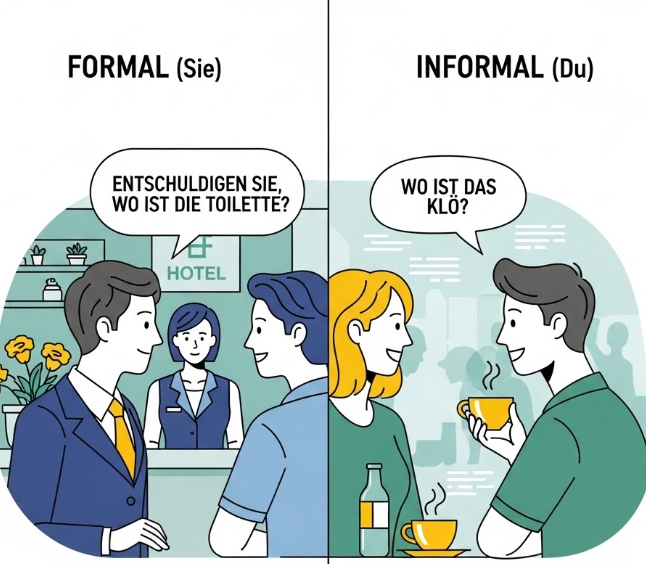
Asking “Where is the bathroom?” in German involves using specific phrases that convey politeness and clarity. The most common translation is “Wo ist die Toilette?”. However, depending on the context and your relationship with the person you’re asking, there are several variations you can use. These variations include more formal and informal options, as well as different ways to specify what you’re looking for, such as a restroom, WC, or ladies’/gents’ room. Understanding these nuances will help you communicate effectively and appropriately in various social settings.
Structural Breakdown of Key Phrases
The basic sentence structure for asking “Where is the bathroom?” in German typically follows a subject-verb-object order, although the word order can sometimes be inverted in questions. Let’s break down the components:
- Wo: This is the interrogative adverb meaning “where.”
- Ist: This is the third-person singular form of the verb “sein” (to be).
- Die Toilette: This is the noun phrase meaning “the bathroom” or “the toilet.” “Die” is the definite article for feminine nouns in the nominative case.
Therefore, “Wo ist die Toilette?” literally translates to “Where is the toilet?”. Grammatically, this is a straightforward question, but understanding the nuances of word order and alternative phrasing is crucial for effective communication.
Types and Categories of Bathroom-Related Questions
There are several ways to ask about the bathroom in German, each with its own level of formality and specificity. Here are some common categories:
Formal Inquiries
These are used when addressing strangers, superiors, or people you don’t know well. Formal inquiries often involve the use of “Sie” (formal you).
Informal Inquiries
These are used with friends, family, or people you know well. Informal inquiries typically use “du” (informal you).
Specific Inquiries
These are used when you want to be more precise about the type of bathroom you’re looking for, such as a ladies’ room or a restroom for disabled people.
General Inquiries
These are broad questions that simply ask for the location of a bathroom without specifying the type or formality.
Examples: Asking Where the Bathroom Is
Below are several examples of how to ask “Where is the bathroom?” in German, categorized by formality and specificity. Each example is accompanied by its English translation for clarity.
Formal Examples
These examples are suitable for use in formal settings or when addressing people you don’t know well. Table 1 illustrates various ways to ask politely and respectfully.
| German Phrase | English Translation |
|---|---|
| Wo ist bitte die Toilette? | Where is the bathroom, please? |
| Entschuldigen Sie, wo befindet sich die Toilette? | Excuse me, where is the bathroom located? |
| Könnten Sie mir bitte sagen, wo die Toilette ist? | Could you please tell me where the bathroom is? |
| Wo ist hier die Toilette? | Where is the bathroom here? |
| Darf ich fragen, wo sich die Toilette befindet? | May I ask where the bathroom is located? |
| Wo ist die nächste Toilette, bitte? | Where is the nearest bathroom, please? |
| Entschuldigen Sie die Störung, aber wo ist die Toilette? | Excuse the interruption, but where is the bathroom? |
| Könnten Sie mir den Weg zur Toilette beschreiben? | Could you describe the way to the bathroom to me? |
| Ich suche die Toilette. Können Sie mir helfen? | I’m looking for the bathroom. Can you help me? |
| Wo finde ich hier eine Toilette? | Where can I find a bathroom here? |
| Verzeihen Sie, können Sie mir sagen, wo die Toilette ist? | Pardon me, can you tell me where the bathroom is? |
| Wo ist die Toilette, wenn ich bitten darf? | Where is the bathroom, if I may ask? |
| Könnten Sie mir freundlicherweise sagen, wo die Toilette ist? | Could you kindly tell me where the bathroom is? |
| Entschuldigen Sie vielmals, wo ist die Toilette? | I’m very sorry to bother you, but where is the bathroom? |
| Wo befindet sich die Damen-/Herrentoilette? | Where is the ladies’/men’s room located? |
| Könnten Sie mir sagen, wie ich zur Toilette komme? | Could you tell me how to get to the bathroom? |
| Wo ist die Toilette in diesem Gebäude? | Where is the bathroom in this building? |
| Entschuldigen Sie, wissen Sie, wo die Toilette ist? | Excuse me, do you know where the bathroom is? |
| Wo ist die Besuchertoilette? | Where is the visitor’s bathroom? |
| Könnten Sie mir die Richtung zur Toilette weisen? | Could you point me in the direction of the bathroom? |
| Ich bin auf der Suche nach der Toilette. | I am looking for the restroom. |
| Entschuldigen Sie, ist hier eine Toilette in der Nähe? | Excuse me, is there a bathroom nearby? |
| Könnten Sie mir bitte den Standort der Toilette nennen? | Could you please tell me the location of the bathroom? |
| Dürfte ich Sie fragen, wo die nächste Toilette ist? | May I ask you where the nearest bathroom is? |
Informal Examples
These examples are appropriate for use with friends, family, or people you know well. Table 2 provides a range of casual and friendly ways to ask.
| German Phrase | English Translation |
|---|---|
| Wo ist das Klo? | Where’s the toilet? (very informal) |
| Wo ist die Toilette? | Where’s the bathroom? |
| Wo finde ich hier eine Toilette? | Where can I find a bathroom here? |
| Weißt du, wo die Toilette ist? | Do you know where the bathroom is? |
| Sag mal, wo ist hier die Toilette? | Hey, where’s the bathroom here? |
| Wo geht’s hier zur Toilette? | Which way to the bathroom? |
| Kannst du mir sagen, wo die Toilette ist? | Can you tell me where the bathroom is? |
| Wo ist denn hier die Toilette? | Where is the bathroom around here? |
| Ich muss mal aufs Klo, wo ist das? | I need to go to the toilet, where is it? |
| Wo ist die nächste Toilette? | Where’s the nearest bathroom? |
| Hey, wo ist die Toilette? | Hey, where’s the bathroom? |
| Weißt du vielleicht, wo die Toilette ist? | Do you happen to know where the bathroom is? |
| Wo finde ich hier ein stilles Örtchen? | Where can I find a quiet place (euphemism for toilet) here? |
| Ich such die Toilette, kannst du helfen? | I’m looking for the bathroom, can you help? |
| Wo ist die Damentoilette? | Where is the women’s restroom? |
| Wo ist die Herrentoilette? | Where is the men’s restroom? |
| Kannst du mir kurz sagen, wo die Toilette ist? | Can you quickly tell me where the bathroom is? |
| Ich muss dringend mal, wo ist die Toilette? | I really need to go, where’s the bathroom? |
| Wo ist die Toilette hier in der Nähe? | Where is the bathroom nearby? |
| Du, wo ist die Toilette? | Hey, where is the bathroom? |
| Gibt es hier irgendwo eine Toilette? | Is there a bathroom somewhere here? |
| Wo ist denn hier ein WC? | Where is a WC around here? |
| Kannst du mir den Weg zur Toilette zeigen? | Can you show me the way to the bathroom? |
| Sag mal, gibt es hier eine Toilette? | Tell me, is there a bathroom here? |
Specific Examples
These examples are used when you need to specify the type of bathroom you’re looking for, such as a men’s or women’s room. Table 3 provides specific options for different situations.
| German Phrase | English Translation |
|---|---|
| Wo ist die Damentoilette? | Where is the ladies’ room? |
| Wo ist die Herrentoilette? | Where is the men’s room? |
| Gibt es hier eine Behindertentoilette? | Is there a disabled toilet here? |
| Wo finde ich eine Toilette für Rollstuhlfahrer? | Where can I find a toilet for wheelchair users? |
| Wo ist die Wickelraumtoilette? | Where is the baby changing room toilet? |
| Gibt es hier eine Unisex-Toilette? | Is there a unisex toilet here? |
| Wo ist die Personaltoilette? | Where is the staff toilet? |
| Wo ist die Kundentoilette? | Where is the customer toilet? |
| Gibt es hier eine öffentliche Toilette? | Is there a public toilet here? |
| Wo ist die nächste öffentliche Toilette? | Where is the nearest public toilet? |
| Wo finde ich eine barrierefreie Toilette? | Where can I find an accessible toilet? |
| Gibt es eine Toilette mit Babywickeltisch? | Is there a toilet with a baby changing table? |
| Wo ist die Toilette für Mitarbeiter? | Where is the toilet for employees? |
| Wo finde ich eine Toilette mit Dusche? | Where can I find a toilet with a shower? |
| Gibt es hier eine Toilette mit Notrufknopf? | Is there a toilet with an emergency button here? |
| Wo ist die Toilette im Erdgeschoss? | Where is the toilet on the ground floor? |
| Gibt es eine Toilette im ersten Stock? | Is there a toilet on the first floor? |
| Wo ist die Toilette in der Nähe des Eingangs? | Where is the toilet near the entrance? |
| Gibt es eine Toilette in der Nähe des Aufzugs? | Is there a toilet near the elevator? |
| Wo ist die Toilette mit mehr Platz? | Where is the toilet with more space? |
| Gibt es eine Toilette, die leicht zugänglich ist? | Is there a toilet that is easily accessible? |
| Wo ist die Toilette, die für ältere Menschen geeignet ist? | Where is the toilet suitable for elderly people? |
| Gibt es eine Toilette mit Haltegriffen? | Is there a toilet with grab bars? |
| Wo finde ich eine Toilette, die sauber ist? | Where can I find a toilet that is clean? |
General Examples
These examples provide a broad and simple way to ask for the location of a bathroom without specifying formality or type. Table 4 lists general inquiries that are universally understood.
| German Phrase | English Translation |
|---|---|
| Wo ist die Toilette? | Where is the bathroom? |
| Wo ist hier ein WC? | Where is a WC here? |
| Wo kann ich aufs Klo gehen? | Where can I go to the toilet? |
| Gibt es hier eine Toilette? | Is there a bathroom here? |
| Wo ist hier die nächste Toilette? | Where is the nearest bathroom here? |
| Wo finde ich eine Toilette? | Where can I find a bathroom? |
| Wo ist ein stilles Örtchen? | Where is a “quiet place” (euphemism for toilet)? |
| Kann mir jemand sagen, wo die Toilette ist? | Can someone tell me where the bathroom is? |
| Wo ist die Toilette in der Nähe? | Where is the bathroom nearby? |
| Wo ist das WC? | Where is the WC? |
| Wo ist die Toilette im Gebäude? | Where is the bathroom in the building? |
| Gibt es in der Nähe eine Toilette? | Is there a bathroom nearby? |
| Wo finde ich hier ein WC? | Where can I find a WC here? |
| Wo ist die Toilette auf dieser Etage? | Where is the bathroom on this floor? |
| Kann mir jemand helfen, die Toilette zu finden? | Can someone help me find the bathroom? |
| Wo ist die Toilette im Restaurant? | Where is the bathroom in the restaurant? |
| Gibt es eine Toilette im Café? | Is there a bathroom in the cafe? |
| Wo ist die Toilette im Laden? | Where is the bathroom in the store? |
| Wo ist die Toilette im Hotel? | Where is the bathroom in the hotel? |
| Gibt es eine Toilette im Kino? | Is there a bathroom in the cinema? |
| Wo ist die Toilette im Museum? | Where is the bathroom in the museum? |
| Gibt es eine Toilette im Bahnhof? | Is there a bathroom in the train station? |
| Wo ist die Toilette am Flughafen? | Where is the bathroom at the airport? |
| Gibt es eine Toilette im Park? | Is there a bathroom in the park? |
Usage Rules: Formal vs. Informal
The choice between formal and informal language in German is crucial for maintaining politeness and respect. Here are some key rules to follow:
- Use “Sie” with strangers, superiors, and older people: This is the formal pronoun for “you.” Use it in conjunction with formal verb conjugations.
- Use “du” with friends, family, and people you know well: This is the informal pronoun for “you.” Use it with informal verb conjugations.
- Pay attention to titles: When addressing someone formally, use their title (e.g., Herr, Frau) followed by their last name.
- Use polite phrases: Incorporate phrases like “bitte” (please) and “Entschuldigen Sie” (Excuse me) to show respect.
For example, if you’re in a restaurant and need to ask the waiter, you would use a formal phrase like “Entschuldigen Sie, wo ist bitte die Toilette?”. However, if you’re at a friend’s house, you could use the informal phrase “Wo ist das Klo?”.
Common Mistakes to Avoid
Even experienced learners can make mistakes when asking for the bathroom in German. Here are some common errors to avoid:
- Using the wrong pronoun: Mixing up “Sie” and “du” can be impolite or inappropriate.
- Incorrect word order: German word order can be tricky, especially in questions. Make sure to place the verb in the correct position.
- Forgetting to use “bitte”: Omitting “bitte” can make your request sound demanding.
- Using overly direct language: Being too direct can come across as rude. Use polite phrases to soften your request.
Table 5 illustrates some common mistakes and their corrections.
| Incorrect | Correct | Explanation |
|---|---|---|
| Wo ist du Toilette? | Wo ist die Toilette? | “Du” is the informal pronoun; “die” is the definite article for “Toilette”. |
| Toilette ist wo? | Wo ist die Toilette? | Incorrect word order. The verb “ist” should come after the interrogative adverb “wo”. |
| Wo ist Toilette? | Wo ist die Toilette? | Missing the definite article “die” before “Toilette”. |
| Wo ist das Toilette? | Wo ist die Toilette? | “Toilette” is feminine, so the correct article is “die”, not “das”. |
| Sag mir wo Toilette. | Sag mir, wo die Toilette ist. | Missing verb and article. The correct sentence structure is needed. |
| Ich will Toilette. | Wo ist die Toilette? | Too direct and impolite. It’s better to ask for the location. |
| Sie ist Toilette? | Wo ist die Toilette? | Completely incorrect. “Sie” means “she” or formal “you”. |
| Toilette wo? | Wo ist die Toilette? | Incomplete sentence. The verb “ist” is missing. |
| WC wo? | Wo ist das WC? | Missing verb “ist” and the correct article “das”. |
| Toilette finden. | Ich möchte die Toilette finden. / Wo ist die Toilette? | Incomplete sentence. Needs a subject and a verb, or a complete question. |
Practice Exercises
Test your knowledge with the following practice exercises. Fill in the blanks with the correct German phrase to ask “Where is the bathroom?”.
Exercise 1: Formal
Complete the sentences using formal language.
| Question | Answer |
|---|---|
| Entschuldigen Sie, ______ die Toilette? | Wo ist die Toilette? |
| Könnten Sie mir bitte sagen, ______ die Toilette ist? | wo |
| ______ befindet sich die Toilette? | Wo |
| Darf ich fragen, ______ sich die Toilette befindet? | wo |
| ______ ist die nächste Toilette, bitte? | Wo |
| Könnten Sie mir den Weg ______ Toilette beschreiben? | zur |
| Ich suche die Toilette. Können Sie ______ helfen? | mir |
| Wo finde ich ______ eine Toilette? | hier |
| Verzeihen Sie, können Sie mir sagen, ______ die Toilette ist? | wo |
| Könnten Sie mir freundlicherweise sagen, _____ die Toilette ist? | wo |
Exercise 2: Informal
Complete the sentences using informal language.
| Question | Answer |
|---|---|
| Wo ______ das Klo? | ist |
| ______ du, wo die Toilette ist? | Weißt |
| Sag mal, wo ______ hier die Toilette? | ist |
| Wo geht’s hier ______ Toilette? | zur |
| Kannst du mir sagen, wo ______ Toilette ist? | die |
| Wo ______ denn hier die Toilette? | ist |
| Ich muss mal aufs Klo, wo ______ das? | ist |
| ______ du vielleicht, wo die Toilette ist? | Weißt |
| Ich such die Toilette, kannst du ______ helfen? | mir |
| Kannst du mir kurz sagen, wo ______ Toilette ist? | die |
Exercise 3: Specific
Complete the sentences using specific terms.
| Question | Answer |
|---|---|
| Wo ist ______ Damentoilette? | die |
| Wo ist ______ Herrentoilette? | die |
| Gibt es hier eine ______? | Behindertentoilette |
| Wo finde ich eine Toilette ______? | für Rollstuhlfahrer |
| Wo ist die ______? | Wickelraumtoilette |
| Gibt es hier eine ______? | Unisex-Toilette |
| Wo ist die ______? | Personaltoilette |
| Wo ist die ______? | Kundentoilette |
| Gibt es hier eine ______? | öffentliche Toilette |
| Wo finde ich eine ______? | barrierefreie Toilette |
Advanced Topics: Nuances and Regional Variations
Beyond the basic phrases, there are several nuances and regional variations to be aware of when asking for the bathroom in German. These include:
- Regional terms: In some regions, different words for “bathroom” or “toilet” may be used. For example, in Austria, “das WC” is very common.
- Euphemisms: Germans sometimes use euphemisms to avoid being too direct. “Das stille Örtchen” (the quiet place) is a common example.
- Cultural sensitivity: In some situations, it may be more polite to ask indirectly or to use a more formal tone.
Understanding these nuances can help you navigate different social situations and communicate more effectively.
FAQ: Frequently Asked Questions
Here are some frequently asked questions about asking for the bathroom in German:
- Is “Wo ist das Klo?” rude?
Yes, “Wo ist das Klo?” can be considered quite informal and even a bit crude. It’s best used among close friends or family. In most other situations, it’s more polite to use “Wo ist die Toilette?”.
- What’s the difference between “Toilette” and “WC”?
“Toilette” is the general term for “bathroom” or “toilet”. “WC” (short for “Water Closet”) is also commonly used and generally interchangeable with “Toilette,” although “WC” might be perceived as slightly more technical or old-fashioned in some contexts. In Austria, “WC” is the more common term.
- How do I ask for a specific type of bathroom, like a disabled toilet?
You can ask “Gibt es hier eine Behindertentoilette?” (Is there a disabled toilet here?) or “Wo finde ich eine Toilette für Rollstuhlfahrer?” (Where can I find a toilet for wheelchair users?).
- Is it necessary to say “bitte” when asking?
Yes, it’s always polite to say “bitte” (please) when making a request in German. It shows respect and consideration for the person you’re asking.
- What should I do if I don’t understand the directions I’m given?
You can say “Entschuldigung, ich habe das nicht verstanden. Könnten Sie das bitte wiederholen?” (Excuse me, I didn’t understand that. Could you please repeat it?). You can also ask them to speak more slowly: “Könnten Sie bitte langsamer sprechen?”.
- How do I ask if there’s a changing table for babies?
You can ask “Gibt es eine Toilette mit Babywickeltisch?” (Is there a toilet with a baby changing table?).
- What’s a good euphemism for “bathroom” in German?
A common euphemism is “das stille Örtchen” (the quiet place). It’s a polite way to refer to the bathroom without being too direct.
- Are there any regional differences in how people ask for the bathroom?
Yes, there are some regional differences. For example, in Austria, “Wo ist das WC?” is very common, while in other regions, “Wo ist die Toilette?” might be more prevalent. Additionally, some regions might have their own local terms or expressions.
Conclusion
Mastering the art of asking “Where is the bathroom?” in German is a crucial step in becoming proficient in the language. This article has provided you with a comprehensive overview of the various ways to ask this essential question, covering formal and informal approaches, specific inquiries, and common mistakes to avoid.
By understanding the grammar, vocabulary, and cultural nuances involved, you’ll be well-equipped to confidently navigate any German-speaking environment. Remember to practice these phrases regularly and pay attention to the context in which you’re using them.
Don’t be afraid to ask for clarification if you don’t understand the directions you’re given.