Understanding the nuances of language involves not only knowing what words mean but also grasping their opposites. The word “ensure,” meaning to guarantee or make certain, is no exception.
Exploring its antonyms provides a deeper understanding of its meaning and usage, and broadens our vocabulary. This article delves into the various antonyms of “ensure,” providing examples, usage rules, and practice exercises to help you master this aspect of English grammar.
This guide is beneficial for English language learners, writers, and anyone looking to improve their communication skills by using a wider range of vocabulary.
Table of Contents
- Introduction
- Definition of “Ensure”
- Structural Breakdown of “Ensure”
- Antonyms of “Ensure”
- Examples of Antonyms in Sentences
- Usage Rules for Antonyms of “Ensure”
- Common Mistakes
- Practice Exercises
- Advanced Topics
- FAQ
- Conclusion
Definition of “Ensure”
“Ensure” is a verb that means to make certain that something will occur or be the case. It implies taking necessary steps to guarantee a particular outcome.
The word is often used in formal contexts, such as legal documents, business reports, and academic writing. It is a transitive verb, meaning it requires a direct object to complete its meaning.
For example, “Ensure safety” or “Ensure compliance.” Ensuring something involves proactive measures and a degree of control over the situation.
The word “ensure” can sometimes be confused with “assure” and “insure.” While all three words involve making something certain, they have distinct meanings. “Assure” means to tell someone something positively to dispel any doubts.
“Insure” relates specifically to protecting against financial loss through an insurance policy. “Ensure,” on the other hand, means to guarantee a particular outcome or condition.
Structural Breakdown of “Ensure”
The verb “ensure” typically follows this structural pattern in a sentence: Subject + Verb (ensure) + Object + [Optional: Clause or Phrase explaining what is being ensured]. The object is the thing or outcome that you are making certain of. The optional clause or phrase provides further detail about the desired result.
Here are some examples illustrating this structure:
- The company (subject) ensures (verb) quality control (object) through rigorous testing (phrase).
- The government (subject) ensures (verb) access to healthcare (object) for all citizens (phrase).
- Proper insulation (subject) ensures (verb) energy efficiency (object).
Understanding this structure helps in constructing grammatically correct sentences using “ensure.” It also provides a framework for identifying its antonyms and how they fit into similar sentence structures.
Antonyms of “Ensure”
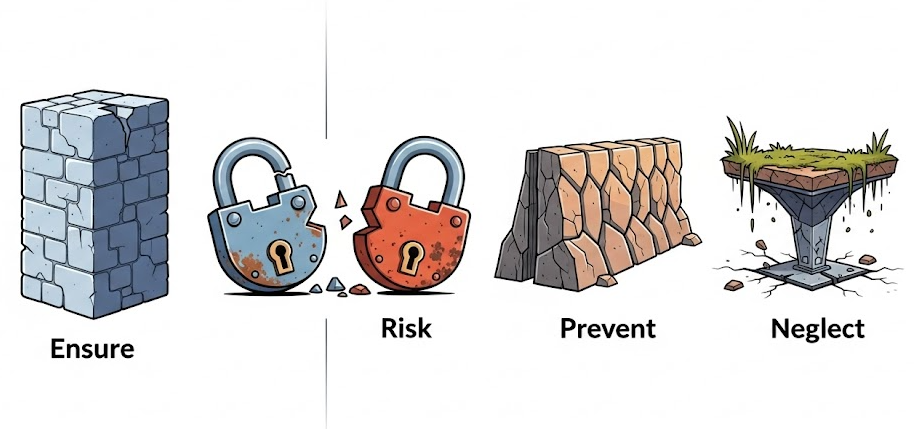
The antonyms of “ensure” express the opposite idea: to prevent something from happening, to create uncertainty, or to neglect taking necessary precautions. There are several words that can be considered antonyms of “ensure,” each with slightly different connotations.
These antonyms can relate to preventing a desired outcome, introducing risk, or simply failing to guarantee a result.
Prevent
“Prevent” means to stop something from happening or arising. It implies taking action to avert a particular outcome.
This is a direct antonym of “ensure” because instead of making something certain, it aims to stop it altogether.
Hinder
“Hinder” means to create difficulties for someone or something, resulting in delay or obstruction. It suggests making it harder for something to happen or progress, without necessarily stopping it completely.
Impede
“Impede” is similar to “hinder” but suggests a more significant degree of obstruction. It means to delay or prevent something by obstructing it; it often implies a more formal or systematic obstruction than “hinder.”
Obstruct
“Obstruct” means to block or get in the way of something. It can refer to a physical obstruction or a metaphorical one, such as obstructing progress or communication.
This is closely related to “hinder” and “impede,” but often implies a more direct and intentional blocking action.
Jeopardize
“Jeopardize” means to put someone or something into a dangerous or risky situation. It suggests that actions are taken (or not taken) that could potentially lead to a negative outcome.
This is an antonym of “ensure” because instead of guaranteeing a positive result, it introduces the possibility of failure or harm.
Risk
“Risk” means to expose someone or something to danger, harm, or loss. It often involves taking a chance where the outcome is uncertain and potentially negative.
Similar to “jeopardize,” it is an antonym of “ensure” by introducing uncertainty rather than guaranteeing security.
Endanger
“Endanger” means to put someone or something in a dangerous situation. It’s a stronger word than “risk” and “jeopardize,” implying a higher level of threat or potential harm.
It directly contrasts with “ensure” by creating a scenario where safety or well-being is compromised.
Undermine
“Undermine” means to erode the base or foundation of something, weakening it gradually. It suggests weakening something subtly or indirectly, often leading to its eventual collapse or failure.
In contrast to “ensure,” which strengthens and secures, “undermine” gradually weakens and destabilizes.
Invalidate
“Invalidate” means to make something no longer valid or acceptable. This often applies to legal documents, contracts, or arguments.
By invalidating something, you are essentially undoing any guarantees or certainties associated with it.
Nullify
“Nullify” is similar to “invalidate,” meaning to make something legally void or ineffective. It implies a formal action that cancels out a previous agreement or guarantee.
Both “invalidate” and “nullify” directly oppose the concept of ensuring something’s validity or effectiveness.
Neglect
“Neglect” means to fail to care for someone or something properly. It implies a failure to take necessary actions to maintain or protect something.
It contrasts with “ensure” by suggesting a lack of attention or effort to guarantee a positive outcome.
Forget
“Forget” means to fail to remember something. In the context of ensuring something, forgetting to take necessary steps can lead to the opposite of the desired outcome.
It suggests a lack of mindfulness or attention to detail.
Disregard
“Disregard” means to pay no attention to something; to ignore. This can involve ignoring rules, warnings, or necessary precautions.
Disregarding important factors can directly lead to the failure to ensure a particular outcome.
Examples of Antonyms in Sentences
The following tables provide numerous examples of how the antonyms of “ensure” are used in sentences. Each table focuses on a different antonym, showcasing its specific meaning and usage within various contexts.
These examples will help you understand how to effectively use these words in your own writing and speech.
Examples Using “Prevent”
This table provides examples of how the word “prevent” is used as an antonym of “ensure” in various sentences.
| Sentence |
|---|
| We must prevent the spread of misinformation. |
| The new regulations aim to prevent pollution. |
| Regular exercise can prevent heart disease. |
| The security system is designed to prevent theft. |
| They took measures to prevent further damage. |
| The government is working to prevent crime. |
| Education can prevent ignorance. |
| Early detection can prevent the disease from spreading. |
| The dam was built to prevent flooding. |
| Good hygiene helps prevent infections. |
| Careful planning can prevent mistakes. |
| The lifeguard’s job is to prevent drownings. |
| The treaty is intended to prevent war. |
| Strict laws are needed to prevent corruption. |
| The campaign aims to prevent drug abuse. |
| Proper maintenance can prevent equipment failure. |
| The program is designed to prevent poverty. |
| Vaccinations can prevent many diseases. |
| The police are trying to prevent the riot from escalating. |
| Firewalls are used to prevent unauthorized access to computer systems. |
| The safety net is there to prevent falls. |
| The speed limit is to prevent accidents. |
| The fences are there to prevent animals from escaping. |
Examples Using “Hinder,” “Impede,” and “Obstruct”
This table provides examples of how the words “hinder,” “impede,” and “obstruct” are used, highlighting their nuances.
| Sentence |
|---|
| Bureaucracy can hinder progress. |
| The heavy traffic impeded our journey. |
| The fallen tree obstructed the road. |
| Lack of funding can hinder research. |
| The storm impeded rescue efforts. |
| The protesters obstructed the entrance to the building. |
| His injury hindered his performance. |
| The language barrier impeded communication. |
| The debris obstructed the flow of water. |
| Red tape can hinder business development. |
| The muddy conditions impeded the advance of the troops. |
| The speaker was constantly obstructed by hecklers. |
| His lack of experience hindered his chances of getting the job. |
| The complex regulations impeded the project’s completion. |
| The police obstructed the suspect’s escape route. |
| Negative attitudes can hinder personal growth. |
| The dense fog impeded visibility. |
| The large crowd obstructed the view of the stage. |
| Unnecessary rules hinder creativity. |
| The steep climb impeded our progress to the summit. |
| The fallen rocks obstructed the path. |
| His nervousness hindered his ability to speak clearly. |
Examples Using “Jeopardize,” “Risk,” and “Endanger”
This table shows how the words “jeopardize,” “risk,” and “endanger” are used to convey the opposite of ensuring safety or success.
| Sentence |
|---|
| His actions jeopardized the entire mission. |
| Driving without a seatbelt risks serious injury. |
| Pollution endangers wildlife. |
| Lying to the police jeopardizes your case. |
| Investing in that company risks losing all your money. |
| Smoking endangers your health. |
| His gambling addiction jeopardized his family’s financial security. |
| Climbing the mountain without proper equipment risks your life. |
| The oil spill endangered marine life. |
| Ignoring safety protocols jeopardizes the safety of everyone. |
| Not saving for retirement risks financial hardship later in life. |
| Deforestation endangers many species. |
| His reckless behavior jeopardized his career. |
| Skipping your workout risks losing strength. |
| The lack of funding endangered the program. |
| He jeopardized the negotiations by revealing confidential information. |
| Ignoring the early warning signs risks a complete system failure. |
| Climate change endangers coastal communities. |
| His arrogance jeopardized his relationships. |
| Driving under the influence risks lives. |
| The factory’s emissions endangered the local ecosystem. |
Examples Using “Undermine,” “Invalidate,” and “Nullify”
This table showcases the use of “undermine,” “invalidate,” and “nullify” as antonyms of “ensure,” emphasizing their specific contexts.
| Sentence |
|---|
| His constant criticism undermined her confidence. |
| The evidence invalidated his alibi. |
| The court nullified the contract. |
| Spreading rumors can undermine trust. |
| The forged signature invalidated the document. |
| The new law nullified the previous regulation. |
| His lies undermined his credibility. |
| The technicality invalidated the election results. |
| The judge nullified the previous ruling. |
| Corruption can undermine the foundations of democracy. |
| The lack of proper documentation invalidated the claim. |
| The agreement was nullified due to breach of contract. |
| His negative attitude undermined the team’s morale. |
| The error invalidated the experiment’s results. |
| The treaty was nullified after the war. |
| Constant negativity can undermine a relationship. |
| The expiration date invalidated the coupon. |
| The parliament voted to nullify the controversial law. |
Examples Using “Neglect,” “Forget,” and “Disregard”
This table demonstrates the usage of “neglect,” “forget,” and “disregard” as antonyms of “ensure,” highlighting their implications of inattention and oversight.
| Sentence |
|---|
| They neglected to maintain the equipment. |
| I forgot to lock the door. |
| He disregarded the warning signs. |
| Neglecting your health can lead to serious problems. |
| She forgot her appointment. |
| The driver disregarded the speed limit. |
| The company neglected its environmental responsibilities. |
| I forgot to bring my wallet. |
| The investor disregarded the expert’s advice. |
| Neglecting your studies can affect your grades. |
| He forgot to set the alarm. |
| The captain disregarded the storm warnings. |
| The landlord neglected the necessary repairs. |
| I forgot to water the plants. |
| The politician disregarded public opinion. |
| Neglecting regular maintenance can lead to costly repairs. |
| She forgot to send the email. |
| The judge disregarded the inadmissible evidence. |
Usage Rules for Antonyms of “Ensure”
When using antonyms of “ensure,” it’s crucial to understand their specific connotations and contexts. Here are some key usage rules:
- Prevent: Use “prevent” when you want to emphasize stopping something from happening altogether. It implies taking proactive measures to avert a specific outcome.
- Hinder/Impede/Obstruct: These words are used when something is making progress difficult but not necessarily impossible. “Hinder” is a general term, while “impede” suggests a more significant obstruction, and “obstruct” implies a direct blocking action.
- Jeopardize/Risk/Endanger: These words are used when something is being put in a potentially harmful or dangerous situation. “Jeopardize” implies putting something at risk, “risk” involves taking a chance with uncertain outcomes, and “endanger” suggests a higher level of threat or potential harm.
- Undermine: Use “undermine” when something is being weakened gradually or subtly. It suggests a slow erosion of strength or stability.
- Invalidate/Nullify: These words are used when something is being made legally void or ineffective. “Invalidate” is a general term, while “nullify” often implies a formal or legal action.
- Neglect/Forget/Disregard: These words are used when something is being overlooked or ignored, leading to a failure to ensure a desired outcome. “Neglect” implies a failure to care for something, “forget” suggests a lack of memory or mindfulness, and “disregard” means paying no attention to something.
Pay attention to the context and the specific nuances of each word to choose the most appropriate antonym for “ensure.”
Common Mistakes
One common mistake is using “assure” or “insure” when “ensure” is the appropriate word. Remember that “assure” means to reassure someone, and “insure” means to protect against financial loss.
Another mistake is using an antonym that doesn’t quite fit the context, such as using “hinder” when “prevent” is more accurate, or vice versa. Careful attention to the specific meanings and connotations of each word is essential.
Here are some examples of common mistakes and their corrections:
| Incorrect | Correct |
|---|---|
| We must assure the spread of misinformation. | We must prevent the spread of misinformation. |
| The rain ensured our picnic. | The rain jeopardized our picnic. |
| He ensured to lock the door. | He forgot to lock the door. |
| The company ensured the regulations. | The company disregarded the regulations. |
Practice Exercises
Test your understanding of the antonyms of “ensure” with these practice exercises. Choose the best antonym for “ensure” in each sentence.
Exercise 1: Fill in the Blanks
Choose the best word from the list to fill in the blank in each sentence: prevent, hinder, jeopardize, undermine, neglect.
| Question | Answer |
|---|---|
| 1. We need to _______ the spread of false information. | prevent |
| 2. His constant complaining _______ the team’s morale. | undermined |
| 3. _______ to maintain the equipment can lead to costly repairs. | Neglecting |
| 4. The heavy traffic _______ our progress. | hindered |
| 5. His reckless actions _______ the safety of others. | jeopardized |
| 6. The new regulations are designed to _______ pollution. | prevent |
| 7. His lack of preparation _______ his chances of success. | undermined |
| 8. Failure to water the plants will _______ their growth. | hinder |
| 9. Ignoring safety protocols will _______ the entire operation. | jeopardize |
| 10. _______ your health can lead to serious consequences. | Neglecting |
Exercise 2: Multiple Choice
Choose the best antonym of “ensure” from the multiple choices provided.
| Question | Options | Answer |
|---|---|---|
| 1. The new policy __________ the success of the project. | (a) ensured (b) prevented (c) assisted (d) guaranteed | (b) prevented |
| 2. His lies __________ his credibility. | (a) ensured (b) undermined (c) supported (d) strengthened | (b) undermined |
| 3. __________ to lock the door made the house vulnerable. | (a) Ensuring (b) Forgetting (c) Remembering (d) Confirming | (b) Forgetting |
| 4. Driving without a license __________ your freedom. | (a) ensures (b) risks (c) confirms (d) secures | (b) risks |
| 5. The debris __________ the flow of the river. | (a) ensured (b) obstructed (c) allowed (d) facilitated | (b) obstructed |
| 6. The judge __________ the contract due to a technicality. | (a) validated (b) nullified (c) ensured (d) confirmed | (b) nullified |
| 7. __________ the warning signs led to the accident. | (a) Ensuring (b) Disregarding (c) Heeding (d) Acknowledging | (b) Disregarding |
| 8. His arrogance __________ his relationships with others. | (a) strengthened (b) jeopardized (c) secured (d) guaranteed | (b) jeopardized |
| 9. Failure to maintain the equipment will __________ its lifespan. | (a) ensure (b) extend (c) hinder (d) preserve | (c) hinder |
| 10. The error __________ the experiment’s results. | (a) validated (b) ensured (c) invalidated (d) confirmed | (c) invalidated |
Advanced Topics
For advanced learners, exploring the subtle differences between near-synonyms of the antonyms can be beneficial. For example, understanding the difference between “thwart” and “impede,” or “compromise” and “jeopardize” can add depth to your vocabulary and improve your ability to express nuanced meanings.
Additionally, studying the etymology of these words can provide further insight into their historical usage and evolution.
Another advanced topic is the use of these antonyms in figurative language, such as metaphors and similes. For instance, “His constant negativity undermined the foundation of their relationship” uses “undermined” in a metaphorical sense to describe the gradual weakening of the relationship.
FAQ
- What is the difference between “ensure,” “assure,” and “insure”?“Ensure” means to guarantee a particular outcome, “assure” means to reassure someone, and “insure” means to protect against financial loss. They are often confused but have distinct meanings.
- When should I use “prevent” instead of “hinder”?Use “prevent” when you want to emphasize stopping something from happening altogether. Use “hinder” when something is making progress difficult but not impossible.
- What is the difference between “jeopardize,” “risk,” and “endanger”?“Jeopardize” implies putting something at risk, “risk” involves taking a chance with uncertain outcomes, and “endanger” suggests a higher level of threat or potential harm.
- How does “undermine” differ from other antonyms of “ensure”?“Undermine” specifically suggests a gradual weakening or erosion of something’s strength or stability. It is not about directly preventing or endangering, but about subtly weakening.
- What is the difference between “invalidate” and “nullify”?“Invalidate” is a general term for making something no longer valid or acceptable, while “nullify” often implies a formal or legal action that cancels out a previous agreement or guarantee.
- How can I improve my vocabulary of antonyms for “ensure”?Read widely, pay attention to the context in which words are used, and use a dictionary or thesaurus to explore synonyms and antonyms. Practice using the words in your own writing and speech.
- Are there any regional differences in the usage of these antonyms?While the core meanings of these words are consistent across different regions, there may be subtle differences in usage or frequency. Pay attention to how native speakers in your region use these words.
- Can these antonyms be used interchangeably?While some of these antonyms have overlapping meanings, they are not always interchangeable. Pay attention to the specific connotations and contexts in which they are used to choose the most appropriate word.
Conclusion
Understanding the antonyms of “ensure” is crucial for developing a comprehensive understanding of the English language. By exploring words like “prevent,” “hinder,” “jeopardize,” and “undermine,” we gain a deeper appreciation for the nuances of meaning and the power of language to express subtle differences in thought.
Mastering these antonyms will enhance your writing and communication skills, allowing you to express yourself with greater precision and clarity. Remember to practice using these words in various contexts to solidify your understanding and build your confidence.
Continue to expand your vocabulary and explore the relationships between words to become a more proficient and articulate communicator. Language learning is a continuous journey, and every new word you learn brings you closer to fluency and mastery.
Keep practicing, keep exploring, and keep learning!